Skip to content
AD

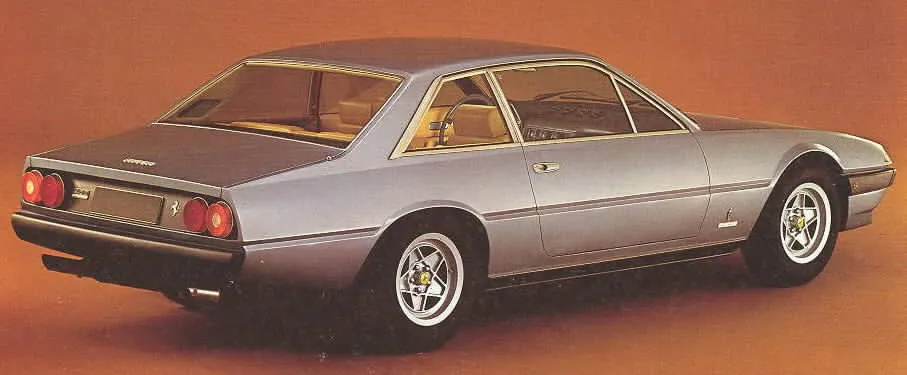
Ferrari 400 (1976 - 1979)

Ferrari · 2 trims

Ferrari 400

The Ferrari 400 (1976 - 1979) is available in 2 trims producing 340 to 340 hp. The fastest trim reaches 245 km/h. The lowest stated fuel consumption is 19.1 l/100 km.

Power
340 hp
0–100
5.9 s
Fuel economy
19.1 l/100 km
Cargo
487 l

400 Trims

Compare →
Trims and engine versions — Ferrari 400
Trim Fuel Power Torque 0–100 Top speed Fuel economy CO2 Select
4.8L V12 3AT RWD (340 HP) Petrol 340 hp 471 Nm 6.6 s 240 km/h 19.1 l/100 km
4.8L V12 5MT RWD (340 HP) Petrol 340 hp 471 Nm 5.9 s 245 km/h 20.5 l/100 km

Fuel economy and CO2 follow the stated test cycle. Manufacturer figures; deviations per market and option pack are possible.

Is Ferrari 400 a good choice against other models?

Average across every Ferrari 400 trim, compared with 457 trims of other cars from the 1973–1979 period.

Is Ferrari 400 a good choice against other models?
Measure This model Average Position
Power 340 hp 130 hp
better than 99%
Torque 471 Nm 196 Nm
better than 100%
Top speed 243 km/h 180 km/h
better than 93%
Acceleration 0–100 km/h 6.3 s 12.4 s
better than 95%
Combined consumption 19.8 l/100 km 10.6 l/100 km
better than 2%
Cargo volume 487 l 415 l
better than 78%
Unladen weight 1,880 kg 1,293 kg
better than 7%

Percentages show the share of trims from the same period this model beats on that measure. Manufacturer figures.

Not stated by the manufacturer: co2 emissions. Those measures are left out of the comparison.

Comparable models from other brands

Toyota Holden Cupra Bristol Mazda

About Ferrari 400

An updated version of the 365 GT4 2+2 came by 1976 by the name of the Ferrari 400. As with the model it replaces, the name refers to the swept volume of a single cylinder.

To visually differentiate the 400 from the 365 GT4, the first comes with a body-colored chin spoiler, five-bolt fixed rims, paired circular stoplights and the deletion of the emblem from the radiator grille. The interior got more sumptuous, with better seat upholstery, different stitching, patterns and slightly changed switchgear. Leather trim and power seats were also available.

The underpinnings of the 400 are almost identical to the 365 GT4 2+2. The car was available in two forms: the 400 Automatic, which was also the first Ferrari with an automatic transmission (Borg-Warner 3-speed automatic), and the 400 GT, coming with a 5-speed manual box. 70% of the customers preferred the automatic gearbox.

The Tipo engine was upgraded to a bigger one and got an extra 20 bhp, the 4.8-liter V12 powerplant producing 340 bhp.

The Ferrari 400 had a top speed of 149 mph and reached 60 mph in around 8 seconds. A total of 502 units were built - 355 automatics and 147 manuals. No US versions were made.

In 1979 the 400 was updated and got a fuel injection system, the model being named Ferrari 400i.

How much power does the Ferrari 400 have?

The most powerful Ferrari 400 trim is the 4.8L V12 3AT RWD (340 HP) with 340 hp. The model has 2 trims, starting at 340 hp.

What is the fuel consumption of the Ferrari 400?

The most economical Ferrari 400 trim is the 4.8L V12 3AT RWD (340 HP), with a stated combined consumption of 19.1 l/100 km and — g CO2 per km.

How quickly does the Ferrari 400 accelerate from 0 to 100 km/h?

The quickest trim is the 4.8L V12 5MT RWD (340 HP): 0-100 km/h in 5.9 seconds, with a top speed of 245 km/h.

How large is the cargo volume of the Ferrari 400?

The largest stated cargo volume for the Ferrari 400 is 487 litres.

Other Ferrari models

Ferrari 400i

1979 - 1985 · 4 trims

Power
315 hp
0–100
6.8 s
Fuel economy
19.9

Petrol

Ferrari Mondial 8

1980 - present · 2 trims

Power
214 hp
0–100
9.4 s
Fuel economy
16.7

Petrol