Skip to content
AD

Ferrari F50 (1995 - 1997)

Ferrari · 1 trim

Ferrari F50

The Ferrari F50 (1995 - 1997) is available in 1 trims producing 520 to 520 hp. The fastest trim reaches 325 km/h. The lowest stated fuel consumption is 26.1 l/100 km.

Power
520 hp
0–100
3.9 s
Fuel economy
26.1 l/100 km
Cargo
40 l

F50 Trims

Compare →
Trims and engine versions — Ferrari F50
Trim Fuel Power Torque 0–100 Top speed Fuel economy CO2 Select
4.7L V12 6MT (520 HP) Petrol 520 hp 470 Nm 3.9 s 325 km/h 26.1 l/100 km

Fuel economy and CO2 follow the stated test cycle. Manufacturer figures; deviations per market and option pack are possible.

Is Ferrari F50 a good choice against other models?

Average across every Ferrari F50 trim, compared with 3,130 trims of other cars from the 1992–1998 period.

Is Ferrari F50 a good choice against other models?
Measure This model Average Position
Power 520 hp 144 hp
better than 100%
Torque 470 Nm 219 Nm
better than 97%
Top speed 325 km/h 196 km/h
better than 100%
Acceleration 0–100 km/h 3.9 s 11.3 s
better than 100%
Combined consumption 26.1 l/100 km 8.7 l/100 km
better than 0%
Cargo volume 40 l 450 l
better than 0%
Unladen weight 1,230 kg 1,323 kg
better than 59%

Percentages show the share of trims from the same period this model beats on that measure. Manufacturer figures.

Not stated by the manufacturer: co2 emissions. Those measures are left out of the comparison.

Comparable models from other brands

Volvo Polestar Aston Martin Mercedes-AMG Porsche Mercedes-Benz

About Ferrari F50

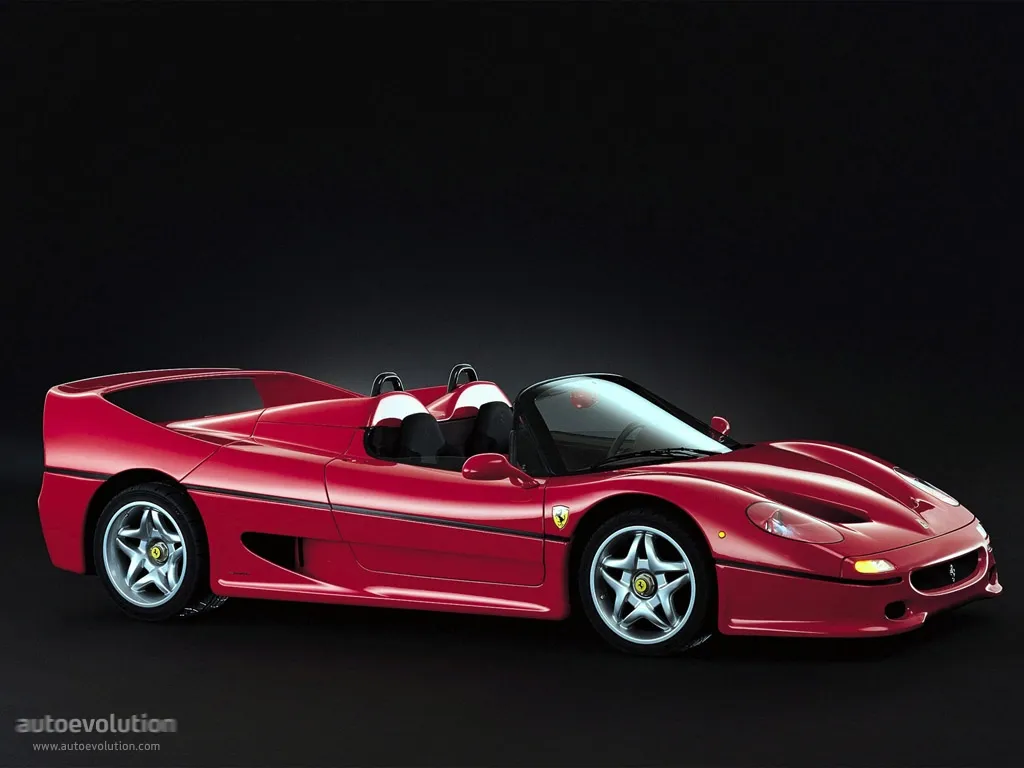
The F50 was one of the most outrageous Ferrari ever made. It carried-over Formula 1 technologies and installed them on a street vehicle.

Ferrari built 349 units, but it sold only 348 of them. The carmaker reserved the last one for its museum. The engineers took the engine from a Formula 1 car and adapted it for road use, increasing its displacement from 3.5-liter to 4.7-liter. The rear suspension was attached to the engine, which was an incredible idea to make the car lighter.

The car's styling was unique on the market due to its massive wing in the back. Pininfarina designed the vehicle with a pair of extracting vents on the front compartment's lid. The aerodynamic package was intense, and it produced a negative lift for the car, which was the main reason why the car couldn't do more than 202 mph (325 kph).

Inside, the carmaker dropped the ideas from the F40 and added some comfort features, such as door-handles and door-pockets. The windows were still cranked, with no power options for them. The bucket-seats were race-inspired with high bolstering and Alcantara wrapped. Since it was a supercar, Ferrari didn't consider covering the carbon-fiber elements with leather or other exclusive materials.

Under the hood, which was in the rear, Ferrari installed a naturally aspirated V12 engine paired to a six-speed manual gearbox. It produced an impressive 110 hp/liter, which was a record for those times. That record was broken a few years later by the Honda S2000 with 120 hp/liter.

How much power does the Ferrari F50 have?

The most powerful Ferrari F50 trim is the 4.7L V12 6MT (520 HP) with 520 hp. The model has 1 trims, starting at 520 hp.

What is the fuel consumption of the Ferrari F50?

The most economical Ferrari F50 trim is the 4.7L V12 6MT (520 HP), with a stated combined consumption of 26.1 l/100 km and — g CO2 per km.

How quickly does the Ferrari F50 accelerate from 0 to 100 km/h?

The quickest trim is the 4.7L V12 6MT (520 HP): 0-100 km/h in 3.9 seconds, with a top speed of 325 km/h.

How large is the cargo volume of the Ferrari F50?

The largest stated cargo volume for the Ferrari F50 is 40 litres.

Other Ferrari models

Ferrari 512 M

1994 - 1996 · 1 trim

Power
440 hp
0–100
4.7 s
Fuel economy
15.7

Petrol

Ferrari 512 TR

1992 - 1994 · 1 trim

Power
428 hp
0–100
4.8 s
Fuel economy
10.0

Petrol

Ferrari 456 GT

1992 - 1997 · 2 trims

Power
442 hp
0–100
5.2 s
Fuel economy
18.0

Petrol

Ferrari 456 M GT

1998 - 2003 · 1 trim

Power
442 hp
0–100
5.2 s
Fuel economy
18.5

Petrol