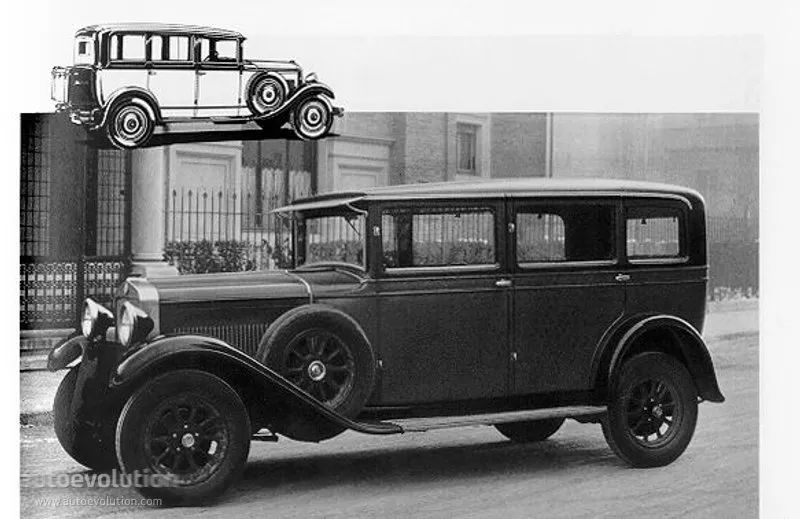
About Fiat 521
Fiat introduced the 521 in 1928 as a replacement for the 520 model, even though the Italian carmaker kept its predecessor into production until 1929.
It was an era of expansion, and Fiat understood that it needs to perform better and produce closer to its customers. That's why it made the 521 outside Italy, at the Fiat-NSU plant in Heilbronn. The vehicle followed the same ideas that made its predecessor a sales hit but with a larger engine and a longer chassis for the regular versions. Fiat also built a shorter version, named 521 C (corrto – short), as a sportier version.
The 521 was a large sedan with a closed cabin built on top of a ladder-chassis. By 1928, the Italian carmaker started to understand the importance of a well-built bodywork and tried to offer less bare-chassis than complete vehicles. Its front fenders were slim and featured special mounting points for the spare wheels. Its rear doors were suicidal type (rear-hinged) to offer a better ingress and egress from the car.
Inside, depending on the customer's wallet, the carmaker offered the car with leather seats and wood-trims from Tasmanian oaks. The driving post was still on the right side, so the driver could step right on the curbside.
From the technological point of view, Fiat made an important step forward, offering the inline-six 2.5-liter engine that was known for its smoothness. It was paired to a four-speed manual transmission and sent the power to the rear wheels via a driveshaft.