About Ford Pinto
While the Pinto was meant to be a money maker for Ford, it ended up being the car that almost ruined the company due to its flawed design.
In the early ‘70s, Ford needed a car to fight against imports, such as the Corolla, the Civic, or the Beetle. Lee Iacocca led the automaker in those times, and he wanted a car to weigh less than 2,000 lbs. (907 kg) and be affordable. In 1970, the average salary in the U.S. was $9,870, and by 1971, when the car came out, that had increased to $10,290, and the Pinto had to be priced below $2,000. The vehicle was developed in 25 months, which was the fastest to date for the American automaker. But all that rush led to a huge problem: the fuel tank was right behind the rear bumper, and it could set the car on fire in the event of a rear-ended accident. Ford was aware of that problem but still produced the car, claiming that the safety regulations allowed them to do that. The problem affected the sedan and the hatchback, but not the station wagon version of the car since that version had a longer rear overhang, and the fuel tank was better protected.
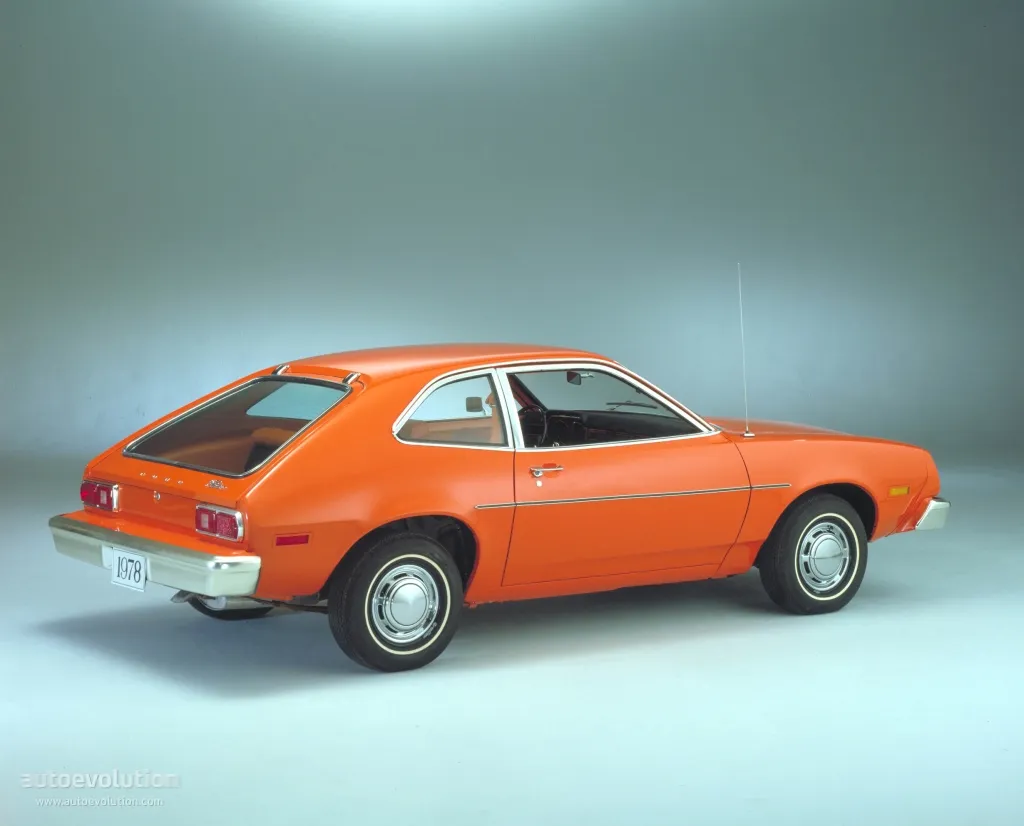
The car’s look was very clean and composed, with a front fascia that sported the mandatory round headlights. Between them, incorporated into the grille, Ford placed the turn signals just above the chromed bumper. The almost flat hood sported a crease in the middle that ran from the front to the windshield’s base.
Ford made the Pinto with two doors, regardless of the body version. The car’s raked windshield and the medium-sized greenhouse offered a generous window area. Its short roof was sloped down towards the back of the vehicle. In the hatchback version, the trunk opened together with the rear window, while the sedan had a smaller lid. Ford placed a metallic rear bumper with additional vertical bars for protection. Still, those were not enough to protect the gas tank against a crash.
Inside, the Pinto offered two bucket seats at the front and a bench fit mostly for two in the back. The transmission tunnel crossed the cabin from front to back, creating a big hump in the floor, limiting legroom for a third, middle-seated rear passenger. In front of the driver, Ford installed a simple, binocular-style instrument cluster with the speedometer on the right, while the left binnacle sported the fuel level gauge and several warning lights for coolant temperature, charging, and brakes. Depending on the model year, Ford made some changes to the dashboard. In addition, the center stack housed the controls for the ventilation system and a stereo.
Under the hood, Ford installed a choice of three engines ranging between 1.6 and 2.3 liters. Depending on the emission standards, the power of these tiny inline-four powerplants varied. The automaker offered the car with either a four-speed manual or a three-speed automatic.