Skip to content
AD

Ford Anglia 100E (1953 - 1959)

Ford · 1 trim

Ford Anglia 100E

The Ford Anglia 100E (1953 - 1959) is available in 1 trims producing 36 to 36 hp. The fastest trim reaches 114 km/h. The lowest stated fuel consumption is 6.7 l/100 km.

Power
36 hp
0–100
31.0 s
Fuel economy
6.7 l/100 km
Cargo
300 l

Anglia 100E Trims

Compare →
Trims and engine versions — Ford Anglia 100E
Trim Fuel Power Torque 0–100 Top speed Fuel economy CO2 Select
1.2L 3MT (36 HP) Petrol 36 hp 72 Nm 31.0 s 114 km/h 6.7 l/100 km

Fuel economy and CO2 follow the stated test cycle. Manufacturer figures; deviations per market and option pack are possible.

Is Ford Anglia 100E a good choice against other models?

Average across every Ford Anglia 100E trim, compared with 110 trims of other cars from the 1950–1956 period.

Is Ford Anglia 100E a good choice against other models?
Measure This model Average Position
Power 36 hp 115 hp
better than 5%
Torque 72 Nm 191 Nm
better than 6%
Top speed 114 km/h 163 km/h
better than 11%
Acceleration 0–100 km/h 31.0 s 17.0 s
better than 8%
Combined consumption 6.7 l/100 km 12.2 l/100 km
better than 98%
Unladen weight 737 kg 1,280 kg
better than 96%

Percentages show the share of trims from the same period this model beats on that measure. Manufacturer figures.

Not stated by the manufacturer: co2 emissions. Those measures are left out of the comparison.

Comparable models from other brands

Fiat Lancia Daewoo Mercedes-Benz Tata Motors

About Ford Anglia 100E

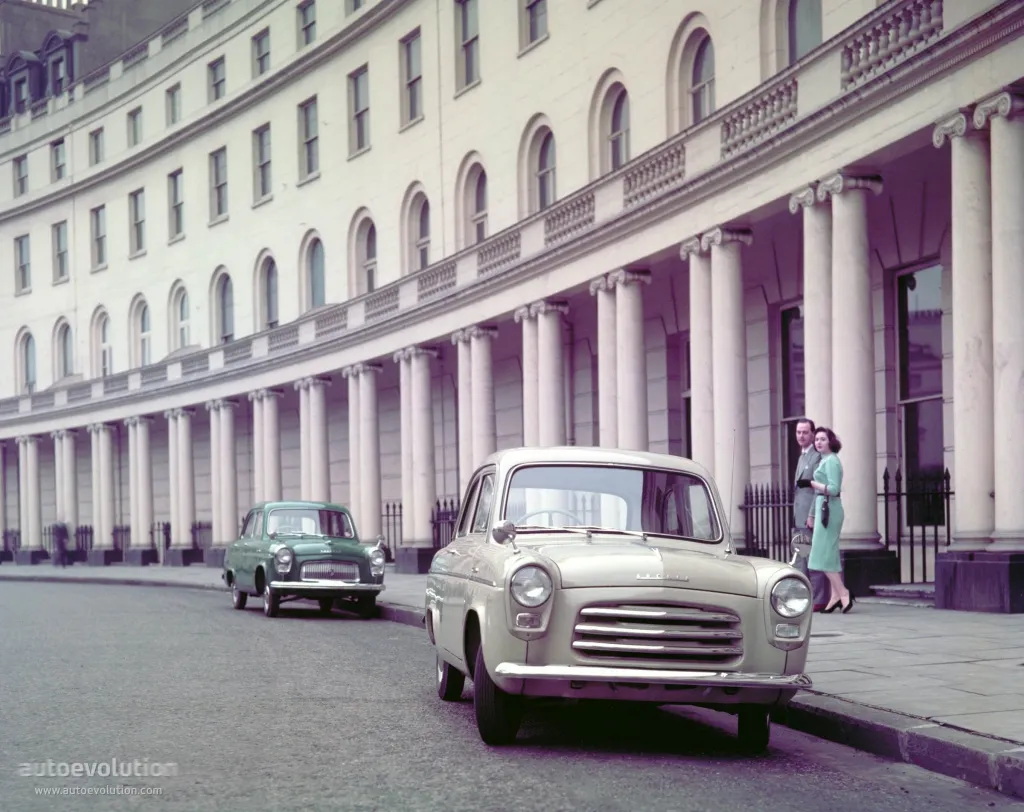
The 1953 Anglia was a two-door sedan built by Ford in the U.K. and it featured a modern outside design and a comfortable interior even if the access was more difficult.

The Ford Dagenham factory was built on an island. It produced its own steel from raw materials with electricity and gas which Ford produced. It was the most complex car-factory in Europe. There, the American car-giant built the Anglia 100E. A car that looked into the future with a “heart” built in the past.

The Anglia 100E was a small, three-box, a sedan with rounded edges. It was the first model that featured a flush, straight bodywork. Gone was the era of flared, exposed, fenders with a tall and narrow engine compartment. The three horizontal chromed bars on the radiator's grille were considered a fashion item.

Inside, the PVC-covered seats were reliable and dirt proof. For the driver's comfort, it featured a hydraulically clutch system. Thus, the car was easier to drive by women. A wide and deep parcel was installed in front of the front passenger. The access to the rear seats was by tilting the front seats. It offered enough room for three adult occupants.

Due to the front independent suspension, the Ford Anglia 100E was more comfortable than its predecessors or other cars on the market. The engine was fitted with side-valves, which made it somehow obsolete even for those times. It offered 36 hp, which was enough to move the 737 kg (1624 lbs) vehicle. The standard transmission was a 3-speed manual. There was an option for a semi-automatic gearbox, named Manumatic.

How much power does the Ford Anglia 100E have?

The most powerful Ford Anglia 100E trim is the 1.2L 3MT (36 HP) with 36 hp. The model has 1 trims, starting at 36 hp.

What is the fuel consumption of the Ford Anglia 100E?

The most economical Ford Anglia 100E trim is the 1.2L 3MT (36 HP), with a stated combined consumption of 6.7 l/100 km and — g CO2 per km.

How quickly does the Ford Anglia 100E accelerate from 0 to 100 km/h?

The quickest trim is the 1.2L 3MT (36 HP): 0-100 km/h in 31.0 seconds, with a top speed of 114 km/h.

How large is the cargo volume of the Ford Anglia 100E?

The largest stated cargo volume for the Ford Anglia 100E is 300 litres.

Other Ford models

Ford Consul

1950 - 1956 · 1 trim

Power
60 hp
0–100
Fuel economy

Petrol

Ford Crestliner

1949 - 1951 · 2 trims

Power
0–100
Fuel economy

Petrol

Ford Anglia 105E

1959 - 1967 · 1 trim

Power
39 hp
0–100
26.5 s
Fuel economy
8.0

Petrol

Ford Pinto

1971 - present · 3 trims

Power
97 hp
0–100
Fuel economy

Petrol