Skip to content
AD

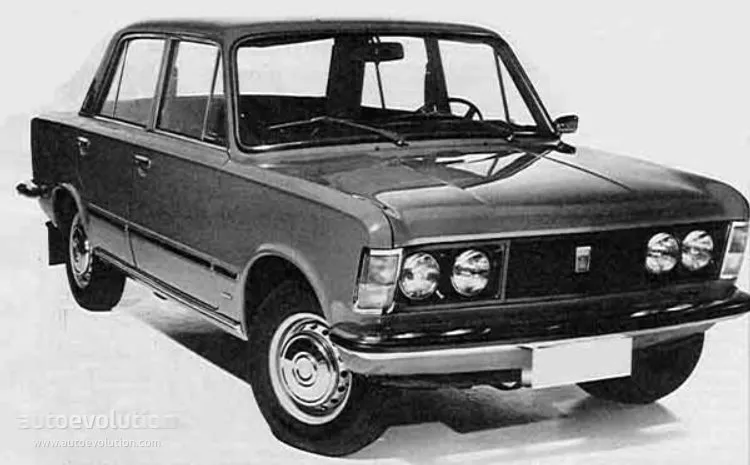
FSO 125 (1968 - 1978)

FSO · 2 trims

FSO 125

The FSO 125 (1968 - 1978) is available in 2 trims producing 71 to 81 hp. The fastest trim reaches 150 km/h. The lowest stated fuel consumption is 8.2 l/100 km.

Power
81 hp
0–100
16.5 s
Fuel economy
8.2 l/100 km
Cargo

125 Trims

Compare →
Trims and engine versions — FSO 125
Trim Fuel Power Torque 0–100 Top speed Fuel economy CO2 Select
1.3L 4MT (71 HP) Petrol 71 hp 104 Nm 20.7 s 140 km/h 8.2 l/100 km 195 g/km
1.5L 4MT (81 HP) Petrol 81 hp 121 Nm 16.5 s 150 km/h 8.2 l/100 km 195 g/km

Fuel economy and CO2 follow the stated test cycle. Manufacturer figures; deviations per market and option pack are possible.

Is FSO 125 a good choice against other models?

Average across every FSO 125 trim, compared with 413 trims of other cars from the 1965–1971 period.

Is FSO 125 a good choice against other models?
Measure This model Average Position
Power 76 hp 179 hp
better than 13%
Torque 113 Nm 287 Nm
better than 14%
Top speed 145 km/h 181 km/h
better than 13%
Acceleration 0–100 km/h 18.6 s 12.0 s
better than 8%
Combined consumption 8.2 l/100 km 13.8 l/100 km
better than 92%
Unladen weight 971 kg 1,344 kg
better than 82%

Percentages show the share of trims from the same period this model beats on that measure. Manufacturer figures.

Not stated by the manufacturer: cargo volume. Those measures are left out of the comparison.

Comparable models from other brands

Bugatti Fiat BMW Bristol Caterham Volkswagen

About FSO 125

Even under the communist era, countries and peoples need to have cars. Poland decided to cut a deal with Fiat and produced their version of Fiat 125.

The need for transportation but lack of experience in the car industry made the Polish look on the market for building a car. The communist regime was not eager to buy foreign cars, especially not those produced in western countries. The East Germans had the Trabant and Wartburg. The Yugoslavians bought the license for Fiat 126 (same as the Polish) and the Romanians already started the production of the Renault 8 in 1968. The only two communist countries without car factories were Hungary and Bulgaria. Czechoslovakia had its brand, Skoda.

The FSO 125 was based on the Fiat 125 with small exterior differences on the headlights and grille. It featured round twin headlamps while the Italian brother had them square. Unlike the Italian 125, the FSO featured flat panels for the bodywork, which were cheaper to produce. The design was not a big concern.

Inside, the car featured elements from the former Fiat 1300/1500 model instead of the new Fiat 125. The Polish government didn't want to spend too much on newer designs so they bought the older one for less. Needless to say, but the car featured an old type of dashboard design.

For economic reasons, the chassis was a carryover from the Fiat 1300/1500 model and so were the engines with 1.3-liter and 1.5-liter that offered 60 hp and 75 hp, respectively. Despite being an old car, the vehicle was well built. It lasted on the market until 1991, to deliver all the cars that were already paid by the customers. Usually, a private customer could have wait for years to get one.

How much power does the FSO 125 have?

The most powerful FSO 125 trim is the 1.5L 4MT (81 HP) with 81 hp. The model has 2 trims, starting at 71 hp.

What is the fuel consumption of the FSO 125?

The most economical FSO 125 trim is the 1.3L 4MT (71 HP), with a stated combined consumption of 8.2 l/100 km and 195 g CO2 per km.

How quickly does the FSO 125 accelerate from 0 to 100 km/h?

The quickest trim is the 1.5L 4MT (81 HP): 0-100 km/h in 16.5 seconds, with a top speed of 150 km/h.

Other FSO models

FSO Prima

1988 - 1996 · 4 trims

Power
103 hp
0–100
9.8 s
Fuel economy
5.8

Petrol Diesel