Skip to content
AD

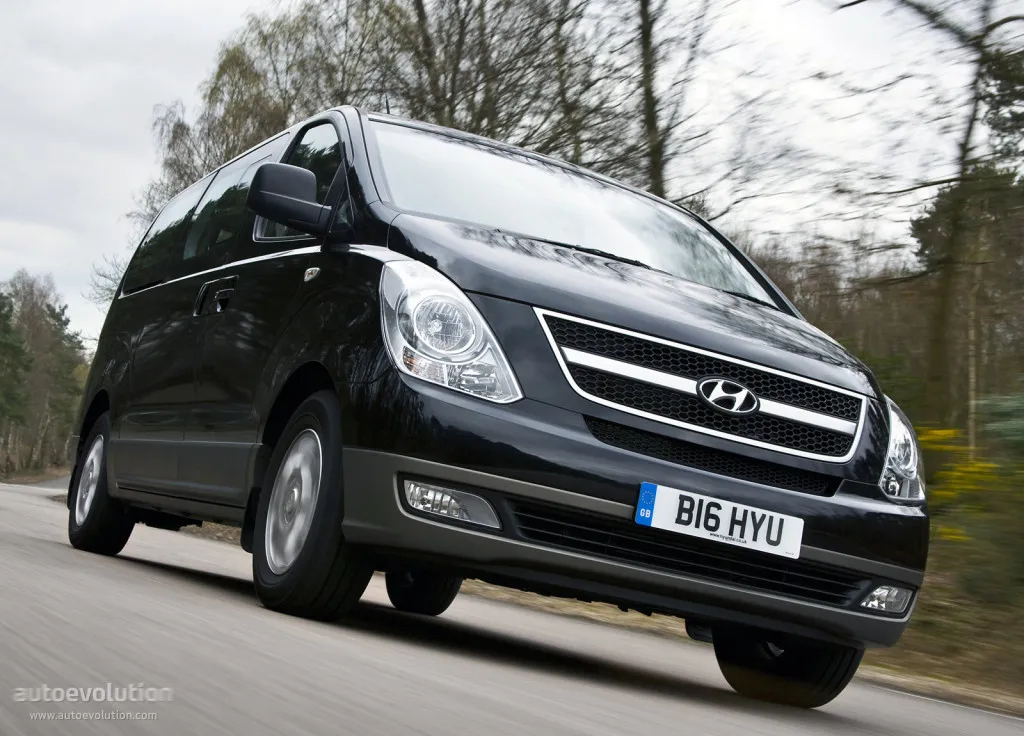
Hyundai i800 / H-1 (2008 - 2018)

Hyundai · 3 trims

Hyundai i800 / H-1

The Hyundai i800 / H-1 (2008 - 2018) is available in 3 trims producing 116 to 170 hp. The fastest trim reaches 180 km/h. The lowest stated fuel consumption is 7.1 l/100 km.

Power
170 hp
0–100
14.5 s
Fuel economy
7.1 l/100 km
Cargo
850 l

i800 / H-1 Trims

Compare →
Trims and engine versions — Hyundai i800 / H-1
Trim Fuel Power Torque 0–100 Top speed Fuel economy CO2 Select
2.5L CRDI 6MT RWD (116 HP) Diesel 116 hp 343 Nm 154 km/h 7.5 l/100 km 197 g/km
2.5L CRDI 6MT RWD (136 HP) Diesel 136 hp 343 Nm 167 km/h 7.5 l/100 km 197 g/km
2.5L CRDi 5AT RWD (170 HP) Diesel 170 hp 392 Nm 14.5 s 180 km/h 7.1 l/100 km 225 g/km

Fuel economy and CO2 follow the stated test cycle. Manufacturer figures; deviations per market and option pack are possible.

Is Hyundai i800 / H-1 a good choice against other models?

Average across every Hyundai i800 / H-1 trim, compared with 7,587 trims of other cars from the 2005–2011 period.

Is Hyundai i800 / H-1 a good choice against other models?
Measure This model Average Position
Power 141 hp 191 hp
better than 38%
Torque 359 Nm 305 Nm
better than 73%
Top speed 167 km/h 209 km/h
better than 7%
Acceleration 0–100 km/h 14.5 s 9.6 s
better than 4%
Combined consumption 7.4 l/100 km 7.8 l/100 km
better than 44%
CO2 emissions 206 g/km 179 g/km
better than 23%
Cargo volume 850 l 470 l
better than 94%
Unladen weight 2,238 kg 1,520 kg
better than 4%

Percentages show the share of trims from the same period this model beats on that measure. Manufacturer figures.

Comparable models from other brands

Ferrari Ford Fiat Peugeot

About Hyundai i800 / H-1

The H1 was a great value vehicle, useful for shuttle companies and big families alike. It offered plenty of room for eight and their luggage.

In some parts of the world, it was known as H1 or i800, while Hyundai offered it with the Starex name in other countries. Regardless of its name, it was a basic, good MPV based on an LCV. It was built as a utility van, and then it was transformed into a passenger vehicle. Depending on countries' regulations, the H1 could have been fitted with up to 11 seats, but usually, it featured only eight.

Hyundai didn't want to build a minibus and have a minibus look. It tried to design the front end with bigger headlights and a racked radiator grille with two horizontal slats. The H1 featured two doors at the front and one sliding door on the curbside, plus a huge tailgate in the back to access the trunk. The second sliding door was on the options list.

The interior was offered in a few trim levels, starting with a basic model that offered cloth seats, a climate control unit for the front passengers and a few vents for the third row, and a stereo. On the upper trim levels, the H1 was fitted with a stationary heating unit, an upgraded air-conditioning unit, and a sound system with more speakers than wheels. The tilting and reclining middle row, the leather upholstery, and the power sliding doors could have been ordered on the top-spec version.

Regardless of the car's name or trim level, the H1 featured only one 2.5-liter turbodiesel engine with three power outputs options. Only the top version was available with an automatic transmission. Unlike its predecessor, it wasn't available with a 4WD system.

How much power does the Hyundai i800 / H-1 have?

The most powerful Hyundai i800 / H-1 trim is the 2.5L CRDi 5AT RWD (170 HP) with 170 hp. The model has 3 trims, starting at 116 hp.

What is the fuel consumption of the Hyundai i800 / H-1?

The most economical Hyundai i800 / H-1 trim is the 2.5L CRDi 5AT RWD (170 HP), with a stated combined consumption of 7.1 l/100 km and 225 g CO2 per km.

How quickly does the Hyundai i800 / H-1 accelerate from 0 to 100 km/h?

The quickest trim is the 2.5L CRDi 5AT RWD (170 HP): 0-100 km/h in 14.5 seconds, with a top speed of 180 km/h.

How large is the cargo volume of the Hyundai i800 / H-1?

The largest stated cargo volume for the Hyundai i800 / H-1 is 850 litres.

Other Hyundai models

Hyundai Grandeur

2005 - 2011 · 3 trims

Power
235 hp
0–100
7.8 s
Fuel economy
7.9

Petrol Diesel

Hyundai Grand i10

2013 - present · 2 trims

Power
83 hp
0–100
Fuel economy

Petrol Diesel

Hyundai Mistra

2014 - present · 2 trims

Power
155 hp
0–100
Fuel economy

Petrol

Hyundai Matrix

2001 - 2010 · 6 trims

Power
122 hp
0–100
11.3 s
Fuel economy
6.0

Petrol Diesel