About Lancia Artena
Lancia withdrew the Lambda lineup in 1931 and replaced it with not one but two new vehicles: the Artena and the Astura, where the former was fitted with smaller engines while the latter had bigger ones.
It was challenging for the Italian automaker to retire the Lambda and Dilambda models from the market since those were very successful. However, since those were unibody constructions, it was almost impossible for independent coachbuilders to create unique bodywork for their customers. As a result, Lancia introduced the body-on-frame type vehicles, the Artena and the Astura. Unfortunately, those were the years of the Great Depression that started in 1929 in the U.S. and spread like wildfire worldwide. Automobile sales dropped significantly, but Lancia saw an opportunity. By using the same chassis for two vehicles, it could cut its production costs. In addition, the lower-powered Artena could be equipped with luxurious bodywork. It looked like an expensive vehicle, even though, thanks to the low-powered, more affordable engine, it wasn’t. The car was launched in 1930 and was produced in four series until 1942, with a production gap between 1936 and 1940.
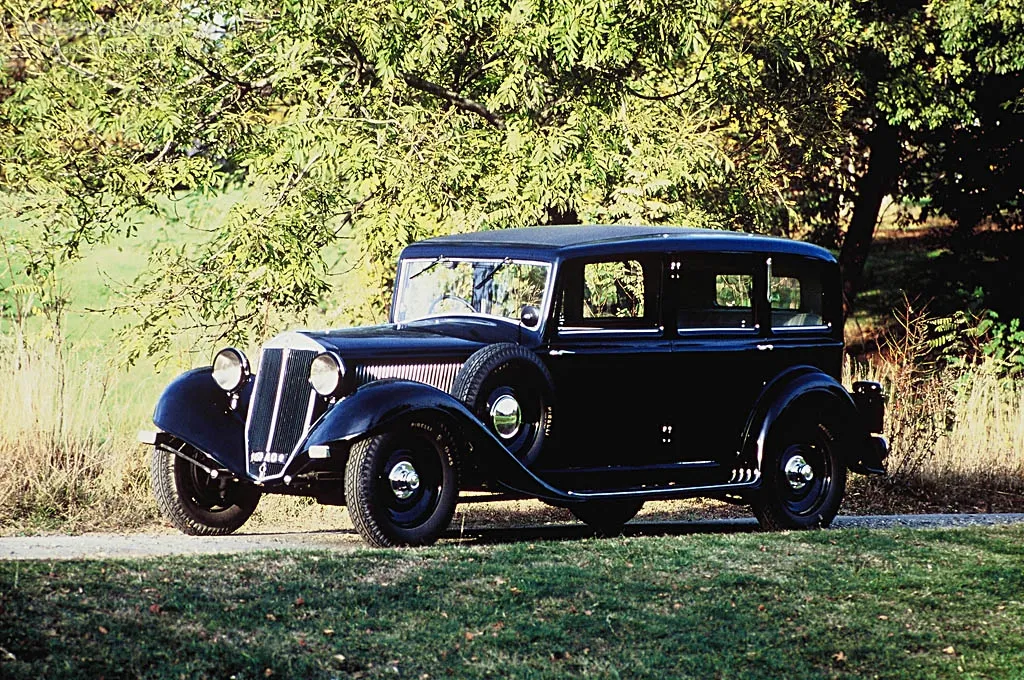
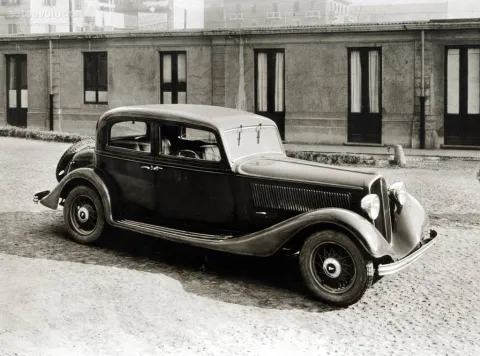
For the first series, Lancia adopted a simple and elegant design for the car’s front fascia. It featured a straight-up radiator shaped like a Greek temple, with a wide V-shaped upper section, like most of the cars from that era, but taller. It was flanked by round electric headlights supported on short stacks by the front valanced fenders. In front of it, mounted on Y-shaped metallic mounts directly onto the chassis’ ends, was a slim bumper, which also protected the wheels in case of a frontal impact. After the second series, the car received a newly shaped radiator, slightly tilted rearward, which sported a vertical chromed slat in the middle.
The Lancia Artena was delivered either as a complete vehicle or as a bare chassis to be bodied by independent coachbuilders. It was available with different wheelbases so customers could create their own vehicles according to their tastes. From the factory, the car left the assembly lines with two or four-door bodies and up to four seats. For the fourth series (1940 – 1942), the long-wheelbase version was available with up to six seats and was made for the Royal Italian Army and high-ranking officers. Independent coachbuilders, such as Cesare Sala of Milan or Carozzeria Farina, made the vehicle in a Coupe de Ville shape, meaning that the driver was completely separated from the rear passengers, who were seated in a closed cabin, while the front seats were protected by removable panels for the windows and roof. On the same chassis, the automaker produced utility vehicles and ambulances.
As expected, the interior of the Artena differed significantly, depending on customers. While some were luxurious, others were just basic. However, they sported similar dashboards since the vehicles were delivered as rolling chassis. In those times, in Italy, cars had the driving post on the right. Lancia installed a minimalistic instrument panel featuring a speedometer, an analog clock, the fuel level, and the oil pressure gauge in the middle of the flat, vertical wooden dashboard. Seating was ensured by comfortable bench seats or individual ones, depending on the customers’ requests.
The Lancia Artena was powered by a narrow-V four-cylinder engine featuring a single-overhead camshaft (SOHC) that developed around 50 PS (48 hp). It was paired with a four-speed manual gearbox that sent the power to the rear wheels. Despite its low power, the car could obtain speeds north of 100 kph (62 mph) thanks to its low weight. Brakes were unassisted and featured drums in all corners.