Skip to content
AD

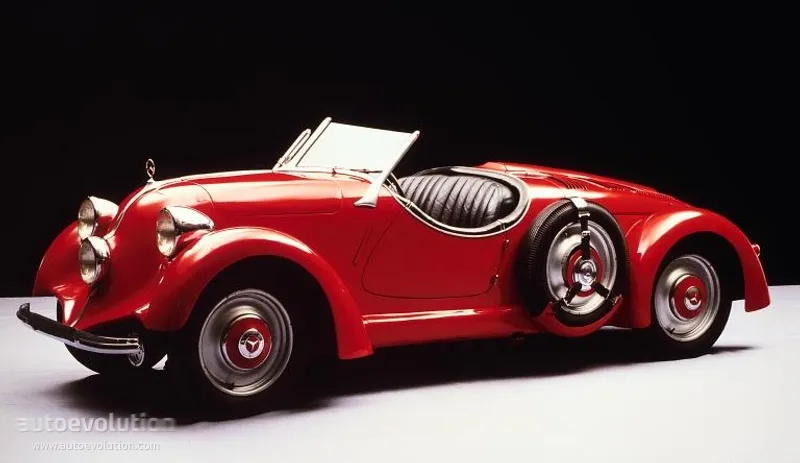
Mercedes-Benz Typ 150 Sport Roadster (W30) (1934 - 1936)

Mercedes-Benz · 1 trim

Mercedes-Benz Typ 150 Sport Roadster (W30)

The Mercedes-Benz Typ 150 Sport Roadster (W30) (1934 - 1936) is available in 1 trims producing 55 to 55 hp. The fastest trim reaches 126 km/h. The lowest stated fuel consumption is 15.0 l/100 km.

Power
55 hp
0–100
Fuel economy
15.0 l/100 km
Cargo

Typ 150 Sport Roadster (W30) Trims

Compare →
Trims and engine versions — Mercedes-Benz Typ 150 Sport Roadster (W30)
Trim Fuel Power Torque 0–100 Top speed Fuel economy CO2 Select
150 Petrol 55 hp 126 km/h 15.0 l/100 km 356 g/km

Fuel economy and CO2 follow the stated test cycle. Manufacturer figures; deviations per market and option pack are possible.

Is Mercedes-Benz Typ 150 Sport Roadster (W30) a good choice against other models?

Average across every Mercedes-Benz Typ 150 Sport Roadster (W30) trim, compared with 123 trims of other cars from the 1931–1937 period.

Is Mercedes-Benz Typ 150 Sport Roadster (W30) a good choice against other models?
Measure This model Average Position
Power 55 hp 101 hp
better than 27%
Top speed 126 km/h 128 km/h
better than 45%
Combined consumption 15.0 l/100 km 19.6 l/100 km
better than 72%
CO2 emissions 356 g/km 488 g/km
better than 81%
Unladen weight 980 kg 1,598 kg
better than 84%

Percentages show the share of trims from the same period this model beats on that measure. Manufacturer figures.

Not stated by the manufacturer: torque, acceleration 0–100 km/h and cargo volume. Those measures are left out of the comparison.

Comparable models from other brands

Fiat Honda ARO Lancia Volvo

About Mercedes-Benz Typ 150 Sport Roadster (W30)

In the late '20s, new ideas emerged for automotive design. Three of them were more important than the others: independent rear suspension, mid-engine cars, and streamlined bodies.

The 150 (W30) was developed as a sport-coupe for racing. But the standard names for that era was "sports saloon". Its closed body was somehow weird looking for the era, with two headlights and one, middle, projector. The sloped rear end had a special purpose: it hosted the engine. Unlike other cars from its era, the 150 used a mid-engine concept, with the engine and transmission fore and aft of the rear axle, respectively.

The engine was based on a 1.3-liter air-cooled unit, but with an increased displacement up to 1.5-liter. It delivered 55 hp, which was a lot for that era. To gain that output, a double-barrel carburetor was installed and it had overhead camshafts. All of these technological updates paid-off when the 150 sports saloon won four gold medals at the 2000-kilometer (1200 miles) endurance race across Germany in July 1934. The greatest sports saloon's triumph was achieved at the end of 1934 when it led the race between Rome and Pisa on the famous Liege-Rome-Liege Rally.

At the end of 1934, the competition vehicle served as the basis for developing the 150 sports roadster (W 130), but the atypical styling for a Mercedes-Benz vehicle did not make it into production.

How much power does the Mercedes-Benz Typ 150 Sport Roadster (W30) have?

The most powerful Mercedes-Benz Typ 150 Sport Roadster (W30) trim is the 150 with 55 hp. The model has 1 trims, starting at 55 hp.

What is the fuel consumption of the Mercedes-Benz Typ 150 Sport Roadster (W30)?

The most economical Mercedes-Benz Typ 150 Sport Roadster (W30) trim is the 150, with a stated combined consumption of 15.0 l/100 km and 356 g CO2 per km.

Other Mercedes-Benz models