
Skip to content
AD

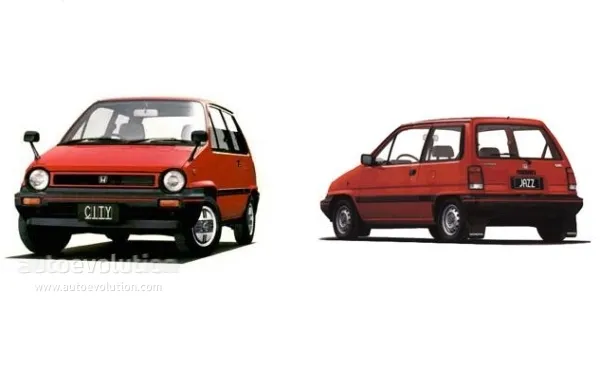
Honda Jazz/City (1983 - 1986)

Honda · 2 trims

Honda Jazz/City

The Honda Jazz/City (1983 - 1986) is available in 2 trims producing 45 to 56 hp. The fastest trim reaches 145 km/h. The lowest stated fuel consumption is 6.0 l/100 km.

Power
56 hp
0–100
13.0 s
Fuel economy
6.0 l/100 km
Cargo

Jazz/City Trims

Compare →
Trims and engine versions — Honda Jazz/City
Trim Fuel Power Torque 0–100 Top speed Fuel economy CO2 Select
1.2L 4MT FWD (45 HP) Petrol 45 hp 82 Nm 16.5 s 135 km/h 6.4 l/100 km
1.2L 5MT FWD (56 HP) Petrol 56 hp 93 Nm 13.0 s 145 km/h 6.0 l/100 km

Fuel economy and CO2 follow the stated test cycle. Manufacturer figures; deviations per market and option pack are possible.

Is Honda Jazz/City a good choice against other models?

Average across every Honda Jazz/City trim, compared with 984 trims of other cars from the 1980–1986 period.

Is Honda Jazz/City a good choice against other models?
Measure This model Average Position
Power 51 hp 119 hp
better than 4%
Torque 88 Nm 180 Nm
better than 6%
Top speed 140 km/h 182 km/h
better than 3%
Acceleration 0–100 km/h 14.8 s 12.5 s
better than 25%
Combined consumption 6.2 l/100 km 8.8 l/100 km
better than 91%
Unladen weight 688 kg 1,148 kg
better than 99%

Percentages show the share of trims from the same period this model beats on that measure. Manufacturer figures.

Not stated by the manufacturer: co2 emissions and cargo volume. Those measures are left out of the comparison.

Comparable models from other brands

ARO Volvo Mercedes-Benz Daihatsu Lancia Fiat

About Honda Jazz/City

In 1981, Honda introduced the City on its home market. Two years later, it sent the car to Europe, where it received the Jazz name.

With its unusual look, the Jazz proved to be a great solution in beating the traffic. Unfortunately, there were two areas where the Japanese carmaker didn't think of price and design. Moreover, Honda had to use the Jazz name since Opel already registered the City name for the automotive segment in Europe.

The designers used their skills to build a car as small as possible while still offering four seats inside the cabin. That said, the result was a tall vehicle, very short and narrower than most on the market. Its rounded headlights in black were no longer in the European design trend anymore, with only a handful of vehicles still keeping them, usually with dual headlamps.

Honda made the Jazz with a very minimalist interior. There were three dials inside the instrument cluster, a ventilation control unit on the dashboard, and a few switched close to the steering wheel. Despite its short length, the carmaker managed to fit a foldable motorbike in a specially designated compartment in the trunk. It was a 50 cc scooter, which could have been used to trip between the parking lot and the destination.

The European continent offered the vehicle with just two engine choices, with 45 hp or 56 hp, depending on the fuel quality.

How much power does the Honda Jazz/City have?

The most powerful Honda Jazz/City trim is the 1.2L 5MT FWD (56 HP) with 56 hp. The model has 2 trims, starting at 45 hp.

What is the fuel consumption of the Honda Jazz/City?

The most economical Honda Jazz/City trim is the 1.2L 5MT FWD (56 HP), with a stated combined consumption of 6.0 l/100 km and — g CO2 per km.

How quickly does the Honda Jazz/City accelerate from 0 to 100 km/h?

The quickest trim is the 1.2L 5MT FWD (56 HP): 0-100 km/h in 13.0 seconds, with a top speed of 145 km/h.

Other Honda models

Honda Beat

1991 - 1996 · 1 trim

Power
64 hp
0–100
13.4 s
Fuel economy
3.7

Petrol

Honda Logo/Fit

1996 - 2001 · 3 trims

Power
65 hp
0–100
14.5 s
Fuel economy
6.3

Petrol

Honda N600

1969 - 1972 · 1 trim

Power
46 hp
0–100
Fuel economy

Petrol

Honda Avancier

1999 - 2003 · 4 trims

Power
215 hp
0–100
8.8 s
Fuel economy
8.5

Petrol

Honda S2000

1999 - 2009 · 2 trims

Power
250 hp
0–100
6.2 s
Fuel economy
9.9

Petrol