Skip to content
AD

Honda Beat (1991 - 1996)

Honda · 1 trim

Honda Beat

The Honda Beat (1991 - 1996) is available in 1 trims producing 64 to 64 hp. The fastest trim reaches 134 km/h. The lowest stated fuel consumption is 3.7 l/100 km.

Power
64 hp
0–100
13.4 s
Fuel economy
3.7 l/100 km
Cargo

Beat Trims

Compare →
Trims and engine versions — Honda Beat
Trim Fuel Power Torque 0–100 Top speed Fuel economy CO2 Select
0.7L 5MT (64 HP) Petrol 64 hp 60 Nm 13.4 s 134 km/h 3.7 l/100 km

Fuel economy and CO2 follow the stated test cycle. Manufacturer figures; deviations per market and option pack are possible.

Is Honda Beat a good choice against other models?

Average across every Honda Beat trim, compared with 2,173 trims of other cars from the 1988–1994 period.

Is Honda Beat a good choice against other models?
Measure This model Average Position
Power 64 hp 135 hp
better than 6%
Torque 60 Nm 202 Nm
better than 0%
Top speed 134 km/h 192 km/h
better than 1%
Acceleration 0–100 km/h 13.4 s 11.7 s
better than 27%
Combined consumption 3.7 l/100 km 8.8 l/100 km
better than 100%
Unladen weight 760 kg 1,278 kg
better than 98%

Percentages show the share of trims from the same period this model beats on that measure. Manufacturer figures.

Not stated by the manufacturer: co2 emissions and cargo volume. Those measures are left out of the comparison.

Comparable models from other brands

Maruti Suzuki Subaru Mazda Dacia Citroën

About Honda Beat

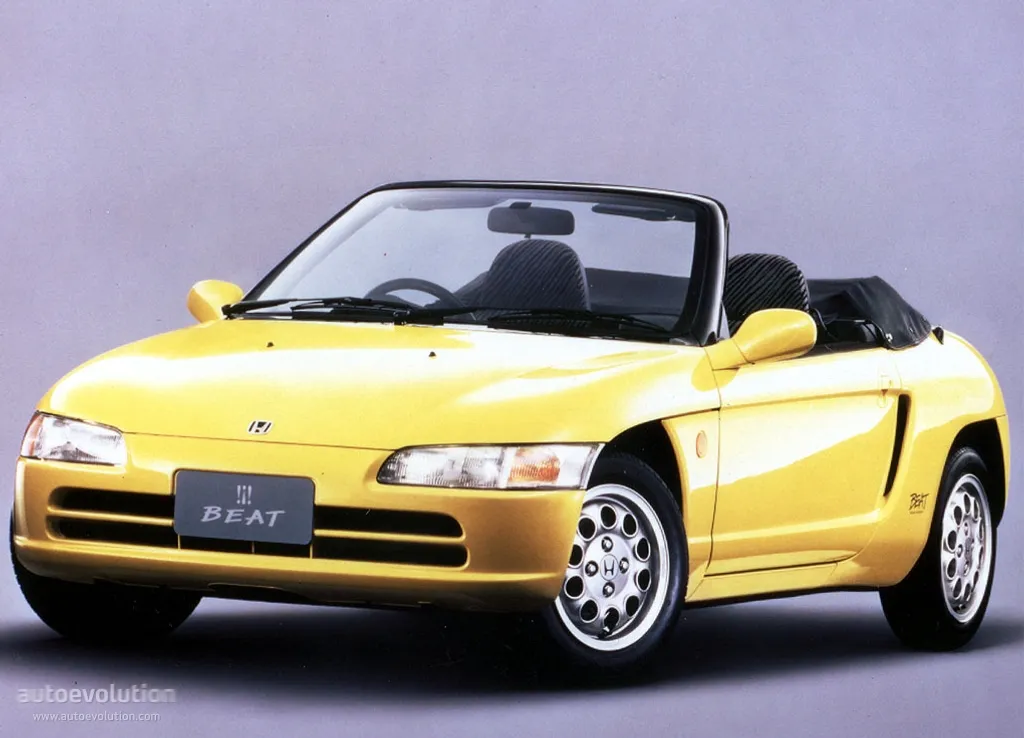
Honda introduced the Beat in 1991 for the Japanese market, in the kei-car segment, and it re-invented the class.

While most kei-cars were boring econoboxes that looked like phone-booth on wheels, the Beat was a completely different vehicle. It was not designed to accommodate five people inside or to carry the weekly shopping. Honda made it for the customers who didn't want to drive boring cars. It was a mid-engined roadster that could fit in the kei-car regulations and started a culture.

Honda was not at its first attempt to create a fun vehicle in the segment. The 600 did that before it, and it was successful, but the Beat was a big step forward. Its narrow headlights and short front overhang made it look longer. Its raked windshield was extended above the steering wheel. On the sides, the carmaker added air intakes for the mid-mounted engine and pushed the rear wheels to the back as far as possible. It concluded the car with an even shorter overhang than the front one.

Inside, there was room for two people separated by a center console where a short gear-stick was the main decoration. Its dashboard was comprehensive, with a proper, sloped center stack. The instrument panel looked like it was carried over from a motorcycle, especially since the tachometer had the red-line at 8,500 rpm. Behind the seats, the carmaker managed to place the removable canvas roof, which was manually operated.

Behind the cabin, the engine compartment hosted a 0.6-liter inline-three unit which featured advanced technologies for a car from that era. It was feed via individual throttle bodies and produced almost 100 hp/liter, which was very difficult for most carmakers. But not for Honda.

How much power does the Honda Beat have?

The most powerful Honda Beat trim is the 0.7L 5MT (64 HP) with 64 hp. The model has 1 trims, starting at 64 hp.

What is the fuel consumption of the Honda Beat?

The most economical Honda Beat trim is the 0.7L 5MT (64 HP), with a stated combined consumption of 3.7 l/100 km and — g CO2 per km.

How quickly does the Honda Beat accelerate from 0 to 100 km/h?

The quickest trim is the 0.7L 5MT (64 HP): 0-100 km/h in 13.4 seconds, with a top speed of 134 km/h.

Other Honda models

Honda Logo/Fit

1996 - 2001 · 3 trims

Power
65 hp
0–100
14.5 s
Fuel economy
6.3

Petrol

Honda S2000

1999 - 2009 · 2 trims

Power
250 hp
0–100
6.2 s
Fuel economy
9.9

Petrol

Honda Avancier

1999 - 2003 · 4 trims

Power
215 hp
0–100
8.8 s
Fuel economy
8.5

Petrol

Honda Jazz/City

1983 - 1986 · 2 trims

Power
56 hp
0–100
13.0 s
Fuel economy
6.0

Petrol

Honda That's

2002 - 2007 · 2 trims

Power
64 hp
0–100
Fuel economy
5.3

Petrol