About Citroën GSA
In 1978, Citroën introduced the GSA as an upgraded version of the 1970 GS, trying to fill the gap between the low-budget cars in its lineup and the luxurious CX.
During the Oil Crisis in the early '70s, Citroën's sales were hit hard. As a result, it faced huge financial difficulties, and it was bought in 1975 by another French automaker, Peugeot. The new owner had to take care of the product lineup that Citroën offered. It decided to keep the GS lineup, improve it, rebadge it as the GSA, and keep it on the assembly lines until 1986. Even though some of its characteristics remained unchanged, it was styled slightly differently. In addition, it featured a simplified version of Citroën's hydropneumatic suspension carried over from the brand's former flagship model, the DS.
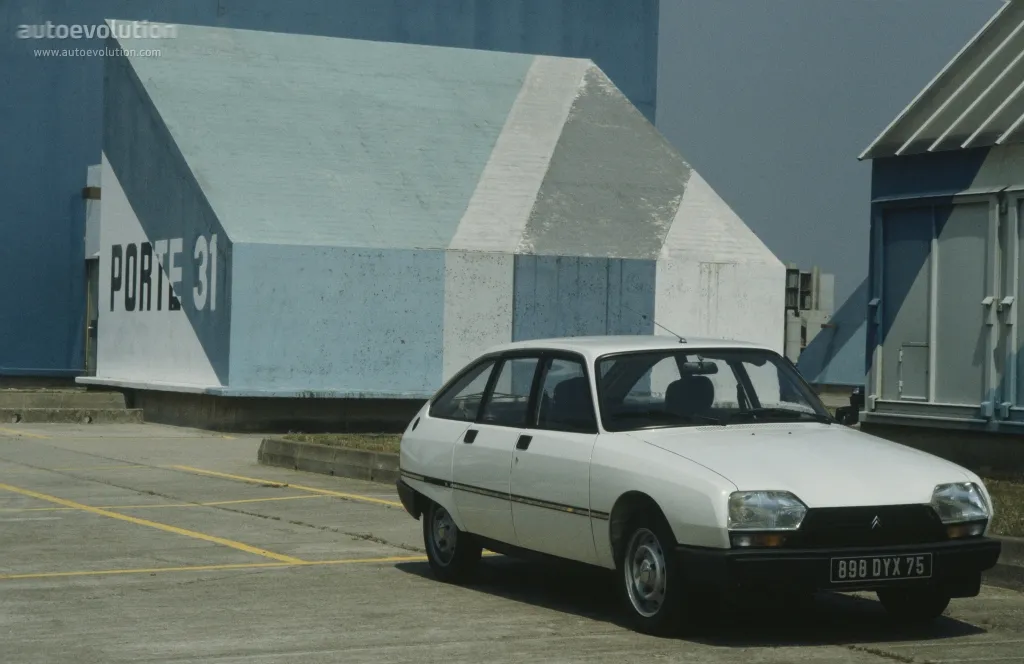
Even though it was challenging to spot the differences between the GS and the GSA, Citroën made some changes to the car. The headlights were identical, but the turn signal lamps and the parking lights underneath them were new. They sported smoked lenses and looked slightly more modern for those times than those placed on its non-facelifted sibling. A significant upgrade was noticed on the bumper, which wasn't made from metal anymore. Instead, the automaker installed a wrapped-around plastic bumper, which also integrated an apron.
From its profile, the compact-sized five-door hatchback featured a Kamm-back styling, echoing the shape of the Citroën CX, albeit in a shorter package. The new flush door handles looked unusual since they had to be pulled forward to open the doors instead of upwards, as on many other vehicles. Citroën considered that its method would solve the problem of accumulated water and eliminate rust issues on those parts. An elegant horizontal rubber line crossed the car front to back and visually connected the bumpers. At the back, the GSA featured a tailgate that lifted the rear window, allowing customers to load or unload the trunk. This was a significant improvement over its GS predecessor, which featured a fixed window and only the metallic vertical panel that could be opened, together with the rear metallic bumper.
Inside, the comfortable cabin featured bucket seats at the front and a bench seat for three in the back. The automaker offered the car with an unusual-looking instrument cluster. It featured a revolving speedometer and tachometer behind rectangular magnifying lenses. The speed and the revolutions per minute were shown by numbers, not by needles around a dial like in most other cars. Furthermore, Citroën installed round-shaped satellites that looked like cans on the side of the dashboard fitted with buttons and lights for turn signals, wipers on the left, and several other buttons on a similar-looking part on the right. Right in the middle of the dashboard, above the center vents, the automaker placed the handle for the emergency brake, which stopped the front wheels from rotating, not the rear ones. In the back, the automaker installed a flat-folding bench seat that could expand the generous trunk.
Under the hood, the car was fitted with flat-four, air-cooled engines developed by Citroën before it was bought by Peugeot. It paired them with a choice of four or five-speed manual transmissions that sent the power to the front wheels. In addition, a three-speed semi-automatic gearbox with a torque converter was also available. The independent suspension and the four-disc braking system were among the best in the compact segment, where most other automakers provided torsion beams and drum brakes for the rear axle.