Skip to content
AD

Honda That's (2002 - 2007)

Honda · 2 trims

Honda That's

The Honda That's (2002 - 2007) is available in 2 trims producing 52 to 64 hp. The lowest stated fuel consumption is 5.3 l/100 km.

Power
64 hp
0–100
Fuel economy
5.3 l/100 km
Cargo

That's Trims

Compare →
Trims and engine versions — Honda That's
Trim Fuel Power Torque 0–100 Top speed Fuel economy CO2 Select
0.7L 3AT (52 HP) Petrol 52 hp 61 Nm 5.3 l/100 km 126 g/km
0.7L Turbo 3AT (64 HP) Petrol 64 hp 93 Nm 5.9 l/100 km 140 g/km

Fuel economy and CO2 follow the stated test cycle. Manufacturer figures; deviations per market and option pack are possible.

Is Honda That's a good choice against other models?

Average across every Honda That's trim, compared with 5,709 trims of other cars from the 1999–2005 period.

Is Honda That's a good choice against other models?
Measure This model Average Position
Power 58 hp 166 hp
better than 1%
Torque 77 Nm 260 Nm
better than 0%
Combined consumption 5.6 l/100 km 8.3 l/100 km
better than 87%
CO2 emissions 133 g/km 199 g/km
better than 92%
Unladen weight 840 kg 1,423 kg
better than 99%

Percentages show the share of trims from the same period this model beats on that measure. Manufacturer figures.

Not stated by the manufacturer: top speed, acceleration 0–100 km/h and cargo volume. Those measures are left out of the comparison.

Comparable models from other brands

Maruti Suzuki Subaru Mazda Dacia Citroën

About Honda That's

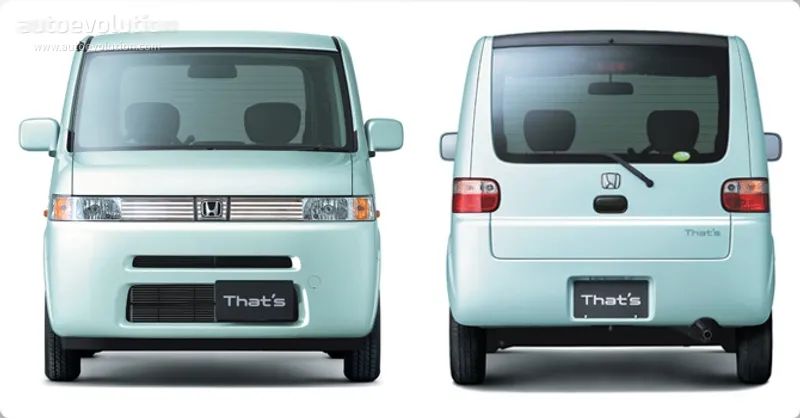
Despite its incomplete name, the That's was designed as a kei-car vehicle for the Japanese market, aimed at the customers that asked for something else. That's was the Honda answer for them.

The kei-cars, or light automobiles, were created in Japan in 1949, and the regulations were precise about the size, engine displacement, and power output. The citizens were encouraged to buy them to lower pollution and overcome traffic congestion. The kei-car segment was about one-third of the overall Japanese car-market. Honda That's was designed and engineered to fit into the kei-cars category and, even though it might look unpleasant for other countries, in Japan was a perfect fit.

With its tall stance and very short hood, the That's was a good example of form following function design principle. The Japanese carmaker tried to offer a car with adequate interior room for four passengers but keep the vehicle in the compulsory dimensions. Even though it looked like a cube with a front extension and headlights, it was a practical vehicle.

Inside, the carmaker installed four seats, with a split-folding arrangement for the rear bench. At the front, to clear the floor, the carmaker installed the gear selector next to the steering column. An infotainment unit found its place in the middle of the dashboard. The carmaker installed a round instrument cluster with a speedometer and two gauges for fuel and coolant temperature.

Under the hood, Honda installed a choice of two engines of 0.6-liter displacement; a naturally aspirated one and a turbocharged version. Both were paired as standard to a three-speed automatic transmission. The That's was available either with a front- or all-wheel-drive system.

How much power does the Honda That's have?

The most powerful Honda That's trim is the 0.7L Turbo 3AT (64 HP) with 64 hp. The model has 2 trims, starting at 52 hp.

What is the fuel consumption of the Honda That's?

The most economical Honda That's trim is the 0.7L 3AT (52 HP), with a stated combined consumption of 5.3 l/100 km and 126 g CO2 per km.

Other Honda models

Honda MDX

2003 - 2006 · 1 trim

Power
260 hp
0–100
Fuel economy

Petrol

Honda Element

2003 - 2011 · 2 trims

Power
166 hp
0–100
Fuel economy

Petrol

Honda Airwave

2005 - 2010 · 2 trims

Power
110 hp
0–100
11.7 s
Fuel economy
5.6

Petrol

Honda Avancier

1999 - 2003 · 4 trims

Power
215 hp
0–100
8.8 s
Fuel economy
8.5

Petrol

Honda S2000

1999 - 2009 · 2 trims

Power
250 hp
0–100
6.2 s
Fuel economy
9.9

Petrol