Skip to content
AD

Mazda MX-6 (1992 - 1997)

Mazda · 2 trims

Mazda MX-6

The Mazda MX-6 (1992 - 1997) is available in 2 trims producing 115 to 165 hp. The fastest trim reaches 220 km/h. The lowest stated fuel consumption is 8.0 l/100 km.

Power
165 hp
0–100
8.1 s
Fuel economy
8.0 l/100 km
Cargo
405 l

MX-6 Trims

Compare →
Trims and engine versions — Mazda MX-6
Trim Fuel Power Torque 0–100 Top speed Fuel economy CO2 Select
2.0i Petrol 115 hp 172 Nm 10.4 s 200 km/h 8.0 l/100 km 190 g/km
2.5i V6 Petrol 165 hp 217 Nm 8.1 s 220 km/h 9.8 l/100 km 233 g/km

Fuel economy and CO2 follow the stated test cycle. Manufacturer figures; deviations per market and option pack are possible.

Is Mazda MX-6 a good choice against other models?

Average across every Mazda MX-6 trim, compared with 2,319 trims of other cars from the 1989–1995 period.

Is Mazda MX-6 a good choice against other models?
Measure This model Average Position
Power 140 hp 139 hp
better than 62%
Torque 195 Nm 208 Nm
better than 58%
Top speed 210 km/h 193 km/h
better than 74%
Acceleration 0–100 km/h 9.3 s 11.6 s
better than 75%
Combined consumption 8.9 l/100 km 8.9 l/100 km
better than 40%
CO2 emissions 212 g/km 211 g/km
better than 38%
Cargo volume 405 l 442 l
better than 48%
Unladen weight 1,187 kg 1,301 kg
better than 58%

Percentages show the share of trims from the same period this model beats on that measure. Manufacturer figures.

Comparable models from other brands

Ssangyong Fiat Ferrari Mitsubishi

About Mazda MX-6

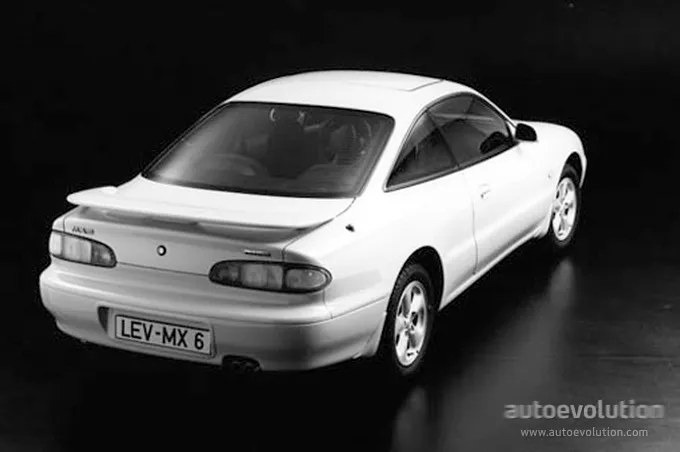
The marriage between Ford and Mazda was not long, but it was long enough for both brands to develop some very interesting vehicles, such as the 1992 Mazda MX6.

The second generation of the Mazda MX6 shared its platform with the Ford Probe and Mazda 626. It was the answer given in Europe against the Opel Calibra and Honda Prelude. It couldn't compete against the BMW 3-Series, which was fitted with much more powerful engines.

The Mazda MX6 and the Mazda 626 were the two and four-door versions of the same car, with the exception of some specific changes. The MX5 was designed as a 2+2 coupe, with enough room for the rear passengers. That is why the sleek front of the car was followed by a high greenhouse, sloped in the rear. In the back, an interesting solution was found for the rear spoiler, which was integrated over the trunk lid via two supporting struts.

Inside, there was room for four adults on comfortable seats. The front ones were simple, without a high bolstering. The flat and low dashboard was in the same lines of the '90s Japanese car style. A simple layout of the instrument cluster offered basic information such as speed, engine speed, fuel, and coolant temperature.

From the technical point of view, the MX6 featured a stiffer suspension than the 626 and a special suspension system in the rear, which allow the wheels to change their camber to improve the cornering speed. For the drivetrain, the MX6 was offered with either a 2.0-liter or a 2.5-liter engine. Both were mated to a standard 5-speed manual, while a 4-speed automatic was on the options list.

How much power does the Mazda MX-6 have?

The most powerful Mazda MX-6 trim is the 2.5i V6 with 165 hp. The model has 2 trims, starting at 115 hp.

What is the fuel consumption of the Mazda MX-6?

The most economical Mazda MX-6 trim is the 2.0i, with a stated combined consumption of 8.0 l/100 km and 190 g CO2 per km.

How quickly does the Mazda MX-6 accelerate from 0 to 100 km/h?

The quickest trim is the 2.5i V6: 0-100 km/h in 8.1 seconds, with a top speed of 220 km/h.

How large is the cargo volume of the Mazda MX-6?

The largest stated cargo volume for the Mazda MX-6 is 405 litres.

Other Mazda models

Mazda Xedos 6

1992 - 1999 · 5 trims

Power
160 hp
0–100
9.3 s
Fuel economy
7.5

Petrol

Mazda MX-3

1991 - 1998 · 4 trims

Power
136 hp
0–100
8.5 s
Fuel economy
7.4

Petrol

Mazda 121 (Mk.1)

1987 - 1991 · 2 trims

Power
67 hp
0–100
11.6 s
Fuel economy
6.7

Petrol