Skip to content
AD

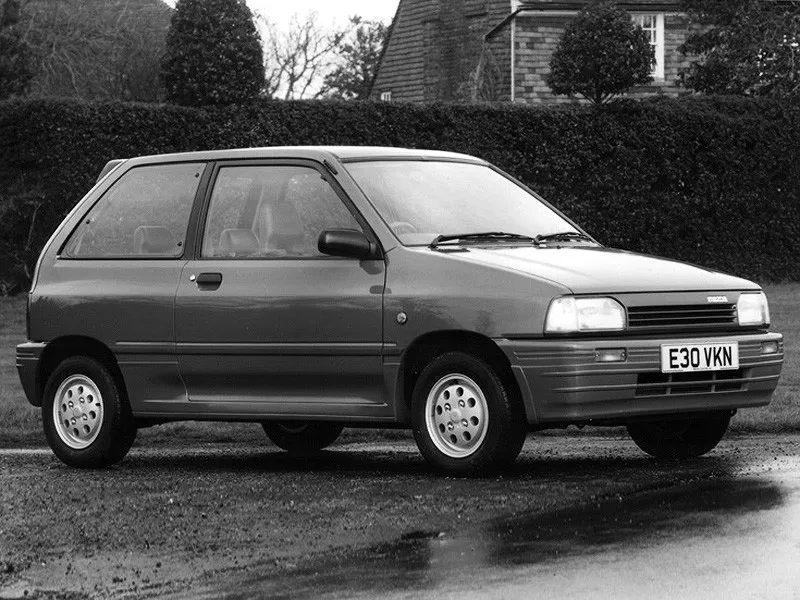
Mazda 121 (Mk.1) (1987 - 1991)

Mazda · 2 trims

Mazda 121 (Mk.1)

The Mazda 121 (Mk.1) (1987 - 1991) is available in 2 trims producing 56 to 67 hp. The fastest trim reaches 159 km/h. The lowest stated fuel consumption is 6.7 l/100 km.

Power
67 hp
0–100
11.6 s
Fuel economy
6.7 l/100 km
Cargo
190 l

121 (Mk.1) Trims

Compare →
Trims and engine versions — Mazda 121 (Mk.1)
Trim Fuel Power Torque 0–100 Top speed Fuel economy CO2 Select
1.1L 5MT (56 HP) Petrol 56 hp 88 Nm 13.6 s 150 km/h 6.8 l/100 km
1.3L 5MT (67 HP) Petrol 67 hp 103 Nm 11.6 s 159 km/h 6.7 l/100 km

Fuel economy and CO2 follow the stated test cycle. Manufacturer figures; deviations per market and option pack are possible.

Is Mazda 121 (Mk.1) a good choice against other models?

Average across every Mazda 121 (Mk.1) trim, compared with 1,269 trims of other cars from the 1984–1990 period.

Is Mazda 121 (Mk.1) a good choice against other models?
Measure This model Average Position
Power 62 hp 126 hp
better than 9%
Torque 96 Nm 188 Nm
better than 6%
Top speed 155 km/h 186 km/h
better than 13%
Acceleration 0–100 km/h 12.6 s 12.0 s
better than 36%
Combined consumption 6.8 l/100 km 8.8 l/100 km
better than 85%
Cargo volume 190 l 446 l
better than 2%
Unladen weight 750 kg 1,212 kg
better than 96%

Percentages show the share of trims from the same period this model beats on that measure. Manufacturer figures.

Not stated by the manufacturer: co2 emissions. Those measures are left out of the comparison.

Comparable models from other brands

Alfa Romeo Peugeot Citroën Mitsubishi Renault Alpine

About Mazda 121 (Mk.1)

Mazda entered the supermini car-segment with the 121 model in 1987. It was sold in Australia and unveiled in Europe at the 1988 Geneva Motor Show.

In 1987 Mazda already had some interesting models on the market, and its main contender was the compact hatchback 323. But the Japanese car-maker needed something smaller for the European market. Ford owned a big part of Mazda at that time and it already had the Fiesta on the market. In the end, the Japanese brand had to open its small-segment car-market, and it did it with the 121. Ford also sold the patent for the car to the Kia, which built the Kia Pride.

Small, practical, and cheap, were the main characteristics of the first generation of the Mazda 121. The flat body panels were inexpensive to build and the whole car was designed and engineered for a low price. The 121 featured a canvas roof as an option (top-cabriolet) that made the car more fun in the city.

Inside there were only a few options to choose from, but it featured a stereo and adjustable steering column. The interior was designed with a sliding rear bench so the car could get more trunk space which, otherwise, was almost non-existent.

For the engine, the Mazda 121 offered a 1.3-liter engine in Australia and a 1.1-liter for the European version. Both engine versions were mated to a 4-speed manual transmission.

How much power does the Mazda 121 (Mk.1) have?

The most powerful Mazda 121 (Mk.1) trim is the 1.3L 5MT (67 HP) with 67 hp. The model has 2 trims, starting at 56 hp.

What is the fuel consumption of the Mazda 121 (Mk.1)?

The most economical Mazda 121 (Mk.1) trim is the 1.3L 5MT (67 HP), with a stated combined consumption of 6.7 l/100 km and — g CO2 per km.

How quickly does the Mazda 121 (Mk.1) accelerate from 0 to 100 km/h?

The quickest trim is the 1.3L 5MT (67 HP): 0-100 km/h in 11.6 seconds, with a top speed of 159 km/h.

How large is the cargo volume of the Mazda 121 (Mk.1)?

The largest stated cargo volume for the Mazda 121 (Mk.1) is 190 litres.

Other Mazda models

Mazda MX-3

1991 - 1998 · 4 trims

Power
136 hp
0–100
8.5 s
Fuel economy
7.4

Petrol

Mazda MX-6

1992 - 1997 · 2 trims

Power
165 hp
0–100
8.1 s
Fuel economy
8.0

Petrol

Mazda Xedos 6

1992 - 1999 · 5 trims

Power
160 hp
0–100
9.3 s
Fuel economy
7.5

Petrol