Skip to content
AD

Renault Kwid (2015 - present)

Renault · 2 trims

Renault Kwid

The Renault Kwid (2015 - present) is available in 2 trims producing 54 to 68 hp. The lowest stated fuel consumption is 3.9 l/100 km.

Power
68 hp
0–100
Fuel economy
3.9 l/100 km
Cargo
300 l

Kwid Trims

Compare →
Trims and engine versions — Renault Kwid
Trim Fuel Power Torque 0–100 Top speed Fuel economy CO2 Select
0.8L 5MT FWD (54 HP) Petrol 54 hp 72 Nm 3.9 l/100 km
1.0L 5MT FWD (68 HP) Petrol 68 hp 91 Nm 4.3 l/100 km

Fuel economy and CO2 follow the stated test cycle. Manufacturer figures; deviations per market and option pack are possible.

Is Renault Kwid a good choice against other models?

Average across every Renault Kwid trim, compared with 7,780 trims of other cars from the 2012–2018 period.

Is Renault Kwid a good choice against other models?
Measure This model Average Position
Power 61 hp 215 hp
better than 1%
Torque 82 Nm 345 Nm
better than 0%
Combined consumption 4.1 l/100 km 6.6 l/100 km
better than 89%
Cargo volume 300 l 478 l
better than 15%
Unladen weight 669 kg 1,580 kg
better than 100%

Percentages show the share of trims from the same period this model beats on that measure. Manufacturer figures.

Not stated by the manufacturer: top speed, acceleration 0–100 km/h and co2 emissions. Those measures are left out of the comparison.

Comparable models from other brands

Alpine Nissan DR Motor Mazda Mitsubishi Fiat

About Renault Kwid

The French car-maker tried to offer a very low priced car for the Indian market. But the car had to offer the Renault minimum standards. The Kwid was the answer.

Renault had a big interest in the Indian market. With over a billion population, India was a highly competitive market for low-priced cars. After the partnership with the local car-maker Mahindra ended, the French car-maker approached the market with a supermini car priced at Indian (very low) prices. It was a car assembled for already developed parts for other cars.

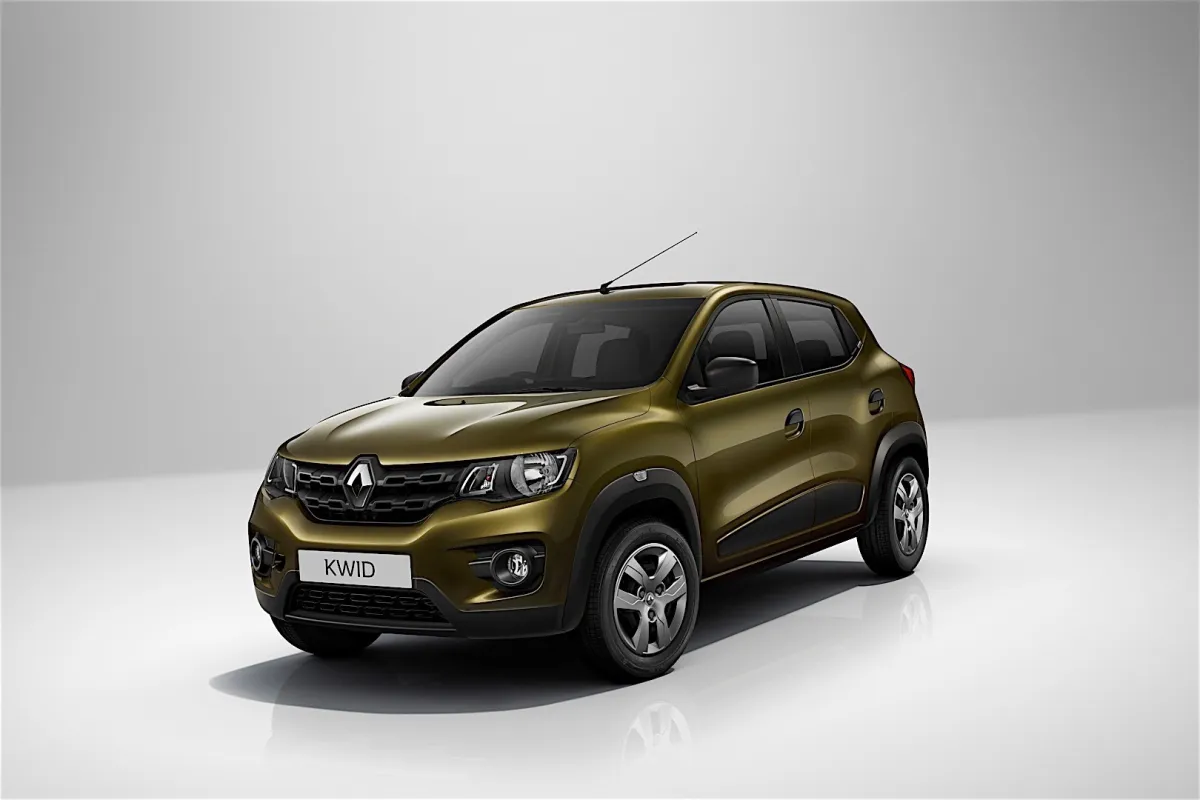
The Kwid featured an SUV-inspired front fascia, with a big grille design and Dacia Sandero inspired headlights. The black moldings over the front and rear wheel-arches amplified the cross-over stance. India was known for its bad roads, so the Kwid came equipped with higher ground clearance and a shrunk-SUV style. The side doors featured curved surfaces and, depending on the trim level, plastic side protection against shopping carts.

Inside, there was a simple, one-piece, dashboard. On the base model, there was just a speedometer on the instrument cluster and no stereo on the center stack. A Medianav Renault system was included on the options list.

For the drivetrain, the Kwid featured a 0.8-liter, or a 1.0-liter engine, mated to a standard 5-speed manual. In Europe, it was expected to be built by Dacia, the most affordable brand in the Renault Alliance.

How much power does the Renault Kwid have?

The most powerful Renault Kwid trim is the 1.0L 5MT FWD (68 HP) with 68 hp. The model has 2 trims, starting at 54 hp.

What is the fuel consumption of the Renault Kwid?

The most economical Renault Kwid trim is the 0.8L 5MT FWD (54 HP), with a stated combined consumption of 3.9 l/100 km and — g CO2 per km.

How large is the cargo volume of the Renault Kwid?

The largest stated cargo volume for the Renault Kwid is 300 litres.

Other Renault models

Renault Alaskan

2016 - present · 3 trims

Power
190 hp
0–100
10.8 s
Fuel economy
6.3

Diesel

Renault Logan

2014 - present · 2 trims

Power
98 hp
0–100
11.5 s
Fuel economy
5.8

Petrol

Renault Scala

2012 - 2017 · 3 trims

Power
99 hp
0–100
14.0 s
Fuel economy
4.6

Petrol Diesel

Renault Twizy

2012 - present · 2 trims

Power
17 hp
0–100
Fuel economy

Electric

Renault K-ZE

2019 - present · 1 trim

Power
45 hp
0–100
Fuel economy

Electric