Skip to content
AD

Nissan Pixo (2009 - 2013)

Nissan · 2 trims

Nissan Pixo

The Nissan Pixo (2009 - 2013) is available in 2 trims producing 68 to 68 hp. The fastest trim reaches 154 km/h. The lowest stated fuel consumption is 4.3 l/100 km.

Power
68 hp
0–100
13.5 s
Fuel economy
4.3 l/100 km
Cargo
130 l

Pixo Trims

Compare →
Trims and engine versions — Nissan Pixo
Trim Fuel Power Torque 0–100 Top speed Fuel economy CO2 Select
1.0L 4AT (68 HP) Petrol 68 hp 89 Nm 17.0 s 150 km/h 5.1 l/100 km 118 g/km
1.0L 5MT (68 HP) Petrol 68 hp 89 Nm 13.5 s 154 km/h 4.3 l/100 km 99 g/km

Fuel economy and CO2 follow the stated test cycle. Manufacturer figures; deviations per market and option pack are possible.

Is Nissan Pixo a good choice against other models?

Average across every Nissan Pixo trim, compared with 7,656 trims of other cars from the 2006–2012 period.

Is Nissan Pixo a good choice against other models?
Measure This model Average Position
Power 68 hp 194 hp
better than 1%
Torque 89 Nm 311 Nm
better than 0%
Top speed 152 km/h 210 km/h
better than 1%
Acceleration 0–100 km/h 15.3 s 9.4 s
better than 2%
Combined consumption 4.7 l/100 km 7.5 l/100 km
better than 87%
CO2 emissions 109 g/km 172 g/km
better than 96%
Cargo volume 130 l 470 l
better than 2%
Unladen weight 898 kg 1,529 kg
better than 99%

Percentages show the share of trims from the same period this model beats on that measure. Manufacturer figures.

Comparable models from other brands

Alpine Renault DR Motor Mazda Mitsubishi Fiat

About Nissan Pixo

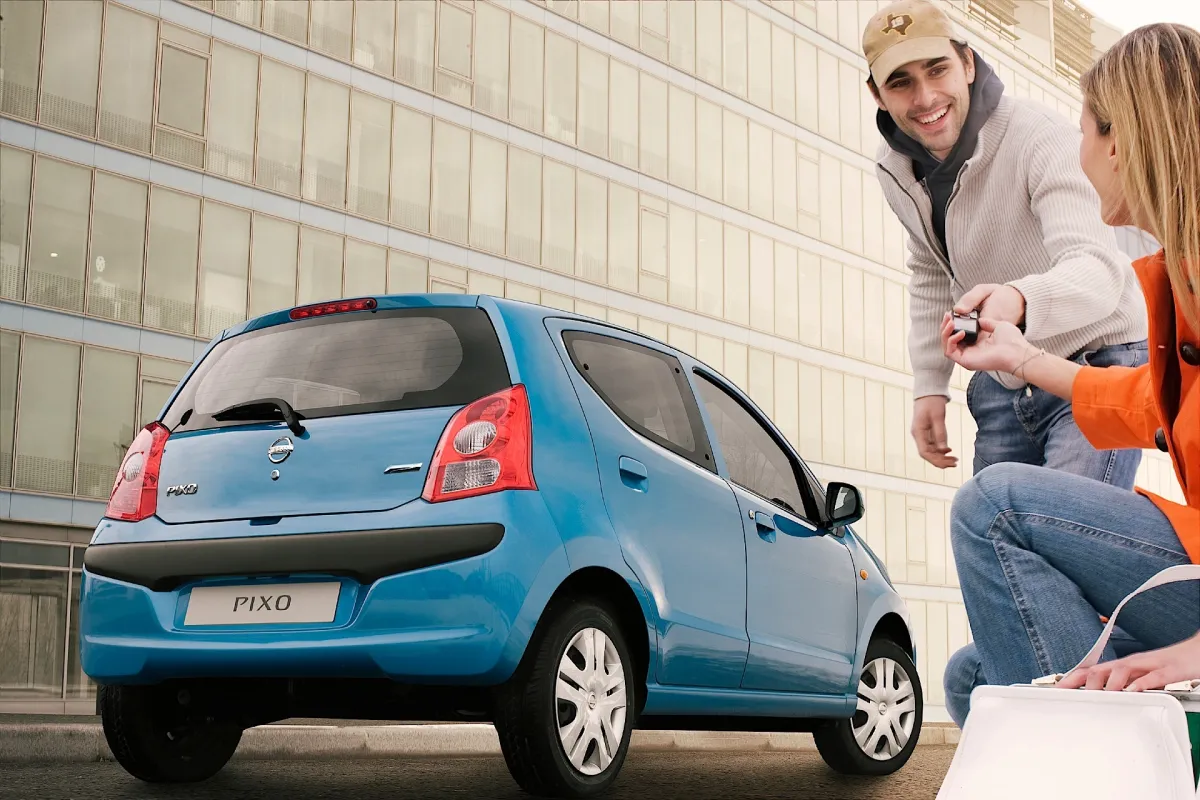
When Nissan needed a car cheaper than the Micra, it turned its eyes to Suzuki, who was working on the Alto model. The result was a re-badged Alto, under the name of Pixo.

Suzuki was a great carmaker of small cars. Its products conquered the emerging markets from India and ASEAN countries. It was cheap, reliable, and easy to run. Moreover, Suzuki found a way to make it even less expensive since it split the production costs with the Indian brand Maruti. As a result, Nissan bought its share, and Suzuki built the Pixo on the same assembly line with the Alto and the Celerio, its slightly stylish cousin.

At the front, Nissan managed to adapt the Note's design with a new grille design that featured an almost entirely closed grille, interrupted only by four cuts. The headlights were swept-back over the front fenders, and that's where Nissan's personality ended. From its sides, it looked very similar to the Alto, with an ascending beltline that merged into a kick over the rear doors.

The Pixo was available in three trim levels. The base model featured four cupholders and a CD-stereo. To get more airbags, the customer should have selected a higher trim level. The carmaker offered an air-conditioning system and an automatic transmission only on the full-option version, the Accenta. That one featured power windows at the front.

Under the hood, Nissan relied on Suzuki's one-liter engine. It was paired to a standard five-speed manual gearbox, while a four-speed automatic transmission was on the options list.

How much power does the Nissan Pixo have?

The most powerful Nissan Pixo trim is the 1.0L 4AT (68 HP) with 68 hp. The model has 2 trims, starting at 68 hp.

What is the fuel consumption of the Nissan Pixo?

The most economical Nissan Pixo trim is the 1.0L 5MT (68 HP), with a stated combined consumption of 4.3 l/100 km and 99 g CO2 per km.

How quickly does the Nissan Pixo accelerate from 0 to 100 km/h?

The quickest trim is the 1.0L 5MT (68 HP): 0-100 km/h in 13.5 seconds, with a top speed of 154 km/h.

How large is the cargo volume of the Nissan Pixo?

The largest stated cargo volume for the Nissan Pixo is 130 litres.

Other Nissan models

Nissan NV200

2009 - present · 2 trims

Power
110 hp
0–100
Fuel economy
4.9

Diesel

Nissan Cube

2009 - present · 5 trims

Power
116 hp
0–100
10.0 s
Fuel economy
5.8

Petrol

Nissan Platina

2006 - 2010 · 1 trim

Power
110 hp
0–100
Fuel economy
6.1

Petrol

Nissan 350 Z

2006 - 2008 · 2 trims

Power
310 hp
0–100
5.8 s
Fuel economy
11.7

Petrol