

About Mclaren Speedtail
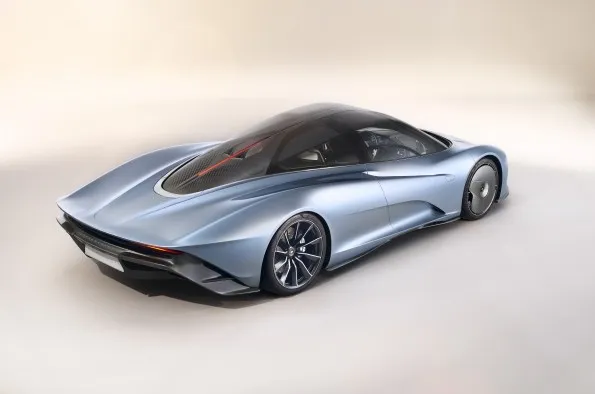
After creating the P1 and Senna, McLaren launched the third member of the Ultimate Series, the 2018 Speedtail, a hypercar that could beat a Bugatti in almost any performance results, apart from the top speed.
When the British car manufacturer unveiled the Speedtail, the car revealed many connections with its grandfather, the iconic McLaren F1. And, just like its illustrious ancestor, the 2018 vehicle featured advanced technologies for its time, and it was the fastest McLaren ever built, although it only passed the top speed of the F1 by just 7 miles per hour (10 kph). But that was not the point. The engineering details made the Speedtail stand apart from any other direct competitors. It was neither a form-followed-purpose concept nor a purpose-followed-form one; it was a best of both worlds neither of its competitors could achieve.
The fluid shapes of the bodywork were carefully crafted and tested in the wind tunnel to the maximum. Its short nose, teardrop-shaped greenhouse, and long rear end, hence the Speedtail name, created an incredibly low drag coefficient. At the front, the LED headlights resembled the same shape as those installed on the rest of the McLaren vehicles and formed, together with the side scoops, a C-shape. Underneath the bumper, the automaker placed a carbon-fiber splitter with a V-shaped element in the middle that channeled the air toward the side intakes. From its profile, the car featured a unique, distinctive look with its caps that covered the front wheels to lower the drag coefficient. Behind them, on the rear side of the fenders, the automaker placed extracting vents to release the pressure within the wheel wells. Furthermore, the ascending curved line above them created a ponton-like element that continued the vehicle's shape toward its back and also formed the upper sides of the rear fenders. Finally, at the rear, the extended rear overhang featured a functional diffuser and a set of fins and vents that also served to decrease the ground effect.
Inside, customers could find a McLaren F1-style cockpit. The driver's seat was in the middle, and it was flanked, in recessed positions, by the passengers' bucket seats. Fronting the driver was a digital instrument cluster flanked on the left by the touchscreen for the HVAC and the infotainment unit's touch panel on the right. Above the driver were the start/stop, the gear selectors (PRND), and the power window buttons. It was a unique solution, unseen in other cars. The carefully crafted carbon fiber elements surrounded the cabin, and McLaren used this material for the seats, door cards, shift paddles, and steering wheel.
But the most essential part of the 2018 Speedtail was under its engine cover, placed behind the cabin. There, McLaren installed a hybrid system powered by a twin-turbocharged 4.0-liter V8 and helped by an electric motor that produced 1050 PS (1036 hp) and could accelerate the car from a standstill to 300 kph (186 mph) in just 12.8 seconds. And that was faster than any other production car on the road.