Skip to content
AD

Toyota Harrier (2014 - present)

Toyota · 3 trims

Toyota Harrier

The Toyota Harrier (2014 - present) is available in 3 trims producing 151 to 196 hp. The fastest trim reaches 180 km/h. The lowest stated fuel consumption is 4.6 l/100 km.

Power
196 hp
0–100
Fuel economy
4.6 l/100 km
Cargo

Harrier Trims

Compare →
Trims and engine versions — Toyota Harrier
Trim Fuel Power Torque 0–100 Top speed Fuel economy CO2 Select
2.0L CVT 2WD (151 HP) Petrol 151 hp 193 Nm 180 km/h 6.2 l/100 km
2.0L CVT AWD (151 HP) Petrol 151 hp 193 Nm 6.5 l/100 km
2.5L E-Four CVT AWD (196 HP) Hybrid 196 hp 206 Nm 4.6 l/100 km

Fuel economy and CO2 follow the stated test cycle. Manufacturer figures; deviations per market and option pack are possible.

Is Toyota Harrier a good choice against other models?

Average across every Toyota Harrier trim, compared with 7,635 trims of other cars from the 2011–2017 period.

Is Toyota Harrier a good choice against other models?
Measure This model Average Position
Power 166 hp 210 hp
better than 48%
Torque 197 Nm 339 Nm
better than 17%
Top speed 180 km/h 214 km/h
better than 14%
Combined consumption 5.8 l/100 km 6.6 l/100 km
better than 52%
Unladen weight 1,563 kg 1,571 kg
better than 44%

Percentages show the share of trims from the same period this model beats on that measure. Manufacturer figures.

Not stated by the manufacturer: acceleration 0–100 km/h, co2 emissions and cargo volume. Those measures are left out of the comparison.

Comparable models from other brands

Plymouth Ferrari Xpeng Bentley GMC Chevrolet

About Toyota Harrier

Toyota introduced in 2017 a mid-life cycle refresh for the 2013 Harrier, a Japan-only re-badged Lexus RX.

The Japanese carmaker launched the Harrier's first generation in 1997 and kept it on the market for six years before it unveiled the second generation. Toyota rushed to improved it, and after just five years, it added important technological and safety features.

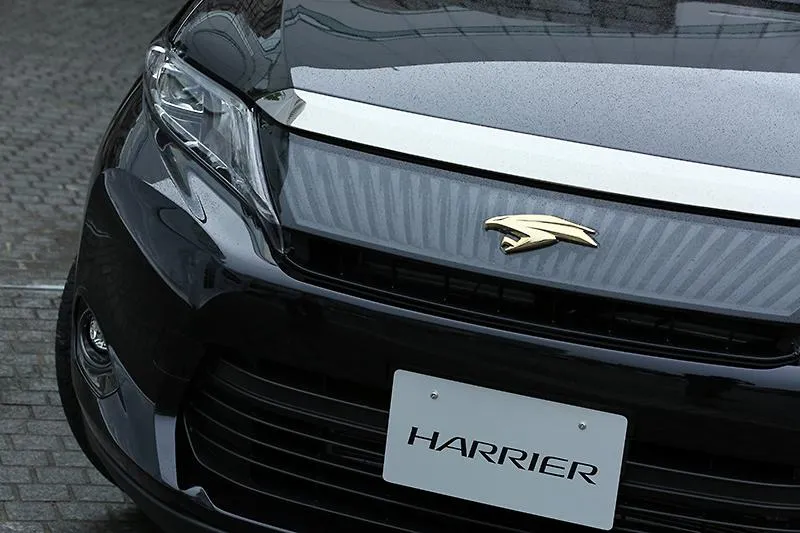
From the design point of view, there were several changes to the car. At the front, it sported a different badge than the rest of its stablemates, with an eagle head instead of the Toyota logo. Its grille was almost completely covered on the upper side, with only a narrow and wide gap underneath, above the bumper. An additional cooling area for the lower-mounted radiators found its place in the bumper. The angular-looking headlights with sharp corners and curved upper and lower sides created an aggressive image for the compact-sized SUV. At the back, the raked-forward tailgate sported a spoiler at the upper side.

Inside, the Harrier featured a leather-clad interior. It wasn't at the same quality level as the premium RX model, but it was close. Its instrument cluster featured two dials that flanked a TFT screen between them for the onboard computer. On the center stack, a large infotainment touch-screen display featured the Entune Toyota system.

Under the skin, the Harrier offered a choice of gasoline and hybrid drivetrains with either a front or all-wheel-drive system. It didn't provide the same wide powerplants options like the Lexus RX, but it had what it takes to get to its customer hearts and wallets.

How much power does the Toyota Harrier have?

The most powerful Toyota Harrier trim is the 2.5L E-Four CVT AWD (196 HP) with 196 hp. The model has 3 trims, starting at 151 hp.

What is the fuel consumption of the Toyota Harrier?

The most economical Toyota Harrier trim is the 2.5L E-Four CVT AWD (196 HP), with a stated combined consumption of 4.6 l/100 km and — g CO2 per km.

Other Toyota models

Toyota GT86

2013 - present · 2 trims

Power
200 hp
0–100
7.6 s
Fuel economy
7.1

Petrol

Toyota Vios

2013 - present · 2 trims

Power
109 hp
0–100
12.0 s
Fuel economy
6.3

Petrol

Toyota Agya

2012 - present · 2 trims

Power
65 hp
0–100
Fuel economy

Petrol

Toyota GT 86

2016 - present · 2 trims

Power
208 hp
0–100
Fuel economy
8.7

Petrol

Toyota Verso-S

2010 - present · 4 trims

Power
99 hp
0–100
12.1 s
Fuel economy
4.3

Petrol Diesel