Skip to content
AD

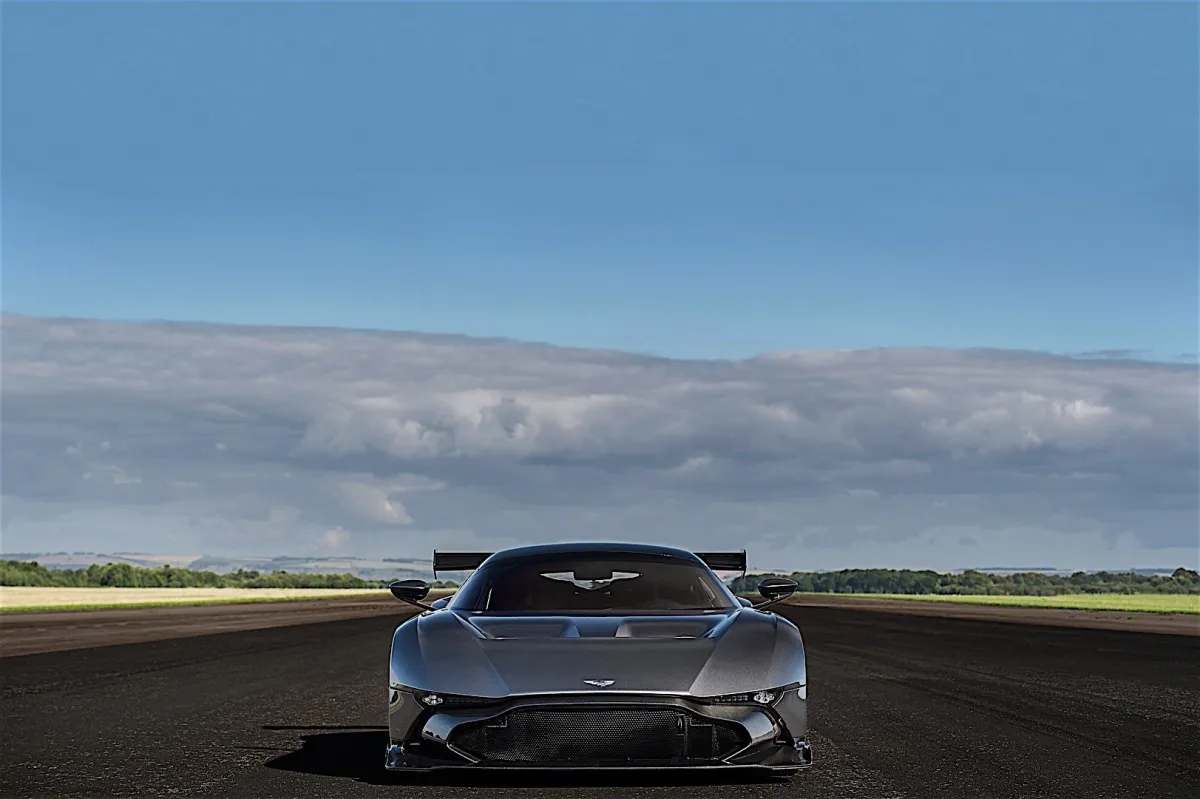
Aston Martin Vulcan (2015 - 2016)

Aston Martin · 1 trim

Aston Martin Vulcan

The Aston Martin Vulcan (2015 - 2016) is available in 1 trims producing 800 to 800 hp. The fastest trim reaches 362 km/h.

Power
800 hp
0–100
3.0 s
Fuel economy
Cargo

Vulcan Trims

Compare →
Trims and engine versions — Aston Martin Vulcan
Trim Fuel Power Torque 0–100 Top speed Fuel economy CO2 Select
7.0L V12 6AT RWD (800 HP) Petrol 800 hp 3.0 s 362 km/h

Fuel economy and CO2 follow the stated test cycle. Manufacturer figures; deviations per market and option pack are possible.

Is Aston Martin Vulcan a good choice against other models?

Average across every Aston Martin Vulcan trim, compared with 7,781 trims of other cars from the 2012–2018 period.

Is Aston Martin Vulcan a good choice against other models?
Measure This model Average Position
Power 800 hp 214 hp
better than 100%
Top speed 362 km/h 215 km/h
better than 100%
Acceleration 0–100 km/h 3.0 s 8.7 s
better than 99%
Unladen weight 1,350 kg 1,580 kg
better than 73%

Percentages show the share of trims from the same period this model beats on that measure. Manufacturer figures.

Not stated by the manufacturer: torque, combined consumption, co2 emissions and cargo volume. Those measures are left out of the comparison.

Comparable models from other brands

Ferrari Mclaren Lucid Motors Koenigsegg

About Aston Martin Vulcan

The British carmaker proved its value on the track with production models, and then it introduced the Vulcan as a track-only weapon.

Aston Martin did its homework on the race tracks, and its engineers learned how to transform a GT coupe into a class-winner. Aston Martin named the car Vulcan honoring the British Avro Vulcan strategic bomber. And when it did that, it had to build a remarkable track vehicle. Its customers were rich people or racing teams.

Since the Vulcan couldn't be registered, the engineers had to worry only about the downforce and the mass distribution. The long hood that covered the V-12 underneath it featured two exhaust vents that extracted the radiator's hot air. At the front, a narrow and wide grille followed the same design idea as any other Aston Martin's grille from the DB2 onwards. From its sides, the low profile hypercar showed a curved sideline with a raised area above the rear fenders, while the greenhouse was tall enough to fit the race bucket-seats inside it. At the back, the carmaker installed a massive wing.

Inside, a cramped cockpit was designed for two seats, but usually, only one was installed during races. There was no CD radio or infotainment unit in it. Its windows were fixed. There were no airbags, and the so-called steering wheel was removable and contained the start button and the paddle-shifters.

Aston Martin built the Vulcan for races only. The carmaker installed a carbon-fiber torque tube and a carbon-fiber driveshaft to send the power to the rear wheels from the front-mid-mounted engine via a six-speed sequential gearbox. Last but not least, the Vulcan featured four hydraulic jacks that lifted the car from the ground to help the team changing the wheels.

How much power does the Aston Martin Vulcan have?

The most powerful Aston Martin Vulcan trim is the 7.0L V12 6AT RWD (800 HP) with 800 hp. The model has 1 trims, starting at 800 hp.

How quickly does the Aston Martin Vulcan accelerate from 0 to 100 km/h?

The quickest trim is the 7.0L V12 6AT RWD (800 HP): 0-100 km/h in 3.0 seconds, with a top speed of 362 km/h.

Other Aston Martin models

Aston Martin DBX

2020 - present · 1 trim

Power
550 hp
0–100
4.5 s
Fuel economy
14.3

Petrol