Skip to content
AD

Ferrari 159 S (1947 - 1948)

Ferrari · 1 trim

Ferrari 159 S

The Ferrari 159 S (1947 - 1948) is available in 1 trims producing 125 to 125 hp. The fastest trim reaches 220 km/h. The lowest stated fuel consumption is 11.5 l/100 km.

Power
125 hp
0–100
10.1 s
Fuel economy
11.5 l/100 km
Cargo

159 S Trims

Compare →
Trims and engine versions — Ferrari 159 S
Trim Fuel Power Torque 0–100 Top speed Fuel economy CO2 Select
1.9 V12 5MT (125 HP) Petrol 125 hp 130 Nm 10.1 s 220 km/h 11.5 l/100 km

Fuel economy and CO2 follow the stated test cycle. Manufacturer figures; deviations per market and option pack are possible.

Is Ferrari 159 S a good choice against other models?

Average across every Ferrari 159 S trim, compared with 53 trims of other cars from the 1944–1950 period.

Is Ferrari 159 S a good choice against other models?
Measure This model Average Position
Power 125 hp 62 hp
better than 89%
Top speed 220 km/h 131 km/h
better than 100%
Unladen weight 750 kg 1,090 kg
better than 81%

Percentages show the share of trims from the same period this model beats on that measure. Manufacturer figures.

Not stated by the manufacturer: co2 emissions and cargo volume. Those measures are left out of the comparison.

Comparable models from other brands

Renault Mercedes-Benz Vauxhall Holden Lancia

About Ferrari 159 S

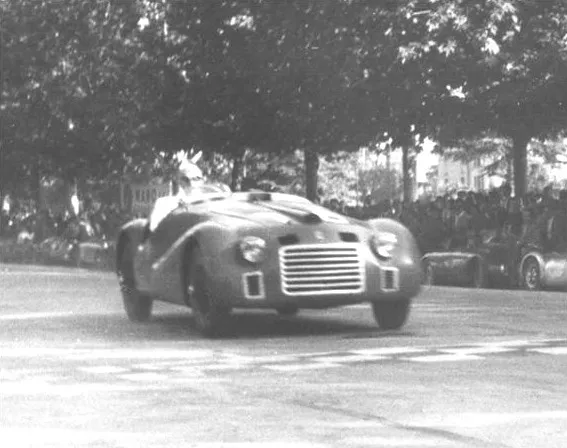
After the successful Ferrari 125 S on the race tracks, the Italian car manufacturer went even further and created the 159 S, which was an evolution of its predecessor.

Built to win races, the 159 S was produced in just two units, just like the 125 S. But there were a few details that distinguished the two models one from the other. The car didn't just have a bigger, more powerful engine. It also sported a different bodywork, albeit it relied on the same chassis.

Gioacchino Colombo was, again, responsible for designing the new model, just like the previous model. Yet, he noticed that the car needed a wider bodywork with the wheels completely covered by fenders so the driver won't get hit by dirt and small stone thrown by the front tires. While it enlarged the front fascia, Colombo also added additional air intakes in front of the car, flanking the main grille to cool the brakes. In addition, the engine compartment received more vents on the sides, behind the fenders, that extracted the heat produced by the engine. The manufacturer also noticed that the doors were not needed for such a roadster, so the 159 S didn't have any.

The cockpit could accommodate two occupants: the driver and the helper. In long-distance races, the navigator was essential for winning races. When raced on closed circuits, though, the car sported only one seat, thus reducing the vehicle's weight. The 159 S was designed and built as a race car, and the main dial on the dashboard was the tachometer placed right in front of the driver.

Colombo modified the engine from the 125 S and increased its bore and stroke, resulting in a 2-liter V12 engine. It was fed by three Webber-32DCF and produced seven more ponies than its predecessor. There were only two vehicles produced, and later on, a 159 S was transformed and evolved into the 166 S that raced at the famous Mille Miglia in Italy.

How much power does the Ferrari 159 S have?

The most powerful Ferrari 159 S trim is the 1.9 V12 5MT (125 HP) with 125 hp. The model has 1 trims, starting at 125 hp.

What is the fuel consumption of the Ferrari 159 S?

The most economical Ferrari 159 S trim is the 1.9 V12 5MT (125 HP), with a stated combined consumption of 11.5 l/100 km and — g CO2 per km.

How quickly does the Ferrari 159 S accelerate from 0 to 100 km/h?

The quickest trim is the 1.9 V12 5MT (125 HP): 0-100 km/h in 10.1 seconds, with a top speed of 220 km/h.

Other Ferrari models

Ferrari 125 S

1947 · 1 trim

Power
118 hp
0–100
11.0 s
Fuel economy
11.0

Petrol

Ferrari 195 S

1950 · 1 trim

Power
170 hp
0–100
8.0 s
Fuel economy

Petrol