
Skip to content
AD

Mercedes-Benz Model 300 (W186) (1951 - present)

Mercedes-Benz · 4 trims

Mercedes-Benz Model 300 (W186)

The Mercedes-Benz Model 300 (W186) (1951 - present) is available in 4 trims producing 115 to 125 hp. The fastest trim reaches 159 km/h. The lowest stated fuel consumption is 12.4 l/100 km.

Power
125 hp
0–100
17.0 s
Fuel economy
12.4 l/100 km
Cargo

Model 300 (W186) Trims

Compare →
Trims and engine versions — Mercedes-Benz Model 300 (W186)
Trim Fuel Power Torque 0–100 Top speed Fuel economy CO2 Select
300 a 4MT (115 HP) Petrol 115 hp 200 Nm 18.0 s 154 km/h 13.8 l/100 km 329 g/km
300 b 4MT (125 HP) Petrol 125 hp 223 Nm 17.0 s 159 km/h 12.5 l/100 km 298 g/km
300 c 4MT (125 HP) Petrol 125 hp 223 Nm 17.0 s 159 km/h 12.5 l/100 km 298 g/km
300 c Lang 4MT (125 HP) Petrol 125 hp 223 Nm 17.0 s 159 km/h 12.4 l/100 km 296 g/km

Fuel economy and CO2 follow the stated test cycle. Manufacturer figures; deviations per market and option pack are possible.

Is Mercedes-Benz Model 300 (W186) a good choice against other models?

Average across every Mercedes-Benz Model 300 (W186) trim, compared with 86 trims of other cars from the 1948–1954 period.

Is Mercedes-Benz Model 300 (W186) a good choice against other models?
Measure This model Average Position
Power 123 hp 109 hp
better than 63%
Torque 217 Nm 174 Nm
better than 73%
Top speed 158 km/h 157 km/h
better than 49%
Acceleration 0–100 km/h 17.3 s 19.3 s
better than 42%
Combined consumption 12.8 l/100 km 11.4 l/100 km
better than 21%
Unladen weight 1,800 kg 1,257 kg
better than 8%

Percentages show the share of trims from the same period this model beats on that measure. Manufacturer figures.

Not stated by the manufacturer: cargo volume. Those measures are left out of the comparison.

Comparable models from other brands

Holden Ferrari Lancia Renault Vauxhall Volvo

About Mercedes-Benz Model 300 (W186)

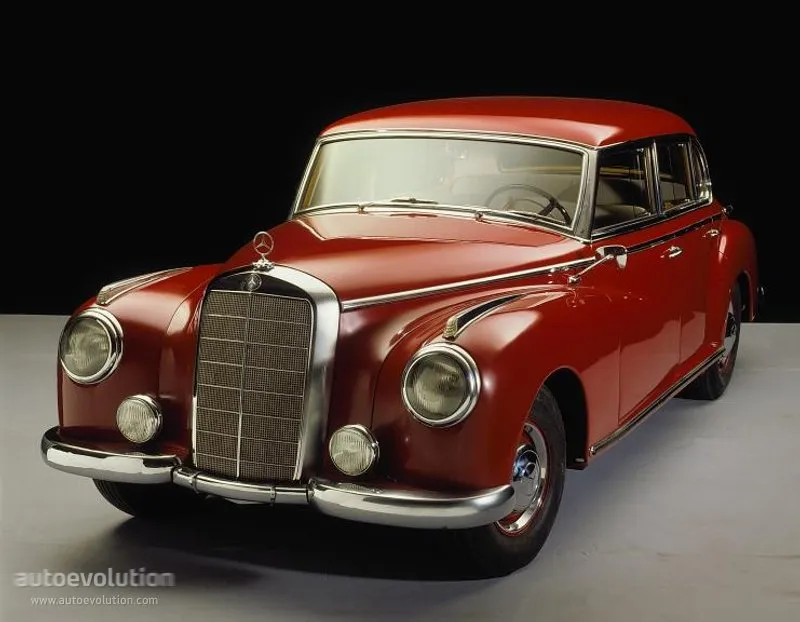
Mercedes-Benz introduced the elegant Model 300 in 1951 and quickly gained its status as a luxury vehicle, and soon became the vehicle of choice for the newly formed West Germany.

The German automaker didn't suffer the same consequences as other carmakers from Germany after WWII. Thus, it could work double-time to develop new vehicles. Thus, in 1951, it unveiled a completely new model, designed from the ground up, based on the carmaker's X-frame chassis. The car's nickname, Adenauer, came from Germany's first chancellor after the war, Konrad Adenauer, who ordered six versions of this vehicle during his time in office between 1949 and 1963.

The car's front fascia featured a tilted radiator grille flanked by wide, visually separated front fenders. On top of them, the automaker placed the turn signals just above the round headlights. Since Mercedes-Benz had already understood the importance of a protection bumper on a vehicle, it installed a chromed one at the lower side of the car's front. From its sides, the elegant Model 300 featured sculptured door panels and a long engine compartment. The cab-rearward design vehicle sported a curved, sloped-down trunk at the back.

Depending on the options, the W186 was fitted with either vinyl or leather seats inside. At the front, the carmaker placed a pair of bucket seats, while at the back installed a benchseat. The instrument cluster was very interesting, with a round, center-mounted speedometer flanked by squarish gauges mounted lower on its sides. Despite being a luxurious vehicle, it was considered a driver's car thanks to its performance and handling.

The inline-six engine was fed by two Solex carburetors and was available in a few power versions. It was mated to a four-speed, column-shifter, manual gearbox.

How much power does the Mercedes-Benz Model 300 (W186) have?

The most powerful Mercedes-Benz Model 300 (W186) trim is the 300 b 4MT (125 HP) with 125 hp. The model has 4 trims, starting at 115 hp.

What is the fuel consumption of the Mercedes-Benz Model 300 (W186)?

The most economical Mercedes-Benz Model 300 (W186) trim is the 300 c Lang 4MT (125 HP), with a stated combined consumption of 12.4 l/100 km and 296 g CO2 per km.

How quickly does the Mercedes-Benz Model 300 (W186) accelerate from 0 to 100 km/h?

The quickest trim is the 300 b 4MT (125 HP): 0-100 km/h in 17.0 seconds, with a top speed of 159 km/h.

Other Mercedes-Benz models