Skip to content
AD

Ford B-Max (2012 - present)

Ford · 6 trims

Ford B-Max

The Ford B-Max (2012 - present) is available in 6 trims producing 75 to 120 hp. The fastest trim reaches 188 km/h. The lowest stated fuel consumption is 4.0 l/100 km.

Power
120 hp
0–100
11.2 s
Fuel economy
4.0 l/100 km
Cargo
317 l

B-Max Trims

Compare →
Trims and engine versions — Ford B-Max
Trim Fuel Power Torque 0–100 Top speed Fuel economy CO2 Select
1.5L Duratorq TDCi 5MT FWD (75 HP) Diesel 75 hp 190 Nm 16.5 s 158 km/h 4.1 l/100 km 109 g/km
1.4L Duratec 5MT FWD (90 HP) Petrol 90 hp 127 Nm 13.8 s 171 km/h 6.0 l/100 km 139 g/km
1.6L Duratorq TDCi 5MT FWD (95 HP) Diesel 97 hp 216 Nm 13.9 s 172 km/h 4.0 l/100 km 104 g/km
1.0L EcoBoost 5MT FWD (100 HP) Petrol 101 hp 169 Nm 13.2 s 175 km/h 4.9 l/100 km 112 g/km
1.6L Duratec Ti-VCT 6AT FWD (105 HP) Petrol 105 hp 150 Nm 12.1 s 180 km/h 6.4 l/100 km 149 g/km
1.0L EcoBoost 5MT FWD (120 HP) Petrol 120 hp 201 Nm 11.2 s 188 km/h 4.9 l/100 km 112 g/km

Fuel economy and CO2 follow the stated test cycle. Manufacturer figures; deviations per market and option pack are possible.

Is Ford B-Max a good choice against other models?

Average across every Ford B-Max trim, compared with 7,671 trims of other cars from the 2009–2015 period.

Is Ford B-Max a good choice against other models?
Measure This model Average Position
Power 98 hp 205 hp
better than 11%
Torque 176 Nm 331 Nm
better than 16%
Top speed 174 km/h 212 km/h
better than 10%
Acceleration 0–100 km/h 13.5 s 9.1 s
better than 7%
Combined consumption 5.1 l/100 km 6.9 l/100 km
better than 73%
CO2 emissions 121 g/km 156 g/km
better than 74%
Cargo volume 317 l 469 l
better than 21%
Unladen weight 1,293 kg 1,567 kg
better than 80%

Percentages show the share of trims from the same period this model beats on that measure. Manufacturer figures.

Comparable models from other brands

Peugeot Lancia Hyundai Volkswagen BMW

About Ford B-Max

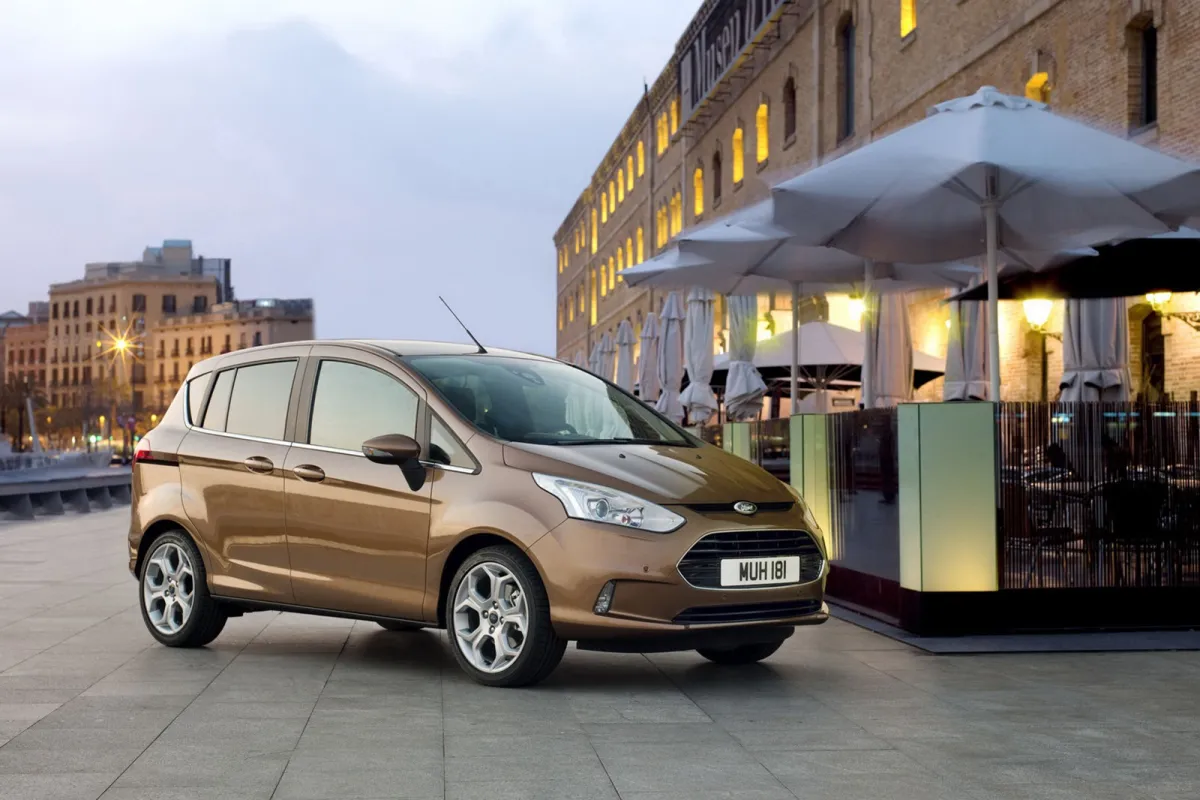
Ford tried to expand its presence into the European minivan segment with the introduction of the B-Max lineup in 2012, although its effort was in vain since it managed to sell just a little over 270,000 units in seven years, with a production that ended in 2017.

The only European automaker who enjoyed success in the MPV segment was Renault. Ford, Volkswagen, and Opel tried to compete with it but failed to impress. Then, the blue-oval brand considered that if it came with smarter solutions, it would be able to get better sales numbers. As a result, it created the B-Max based on the same platform as the B-segment, small-sized Fiesta. Despite assembling the vehicle in Romania, with lower production costs, it couldn’t convince customers that the practical minivan was a clever solution. Furthermore, the car came during an era when buyers started to look toward the crossover and SUV segment.

But the B-Max was a bold move made by Ford. By using the same platform as the Fiesta, it shared some design elements with that, including the swept-back headlights that flanked the narrow upper grille where the blue-oval badge took center stage. To conceal the car’s height and complement the necessary cooling area, the automaker installed a hexagonal-shaped lower grille that covered part of the bumper and the apron, while in the lower area, it installed side scoops for the optional fog lamps and a lip spoiler needed to enhance pedestrian protection. From its sides, the B-Max surprised customers with its rear sliding doors that greatly improved ingress and egress to the rear bench seat, especially when the front doors were opened and there was no B-post in place. The back of the car tried to mimic Fiesta’s successful look, although the tall lower panel wasn’t everybody’s cup of tea.

The cabin featured high-mounted seats, so all customers could enjoy enough legroom. In addition, the tall greenhouse provided enough headroom for five adult-sized occupants. On the dashboard, Ford created a separate area for the driver with a binocular-styled instrument cluster that featured a TFT between the speedometer and tachometer. Atop the center stack, Ford placed the screen for the infotainment system, although that was very small and hard to read while driving. Still, controls for it were easy thanks to the turning knob and the buttons that were placed underneath it. In the back, the 60/40 flat-folding seatback allowed customers to load long items, and even the front side passenger seat could fold down.

Under the hood, Ford installed a choice of turbocharged gasoline or diesel engines that sent their power to the front wheels only, just like in the Fiesta. Power ranged between 75 PS (74 hp) and 120 PS (118 hp), depending on the version.

How much power does the Ford B-Max have?

The most powerful Ford B-Max trim is the 1.0L EcoBoost 5MT FWD (120 HP) with 120 hp. The model has 6 trims, starting at 75 hp.

What is the fuel consumption of the Ford B-Max?

The most economical Ford B-Max trim is the 1.6L Duratorq TDCi 5MT FWD (95 HP), with a stated combined consumption of 4.0 l/100 km and 104 g CO2 per km.

How quickly does the Ford B-Max accelerate from 0 to 100 km/h?

The quickest trim is the 1.0L EcoBoost 5MT FWD (120 HP): 0-100 km/h in 11.2 seconds, with a top speed of 188 km/h.

How large is the cargo volume of the Ford B-Max?

The largest stated cargo volume for the Ford B-Max is 317 litres.

Other Ford models

Ford Grand C-Max

2011 - 2015 · 13 trims

Power
182 hp
0–100
8.9 s
Fuel economy
4.9

Petrol Diesel

Ford Raptor Ranger

2018 - present · 2 trims

Power
217 hp
0–100
10.5 s
Fuel economy
8.9

Petrol Diesel