Skip to content
AD

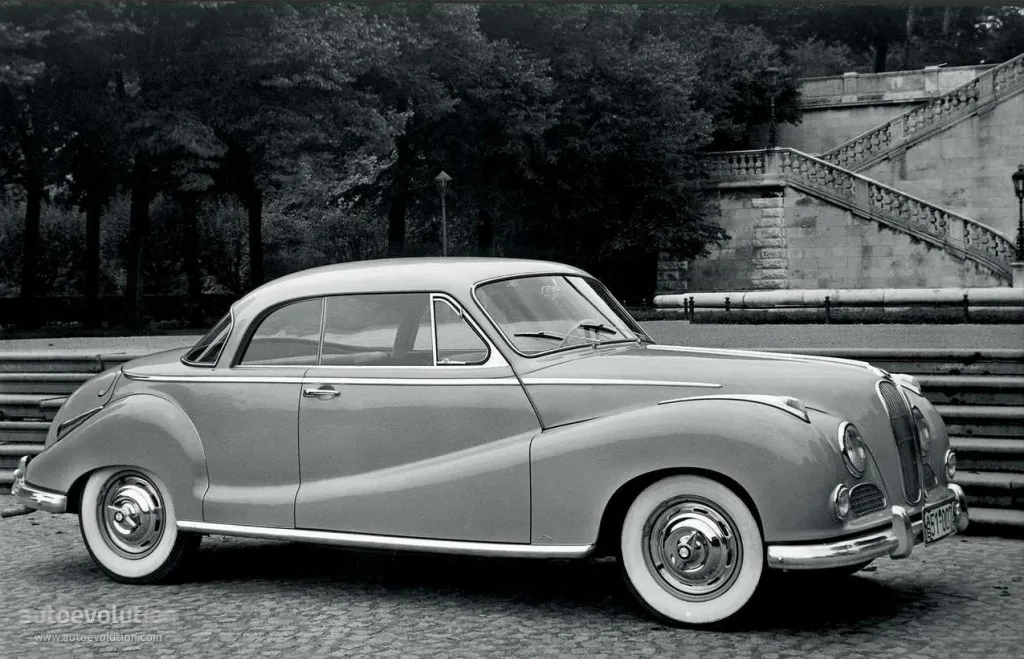
BMW 502 Coupe (1954 - 1955)

BMW · 2 trims

BMW 502 Coupe

The BMW 502 Coupe (1954 - 1955) is available in 2 trims producing 100 to 120 hp. The fastest trim reaches 171 km/h. The lowest stated fuel consumption is 12.1 l/100 km.

Power
120 hp
0–100
Fuel economy
12.1 l/100 km
Cargo

502 Coupe Trims

Compare →
Trims and engine versions — BMW 502 Coupe
Trim Fuel Power Torque 0–100 Top speed Fuel economy CO2 Select
2.6L V8 4MT (100 HP) Petrol 100 hp 180 Nm 159 km/h 12.1 l/100 km
3.2L V8 4MT (120 HP) Petrol 120 hp 209 Nm 171 km/h 12.5 l/100 km

Fuel economy and CO2 follow the stated test cycle. Manufacturer figures; deviations per market and option pack are possible.

Is BMW 502 Coupe a good choice against other models?

Average across every BMW 502 Coupe trim, compared with 110 trims of other cars from the 1951–1957 period.

Is BMW 502 Coupe a good choice against other models?
Measure This model Average Position
Power 110 hp 129 hp
better than 45%
Torque 195 Nm 203 Nm
better than 55%
Top speed 165 km/h 165 km/h
better than 51%
Combined consumption 12.3 l/100 km 12.6 l/100 km
better than 52%
Unladen weight 1,448 kg 1,287 kg
better than 31%

Percentages show the share of trims from the same period this model beats on that measure. Manufacturer figures.

Not stated by the manufacturer: acceleration 0–100 km/h, co2 emissions and cargo volume. Those measures are left out of the comparison.

Comparable models from other brands

Fiat Ford Lancia Peugeot Volkswagen Hyundai

About BMW 502 Coupe

BMW launched the 502 coupe version at the 1954 Geneva Motor Show, aiming to create a sportier variant of the previous 501 model.

Despite sharing its chassis and bodywork with the 501, this new coupe model was initially fitted with an innovative 2.6L V8 engine (built out of lightweight components) that delivered 100 hp. The engine was mated to a 4-speed manual gearbox. Later on, a 3.2L variant of this V8 unit was introduced as an option, setting a new output standard of 120 mph. The 502’s engine was the first post-war V8 powerplant.

The car's chassis was more robust and offered better ratings in terms of front/side collision, while the fuel tank was positioned in such a way that it minimized the danger of an explosion in case of an accident. Other differences to the 501 model were the exterior chrome trims and interior design as well as the obvious 2-door coupe shape, standard features such as individual front seats and fog lights.

The BMW 502 registered low sales due to its increased price, which was around four times the average salary in Germany. Both the 501 and 502 were nicknamed “Baroque Angel” due to their flowing design.

The coupe and the cabriolet models were designed by Baur, a respected coach-builder who was already acquainted with BMW’s standards as he dealt with the BMW convertibles since 1930.

Both the 501 and the 502 models were discontinued in 1958, being renamed as BMW 2.6, respectively BMW 2.6 Luxus.

How much power does the BMW 502 Coupe have?

The most powerful BMW 502 Coupe trim is the 3.2L V8 4MT (120 HP) with 120 hp. The model has 2 trims, starting at 100 hp.

What is the fuel consumption of the BMW 502 Coupe?

The most economical BMW 502 Coupe trim is the 2.6L V8 4MT (100 HP), with a stated combined consumption of 12.1 l/100 km and — g CO2 per km.

Other BMW models

BMW isetta

1955 - present · 2 trims

Power
20 hp
0–100
Fuel economy

Petrol

BMW 501/502

1952 - 1964 · 6 trims

Power
160 hp
0–100
10.0 s
Fuel economy
9.0

Petrol

BMW 1500

1962 - 1966 · 1 trim

Power
80 hp
0–100
13.5 s
Fuel economy
9.9

Petrol

BMW 3200 CS

1962 - present · 1 trim

Power
160 hp
0–100
14.0 s
Fuel economy
15.0

Petrol

BMW 2000 CS

1965 - 1969 · 1 trim

Power
120 hp
0–100
11.0 s
Fuel economy
10.9

Petrol

BMW 1600

1966 - 1975 · 1 trim

Power
84 hp
0–100
13.0 s
Fuel economy
10.0

Petrol