Skip to content
AD

BMW 1600 (1966 - 1975)

BMW · 1 trim

BMW 1600

The BMW 1600 (1966 - 1975) is available in 1 trims producing 84 to 84 hp. The fastest trim reaches 150 km/h. The lowest stated fuel consumption is 10.0 l/100 km.

Power
84 hp
0–100
13.0 s
Fuel economy
10.0 l/100 km
Cargo
600 l

1600 Trims

Compare →
Trims and engine versions — BMW 1600
Trim Fuel Power Torque 0–100 Top speed Fuel economy CO2 Select
1.6L 4MT (84 HP) Petrol 84 hp 113 Nm 13.0 s 150 km/h 10.0 l/100 km

Fuel economy and CO2 follow the stated test cycle. Manufacturer figures; deviations per market and option pack are possible.

Is BMW 1600 a good choice against other models?

Average across every BMW 1600 trim, compared with 324 trims of other cars from the 1963–1969 period.

Is BMW 1600 a good choice against other models?
Measure This model Average Position
Power 84 hp 169 hp
better than 21%
Torque 113 Nm 263 Nm
better than 17%
Top speed 150 km/h 180 km/h
better than 21%
Acceleration 0–100 km/h 13.0 s 12.3 s
better than 34%
Combined consumption 10.0 l/100 km 13.0 l/100 km
better than 64%
Cargo volume 600 l 370 l
better than 82%
Unladen weight 1,050 kg 1,281 kg
better than 68%

Percentages show the share of trims from the same period this model beats on that measure. Manufacturer figures.

Not stated by the manufacturer: co2 emissions. Those measures are left out of the comparison.

Comparable models from other brands

Tata Motors Lada Proton Maruti Suzuki Hyundai Fiat

About BMW 1600

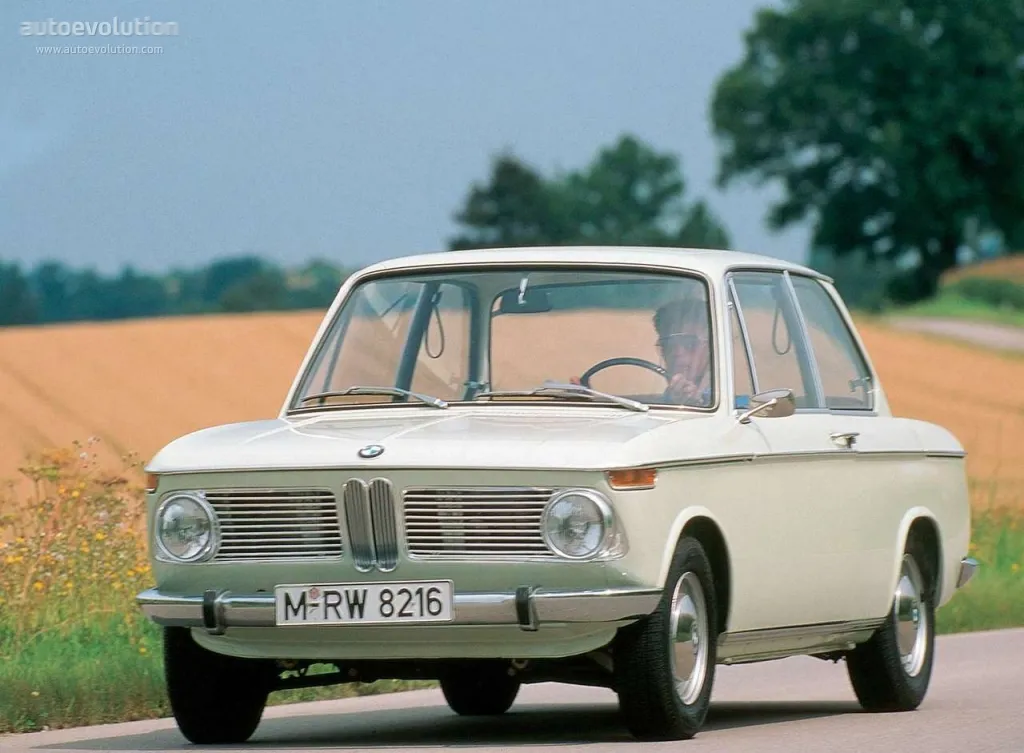
In 1966, after two years of the introduction of the “New Class Sedan” in the BMW lineup, a more affordable version was unveiled at the Geneva Motor Show: the 1600-2 coupe.

While it was known mostly as 1600, the -2 characters meant that the car featured two doors. Even if the general design concept was similar to the bigger brother 1600, it featured a different style. The lead designer was Wilhelm Hofmeister, the man responsible for that particular shape of the C-pillars in all the BMW vehicles since the mid-'60s. A Baur cabriolet version was offered to the market and in 1971 a so-called Touring version in the form of a three-door hatchback was on the sales list. The Touring was produced only a year due to its very low sales.

With a low height, a balanced design, and a tall greenhouse, the 1600 coupe was light, nimble and affordable. Its two round headlights were standard but some versions were offered with four round headlights. The interior was cramped for four occupants but offered enough room for two in the front.

The engine was taken from the 1600 model with four doors, but with a different carburetor. It was mated to a 4-speed manual gearbox. It offered only 96 hp. A year later, a new version was introduced: the 1600 TI that offered 110 hp. It was a revelation for the light, 960 kg (2,116 lbs) car. A 3-speed automatic was offered as an option. For some markets, the little 1600 received a 2.0-liter engine since 1971

How much power does the BMW 1600 have?

The most powerful BMW 1600 trim is the 1.6L 4MT (84 HP) with 84 hp. The model has 1 trims, starting at 84 hp.

What is the fuel consumption of the BMW 1600?

The most economical BMW 1600 trim is the 1.6L 4MT (84 HP), with a stated combined consumption of 10.0 l/100 km and — g CO2 per km.

How quickly does the BMW 1600 accelerate from 0 to 100 km/h?

The quickest trim is the 1.6L 4MT (84 HP): 0-100 km/h in 13.0 seconds, with a top speed of 150 km/h.

How large is the cargo volume of the BMW 1600?

The largest stated cargo volume for the BMW 1600 is 600 litres.

Other BMW models

BMW 2000 CS

1965 - 1969 · 1 trim

Power
120 hp
0–100
11.0 s
Fuel economy
10.9

Petrol

BMW 2800 CS

1968 - present · 2 trims

Power
170 hp
0–100
8.4 s
Fuel economy
11.0

Petrol

BMW 1500

1962 - 1966 · 1 trim

Power
80 hp
0–100
13.5 s
Fuel economy
9.9

Petrol

BMW 3200 CS

1962 - present · 1 trim

Power
160 hp
0–100
14.0 s
Fuel economy
15.0

Petrol

BMW 3.0 CSi

1971 - 1975 · 1 trim

Power
200 hp
0–100
7.6 s
Fuel economy
10.9

Petrol

BMW 3.0 CSL (E9)

1971 - 1975 · 3 trims

Power
205 hp
0–100
6.9 s
Fuel economy
10.9

Petrol