Skip to content
AD

BMW 3200 CS (1962 - present)

BMW · 1 trim

BMW 3200 CS

The BMW 3200 CS (1962 - present) is available in 1 trims producing 160 to 160 hp. The fastest trim reaches 200 km/h. The lowest stated fuel consumption is 15.0 l/100 km.

Power
160 hp
0–100
14.0 s
Fuel economy
15.0 l/100 km
Cargo

3200 CS Trims

Compare →
Trims and engine versions — BMW 3200 CS
Trim Fuel Power Torque 0–100 Top speed Fuel economy CO2 Select
3.2L V8 4MT (160 HP) Petrol 160 hp 240 Nm 14.0 s 200 km/h 15.0 l/100 km

Fuel economy and CO2 follow the stated test cycle. Manufacturer figures; deviations per market and option pack are possible.

Is BMW 3200 CS a good choice against other models?

Average across every BMW 3200 CS trim, compared with 184 trims of other cars from the 1959–1965 period.

Is BMW 3200 CS a good choice against other models?
Measure This model Average Position
Power 160 hp 158 hp
better than 58%
Torque 240 Nm 246 Nm
better than 57%
Top speed 200 km/h 180 km/h
better than 62%
Acceleration 0–100 km/h 14.0 s 12.3 s
better than 22%
Combined consumption 15.0 l/100 km 12.4 l/100 km
better than 19%
Unladen weight 1,500 kg 1,337 kg
better than 32%

Percentages show the share of trims from the same period this model beats on that measure. Manufacturer figures.

Not stated by the manufacturer: co2 emissions and cargo volume. Those measures are left out of the comparison.

Comparable models from other brands

Mercedes-Benz

About BMW 3200 CS

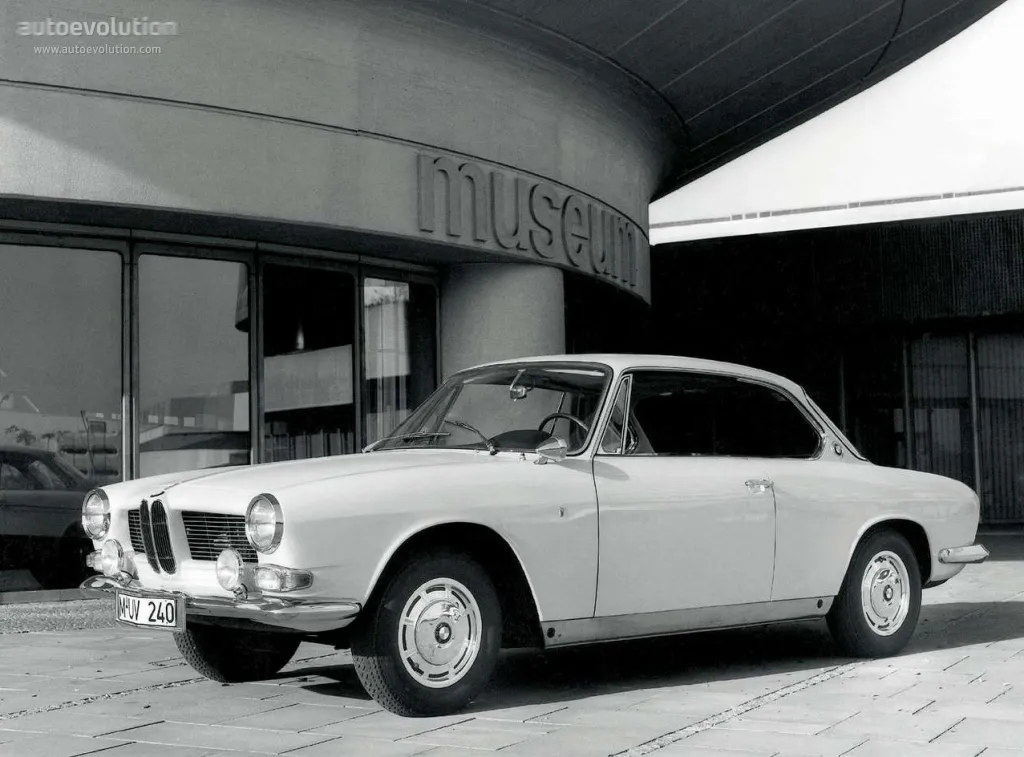
Introduced at the 1961 Frankfurt Motor Show, the BMW 3200 CS was a stunning-looking coupe built on a decade-old chassis, but nobody seemed to care about that.

The German brand needed a new design language for its cars and tried to achieve that with a sporty-looking coupe. While at first, the company's management looked at the Lancia Flaminia coupe as an inspiration, they soon ditched that idea. Instead, BMW hired Bertone studios to pen a new vehicle, and they gave them a chassis from that, which was sourced from the BMW 502 that was launched in 1951. The solution worked, and that's how the 3200 Coupe CS was born.

It was the first car that sported the famous Hofmeister kink on the C-pillar, and that was the design element that defined BMW cars for decades to come. The front fascia sported the traditional kidney grille but slimmer and shorter, flanked by thin horizontal slats. Thus, the cooling area was ensured. With its low-profile beltline and the tall greenhouse with slim pillars, the car looked light, even though it wasn't in the featherweight category. At the back, the raked-forward curved windscreen and the slightly sloped-down deck followed the elegant lines of the vehicle. Finally, the automaker installed round taillights on the rear fascia with chromed surroundings.

Inside, the automaker placed a wooden dash panel with three dials fronting the driver and an upper vinyl-trimmed area to protect it from the sun. In the center, the 3200 CS featured a radio and an ashtray. The front bucket seats were so wide that they actually formed a bench seat above the transmission tunnel, while in the back, there was room for two adults.

Under the hood, BMW installed the 3.2-liter push-rod V8 engine previously used on the 502 and 503 models paired with a four-speed manual that sent the power to the rear wheels.

How much power does the BMW 3200 CS have?

The most powerful BMW 3200 CS trim is the 3.2L V8 4MT (160 HP) with 160 hp. The model has 1 trims, starting at 160 hp.

What is the fuel consumption of the BMW 3200 CS?

The most economical BMW 3200 CS trim is the 3.2L V8 4MT (160 HP), with a stated combined consumption of 15.0 l/100 km and — g CO2 per km.

How quickly does the BMW 3200 CS accelerate from 0 to 100 km/h?

The quickest trim is the 3.2L V8 4MT (160 HP): 0-100 km/h in 14.0 seconds, with a top speed of 200 km/h.

Other BMW models

BMW 1500

1962 - 1966 · 1 trim

Power
80 hp
0–100
13.5 s
Fuel economy
9.9

Petrol

BMW 2000 CS

1965 - 1969 · 1 trim

Power
120 hp
0–100
11.0 s
Fuel economy
10.9

Petrol

BMW 1600

1966 - 1975 · 1 trim

Power
84 hp
0–100
13.0 s
Fuel economy
10.0

Petrol

BMW 2800 CS

1968 - present · 2 trims

Power
170 hp
0–100
8.4 s
Fuel economy
11.0

Petrol

BMW isetta

1955 - present · 2 trims

Power
20 hp
0–100
Fuel economy

Petrol

BMW 502 Coupe

1954 - 1955 · 2 trims

Power
120 hp
0–100
Fuel economy
12.1

Petrol