Skip to content
AD

BMW 501/502 (1952 - 1964)

BMW · 6 trims

BMW 501/502

The BMW 501/502 (1952 - 1964) is available in 6 trims producing 65 to 160 hp. The fastest trim reaches 190 km/h. The lowest stated fuel consumption is 9.0 l/100 km.

Power
160 hp
0–100
10.0 s
Fuel economy
9.0 l/100 km
Cargo

501/502 Trims

Compare →
Trims and engine versions — BMW 501/502
Trim Fuel Power Torque 0–100 Top speed Fuel economy CO2 Select
2.0L 4MT RWD (65 HP) Petrol 65 hp 130 Nm 24.0 s 135 km/h 10.0 l/100 km
2.0L 4MT RWD (72 HP) Petrol 72 hp 130 Nm 21.0 s 145 km/h 9.0 l/100 km
2.6L V8 4MT RWD (105 HP) Petrol 100 hp 180 Nm 14.0 s 166 km/h 12.5 l/100 km
3.2L V8 5MT RWD (120 HP) Petrol 120 hp 209 Nm 13.0 s 171 km/h 12.7 l/100 km
3.2L V8 Super 4MT RWD (140 HP) Petrol 140 hp 222 Nm 11.5 s 180 km/h 16.0 l/100 km
3.2L V8 S 4MT RWD (160 HP) Petrol 160 hp 240 Nm 10.0 s 190 km/h 11.7 l/100 km

Fuel economy and CO2 follow the stated test cycle. Manufacturer figures; deviations per market and option pack are possible.

Is BMW 501/502 a good choice against other models?

Average across every BMW 501/502 trim, compared with 103 trims of other cars from the 1949–1955 period.

Is BMW 501/502 a good choice against other models?
Measure This model Average Position
Power 110 hp 107 hp
better than 56%
Torque 185 Nm 178 Nm
better than 64%
Top speed 165 km/h 156 km/h
better than 62%
Acceleration 0–100 km/h 15.6 s 18.7 s
better than 51%
Combined consumption 12.0 l/100 km 11.7 l/100 km
better than 46%
Unladen weight 1,413 kg 1,244 kg
better than 26%

Percentages show the share of trims from the same period this model beats on that measure. Manufacturer figures.

Not stated by the manufacturer: co2 emissions and cargo volume. Those measures are left out of the comparison.

Comparable models from other brands

Mercedes-Benz

About BMW 501/502

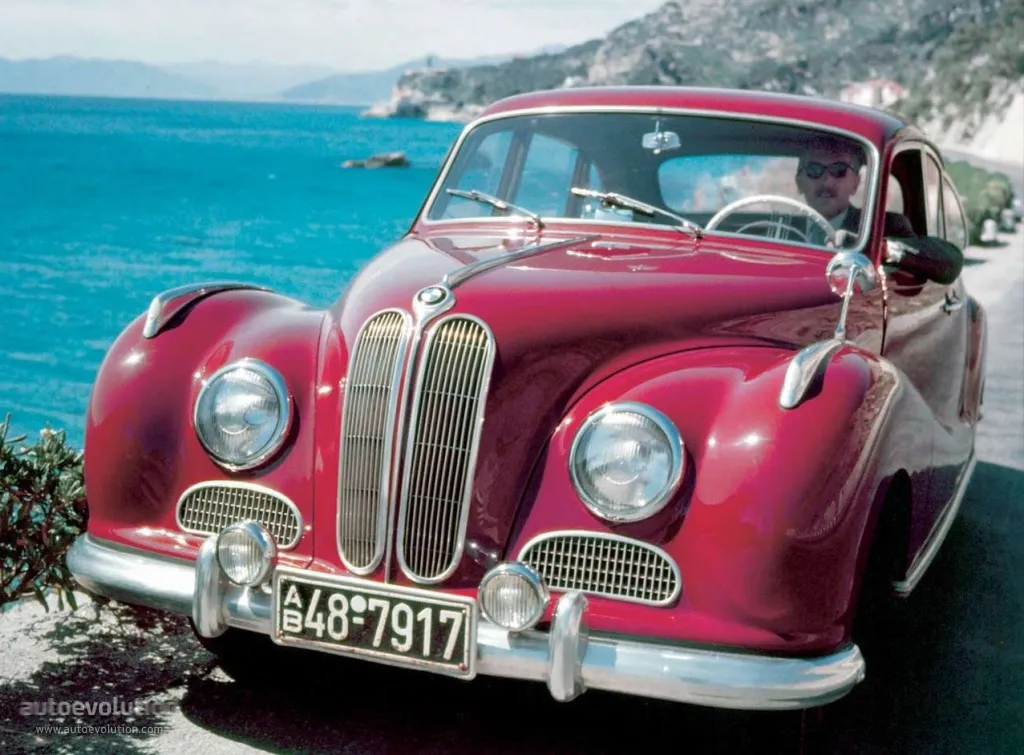
After WWII, BMW tried to make its move and return to the automotive industry. And its first model for a limousine was a big car that almost buried the brand.

The BMW 501 could be served as a lesson for trials and errors. The BMW was finally cleared to build cars, stepping up from motorcycles and mini-vehicles such as the Isetta. The company engineers dig up for former good vehicles in the library and pulled out a chassis and the engine from the pre-war model 326 and tried to make a car. The result was a heavy, baroque design, vehicle. It had the name 501 and the nickname Baroque-Angel.

The 501 was intended to be used by the new upper-class managers from Germany. The direct competitor was Mercedes-Benz. The long, flared wheel arches and the rear-hinged doors provided excellent access to the comfortable rear seats. It had a strange technical solution for the gearbox that was mounted further away from the engine. The torque was sent to that via a short drive-shaft and from there on to the rear wheels.

The price was lower than the main competitor, the Mercedes-Benz 220, but the car was ready to be delivered only in late 1952. The delay of the delivery put the BMW in a difficult financial situation. To gain the lost ground, the Munich based company installed a V8 engine under the hood in 1954 for the 502 model, which was more of a 501 version than a new model. Both cars had poor sales despite the technical quality. The price to develop the vehicles and the new V8 engine was high.

How much power does the BMW 501/502 have?

The most powerful BMW 501/502 trim is the 3.2L V8 S 4MT RWD (160 HP) with 160 hp. The model has 6 trims, starting at 65 hp.

What is the fuel consumption of the BMW 501/502?

The most economical BMW 501/502 trim is the 2.0L 4MT RWD (72 HP), with a stated combined consumption of 9.0 l/100 km and — g CO2 per km.

How quickly does the BMW 501/502 accelerate from 0 to 100 km/h?

The quickest trim is the 3.2L V8 S 4MT RWD (160 HP): 0-100 km/h in 10.0 seconds, with a top speed of 190 km/h.

Other BMW models

BMW 502 Coupe

1954 - 1955 · 2 trims

Power
120 hp
0–100
Fuel economy
12.1

Petrol

BMW isetta

1955 - present · 2 trims

Power
20 hp
0–100
Fuel economy

Petrol

BMW 1500

1962 - 1966 · 1 trim

Power
80 hp
0–100
13.5 s
Fuel economy
9.9

Petrol

BMW 3200 CS

1962 - present · 1 trim

Power
160 hp
0–100
14.0 s
Fuel economy
15.0

Petrol

BMW 2000 CS

1965 - 1969 · 1 trim

Power
120 hp
0–100
11.0 s
Fuel economy
10.9

Petrol

BMW 335

1939 - 1941 · 1 trim

Power
90 hp
0–100
Fuel economy

Petrol