
About Hyundai Venue
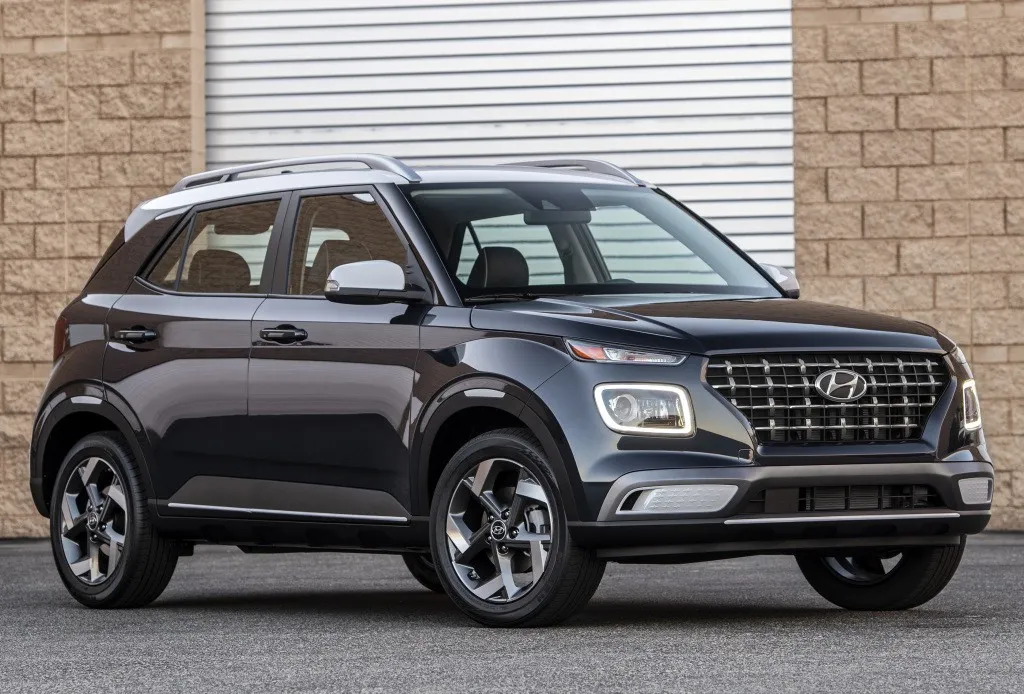
With an increasing demand for small-sized crossovers, Hyundai had to find a solution, and the answer was the 2020 Venue that the Korean automaker unveiled at the 2019 New York Auto Show.
Hyundai built the Venue on the same platform as the fifth generation of the Accent, but it added a higher ground clearance and a taller bodywork to make room for five passengers and some trunk space inside. Even if it was fitted with a two-wheel-drive system only, it managed to do well on the market thanks to its ability to climb over curbs and park in tight spots where a compact-sized vehicle wouldn’t fit. It was an adequate grocery-getter and rewarded its customers with excellent fuel efficiency.
The Venue was penned using the design-follow-function method, and that affected the exterior look of the vehicle, which was nothing to write home about. Its front fascia resembled its bigger brother, the Kona, with the headlights mounted in the bumper below the LED daytime running lights. The big cascade grille crossed by vertical and horizontal slats supported the brand’s logo. On the lower part of the bumper, the Venue sported trim that mimicked a skid plate, but it was made from plastic. A set of fake side scoops flanked the lower air intake that helped to cool the engine.
From its profile, the tall greenhouse created enough headroom for the passengers, and the roof was slightly sloped down towards the back of the vehicle. The car’s angular lines were tamed down by the curves made on the bodywork above the front and rear wheels, which were inspired by other serious off-road vehicles. In addition, at the back, the tilted forward tailgate adorned by a roof spoiler made the vehicle look bigger than it actually was. Finally, at the back, the automaker made a bumper adorned on its lower side by another silver trim that mimicked a skid plate.
Thanks to the tall greenhouse, Hyundai could install high-mounted seats for the front occupants, which allowed the rear-seated ones to slit their feet underneath for improved legroom. The driver fronted a clean-designed instrument cluster fitted with two large dials for the speedometer and tachometer, which flanked an LCD that showed data from the car’s onboard computer. In the back, the split-folding (60/40) bench seat was good enough to accommodate two adult-sized occupants and a third one between them for short jaunts. In terms of safety, Hyundai installed many advanced features that made the Venue a vehicle suited especially for the urban environment.
Under the hood, Hyundai installed a choice of four engines, depending on the market. The U.S. customers got just the spark-ignited version, while in India and other parts of the world, Hyundai offered the vehicle with a turbo diesel. Most versions sent their power to the front wheels via a six-speed manual, but a seven-speed automatic (dual-clutch) was on the options list for selected engine versions.