Skip to content
AD

Jaguar E-Pace (2017 - present)

Jaguar · 9 trims

Jaguar E-Pace

The Jaguar E-Pace (2017 - present) is available in 9 trims producing 150 to 300 hp. The fastest trim reaches 243 km/h. The lowest stated fuel consumption is 4.7 l/100 km. On the Belgian market the list price started at € 36,500 when it launched in 2017.

Price from
€ 36,500
Power
300 hp
0–100
6.4 s
Fuel economy
4.7 l/100 km
Cargo
578 l

Launch price from (2017)

€ 36,500

Most expensive regular version

€ 58,000

Belgian list price for a new car in 2017, including 21% VAT and excluding options, delivery costs and the regional registration tax (BIV). A historical guide price, not a current asking price.

E-Pace Trims

Compare →
Trims and engine versions — Jaguar E-Pace
Trim Fuel Power Torque 0–100 Top speed Fuel economy CO2 Select
D150 6MT AWD (150 HP) Diesel 150 hp 380 Nm 10.7 s 195 km/h 5.2 l/100 km 137 g/km
D150 6MT FWD (150 HP) Diesel 150 hp 380 Nm 10.1 s 200 km/h 4.7 l/100 km 124 g/km
D150 9AT AWD (150 HP) Diesel 150 hp 380 Nm 10.5 s 193 km/h 5.6 l/100 km 147 g/km
D180 6MT AWD (180 HP) Diesel 180 hp 430 Nm 9.9 s 208 km/h 5.2 l/100 km 137 g/km
D180 9AT AWD (180 HP) Diesel 180 hp 430 Nm 9.3 s 204 km/h 5.6 l/100 km 147 g/km
P200 9AT AWD (200 HP) Petrol 200 hp 340 Nm 8.2 s 216 km/h 8.2 l/100 km 186 g/km
D240 9AT AWD (240 HP) Diesel 240 hp 500 Nm 7.4 s 224 km/h 6.2 l/100 km 162 g/km
P250 9AT AWD (250 HP) Petrol 250 hp 365 Nm 7.0 s 230 km/h 7.7 l/100 km 174 g/km
P300 9AT AWD (300 HP) Petrol 300 hp 400 Nm 6.4 s 243 km/h 8.0 l/100 km 181 g/km

Fuel economy and CO2 follow the stated test cycle. Manufacturer figures; deviations per market and option pack are possible.

Is Jaguar E-Pace a good choice against other models?

Average across every Jaguar E-Pace trim, compared with 6,476 trims of other cars from the 2014–2020 period.

Is Jaguar E-Pace a good choice against other models?
Measure This model Average Position
Power 200 hp 228 hp
better than 59%
Torque 401 Nm 364 Nm
better than 73%
Top speed 213 km/h 217 km/h
better than 53%
Acceleration 0–100 km/h 8.8 s 8.4 s
better than 45%
Combined consumption 6.3 l/100 km 6.6 l/100 km
better than 42%
CO2 emissions 155 g/km 146 g/km
better than 30%
Cargo volume 578 l 500 l
better than 81%
Unladen weight 1,837 kg 1,615 kg
better than 22%

Percentages show the share of trims from the same period this model beats on that measure. Manufacturer figures.

Comparable models from other brands

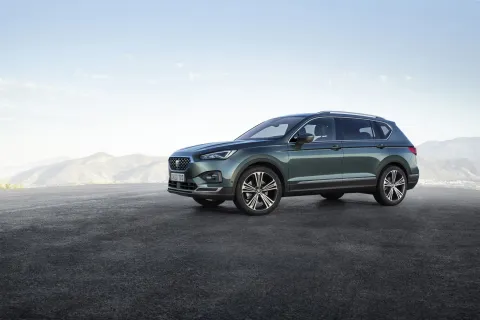
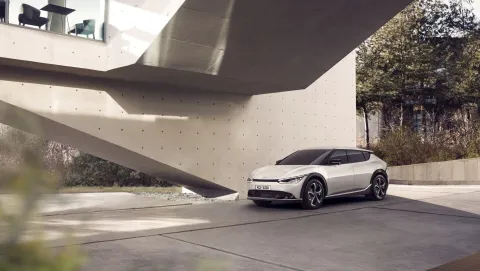
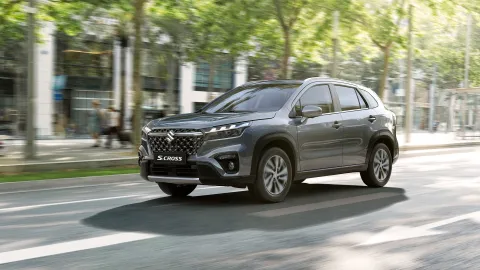
Cupra Škoda SEAT Kia Suzuki

About Jaguar E-Pace

In 2017 Jaguar introduced the E-Pace crossover as a smaller sibling to the F-Pace and shared its underpinnings with the Land Rover Range Rover Evoque.

While at first sight, it didn't look like a good idea for Jaguar to offer an SUV or a crossover in its lineup, sales proved that misconception wrong. Sure, the brand's hard-core fans didn't want to look at it, but new customers stormed Jaguar's showrooms. Finally, the British brand had a car to compete against its main German rivals, the Q3 from Audi, the X1 from BMW, and the GLA from Mercedes-Benz.

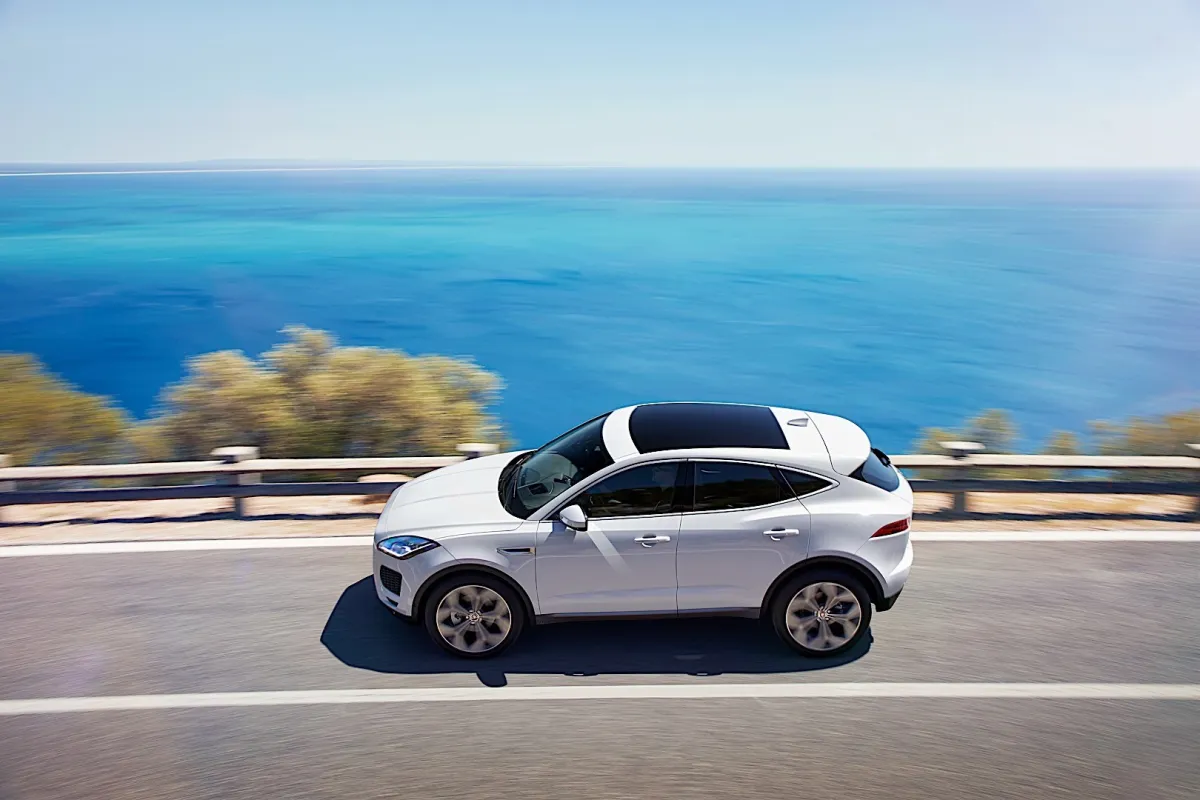
Even though it was based on the same platform as other Land Rover products, the car's exterior, brilliantly designed by Ian Callum, didn't show that. Moreover, the E-Pace's lines resembled those from the F-Type coupe with the swept-back, organic-shaped headlights that flanked the main broad grille. Lower, on the bumper, Jaguar added a pair of side scoops and a second grille in the apron. From its profile, the E-Pace revealed a coupe-like shaped greenhouse with a raked-forward tailgate at the back adorned by a roof spoiler. Furthermore, the taillights resembled those from the F-Type.

Inside, the car's luxurious cabin boasted a pair of bolstered front seats at the front and a bench seat out back. In addition, the center stack housed the infotainment touchscreen, while the driver fronted a binnacle with large dials for the speedometer and tachometer in individual clusters that flanked an LCD between them. On the center stack, the automaker placed the touchscreen for the infotainment system, which unfortunately didn't feature Android Auto or Apple CarPlay.

Under the hood, Jaguar installed a range of inline-four engines, either gasoline or diesel depending on the market. All of them were turbocharged, and most versions were fitted with an all-wheel drive system.

What did the Jaguar E-Pace cost new?

On the Belgian market the Jaguar E-Pace started at € 36,500 when it launched in 2017, rising to € 58,000 for the most expensive regular trim. This is the list price for that model year, not a current asking price.

How much power does the Jaguar E-Pace have?

The most powerful Jaguar E-Pace trim is the P300 9AT AWD (300 HP) with 300 hp. The model has 9 trims, starting at 150 hp.

What is the fuel consumption of the Jaguar E-Pace?

The most economical Jaguar E-Pace trim is the D150 6MT FWD (150 HP), with a stated combined consumption of 4.7 l/100 km and 124 g CO2 per km.

How quickly does the Jaguar E-Pace accelerate from 0 to 100 km/h?

The quickest trim is the P300 9AT AWD (300 HP): 0-100 km/h in 6.4 seconds, with a top speed of 243 km/h.

How large is the cargo volume of the Jaguar E-Pace?

The largest stated cargo volume for the Jaguar E-Pace is 578 litres.

Other Jaguar models

Jaguar XJR575

2017 - present · 1 trim

Power
575 hp
0–100
4.4 s
Fuel economy
11.1

Jaguar I-PACE

2018 - present · 1 trim

Power
394 hp
0–100
4.6 s
Fuel economy

Electric

Jaguar XJ220

1992 - 1994 · 1 trim

Power
542 hp
0–100
3.6 s
Fuel economy

Petrol

Jaguar XJR15

1990 - 1992 · 1 trim

Power
450 hp
0–100
3.3 s
Fuel economy

Petrol