About Kia Joice
After a year since Hyundai bought it, Kia introduced the Joice as a seven-seat minivan aimed at the European market, trying to get a spot into its new customers’ hearts.
Before being bought by Hyundai, Kia’s presence in Europe was unimportant. Its products co-developed with Ford and Mazda didn’t enjoy too much success. Still, Hyundai had its plans, and they worked well after it purchased the almost-bankrupt Kia automaker. Among the first steps, it did as its new parent company was to create badge-engineered products such as the Joice, which shared its underpinnings with the Santamo MPV made by Hyundai using a Mitsubishi platform. Even though the Joice was not that successful, it convinced enough customers with an attractive price and enough standard features to make it a bargain in its segment.
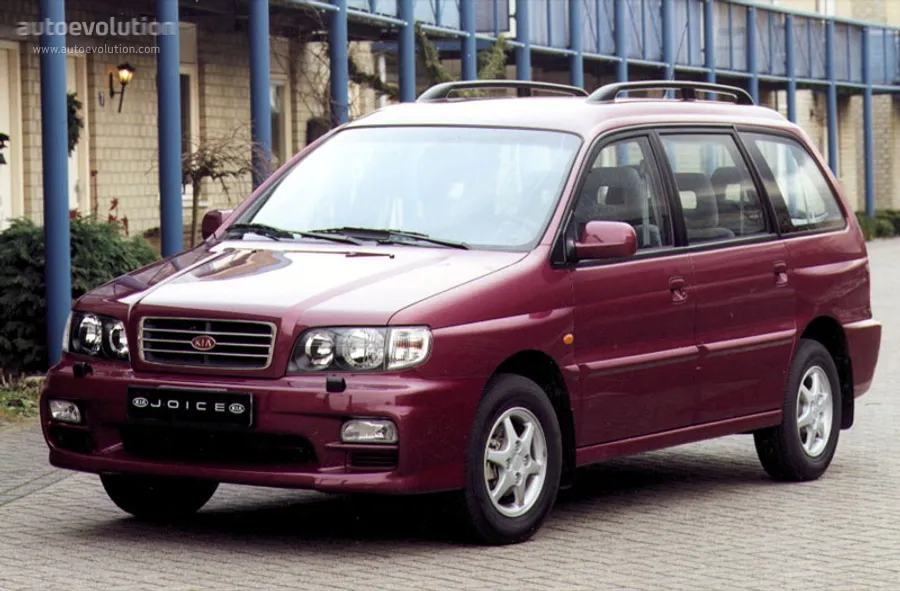
Kia didn’t have very experienced car designers in its company, so the Joice was more of a vehicle shaped to serve a purpose, not to be attractive. The car’s front fascia featured rectangular headlights and a grille that followed some styling ideas from the mid-80s. Lower, on the apron, the automaker installed an aggressive bumper that incorporated an air intake that helped to cool the engine and a set of fog lamps.
From its profile, the Joice looked like it had an overhang that was too long due to the new extended bumper. Its almost flat hood and raked windshield didn’t impress with its design. But still, there were some lines that showed some interest from the styling team, such as the blackened B- and C-posts and the wide windows for everybody. In addition, a third set of fixed glass areas was installed between the C-pillars and the tailgate. Finally, at the back, the slightly tilted forward rear end was adorned by the corner-mounted taillights and a low cut into the bumper for the tailgate.
Inside, the Joice could accommodate up to seven people on its three rows of seats. At the front, the automaker installed two bucket seats, while the middle row featured a split folding bench seat fit for three adults. At the same time, the rearmost row was tiny and offered enough room just for children on the individual folding seats. The driver fronted a simple instrument panel where the speedometer took center stage and was flanked on the right by the tachometer and on its left by the fuel level and coolant temperature gauges. On the center stack, the automaker installed the HVAC controls and a CD stereo. At the same time, between the seats, a tiny center console housed the gear stick and the handbrake.
Under the hood, the 1999 Joice had a two-liter inline-four powerplant carried over from Hyundai. Kia offered the Joice with either a five-speed manual or a four-speed automatic that sent the power to the front wheels only.