Skip to content
AD

Lotus Excel (1982 - 1992)

Lotus · 2 trims

Lotus Excel

The Lotus Excel (1982 - 1992) is available in 2 trims producing 162 to 183 hp. The fastest trim reaches 206 km/h.

Power
183 hp
0–100
Fuel economy
Cargo
371 l

Excel Trims

Compare →
Trims and engine versions — Lotus Excel
Trim Fuel Power Torque 0–100 Top speed Fuel economy CO2 Select
2.2L 5MT RWD (162 HP) Petrol 162 hp 217 Nm 206 km/h
2.2L 4AT RWD (183 HP) Petrol 183 hp 224 Nm 200 km/h

Fuel economy and CO2 follow the stated test cycle. Manufacturer figures; deviations per market and option pack are possible.

Is Lotus Excel a good choice against other models?

Average across every Lotus Excel trim, compared with 877 trims of other cars from the 1979–1985 period.

Is Lotus Excel a good choice against other models?
Measure This model Average Position
Power 173 hp 119 hp
better than 86%
Torque 221 Nm 182 Nm
better than 74%
Top speed 203 km/h 180 km/h
better than 79%
Cargo volume 371 l 462 l
better than 32%
Unladen weight 1,156 kg 1,178 kg
better than 48%

Percentages show the share of trims from the same period this model beats on that measure. Manufacturer figures.

Not stated by the manufacturer: acceleration 0–100 km/h, combined consumption and co2 emissions. Those measures are left out of the comparison.

Comparable models from other brands

Alfa Romeo Honda Caterham BMW Ford Zender

About Lotus Excel

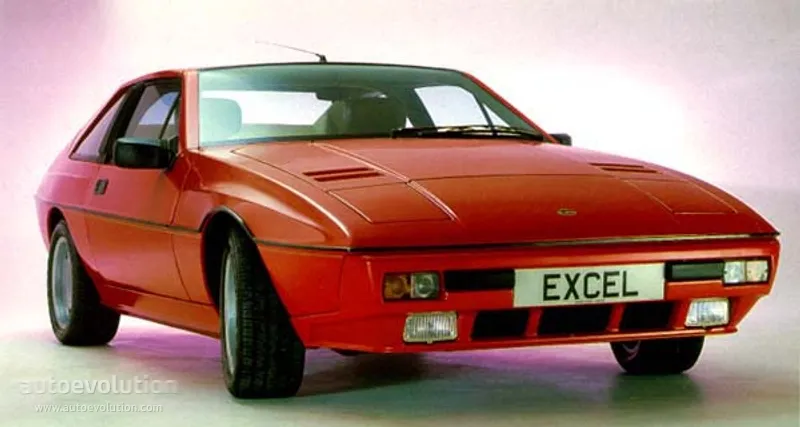
Lotus unveiled the Excel in 1982, and it was a turning point for the British sportscar maker, with a great impact on its following models.

When Peter Stevens designed the Excel, he could only hope for the car's success for a decade. Lotus's idea was simple: design a beautiful body, use a great suspension to keep the car planted on the road, and drop a reliable engine inside. The theory was right, and it worked for some time. But every rose has its thorns, and every Lotus had its weaknesses on the reliability factor.

On the outside, Excel couldn't hide too much its connections with the Lotus Eclat. The car's front side looked the same with the pop-up headlights and the flat, sharp nose. Its lower bumper area featured a few air-intakes, the turn-signals, and the stationary lamps. It was the rear part of the vehicle that made the Excel different than the Eclat. Its taillights were still mounted low in the bumper, but they were bigger. A big wing-spoiler almost killed the rear-view for the driver due to its size. But it didn't matter as long as the car's exterior look better.

Inside, it was as cramped as its predecessor. It could actually fit four people inside, as long as they were not above the average height.

The biggest difference between the Eclat and Excel was under the bodywork. After signing an agreement with Toyota, the British carmaker got the five-speed manual transmission and brakes from Supra, plus broader, lower rear wishbones. The chassis was galvanized.

How much power does the Lotus Excel have?

The most powerful Lotus Excel trim is the 2.2L 4AT RWD (183 HP) with 183 hp. The model has 2 trims, starting at 162 hp.

How large is the cargo volume of the Lotus Excel?

The largest stated cargo volume for the Lotus Excel is 371 litres.

Other Lotus models

Lotus Esprit

1976 - 2004 · 11 trims

Power
355 hp
0–100
4.9 s
Fuel economy

Petrol

Lotus 2 Eleven

2007 - 2015 · 1 trim

Power
256 hp
0–100
3.9 s
Fuel economy
10.7

Petrol

Lotus Evija

2020 - present · 1 trim

Power
2,000 hp
0–100
3.0 s
Fuel economy

Electric