Skip to content
AD

Mercedes-Benz 500 E (W124) (1991 - 1993)

Mercedes-Benz · 2 trims

Mercedes-Benz 500 E (W124)

The Mercedes-Benz 500 E (W124) (1991 - 1993) is available in 2 trims producing 320 to 326 hp. The fastest trim reaches 250 km/h. The lowest stated fuel consumption is 13.5 l/100 km.

Power
326 hp
0–100
6.1 s
Fuel economy
13.5 l/100 km
Cargo
484 l

500 E (W124) Trims

Compare →
Trims and engine versions — Mercedes-Benz 500 E (W124)
Trim Fuel Power Torque 0–100 Top speed Fuel economy CO2 Select
5.0L V8 4AT RWD (320 HP) Petrol 320 hp 470 Nm 6.1 s 250 km/h 14.9 l/100 km
5.0L V8 4AT RWD (326 HP) Petrol 326 hp 480 Nm 6.1 s 250 km/h 13.5 l/100 km

Fuel economy and CO2 follow the stated test cycle. Manufacturer figures; deviations per market and option pack are possible.

Is Mercedes-Benz 500 E (W124) a good choice against other models?

Average across every Mercedes-Benz 500 E (W124) trim, compared with 2,172 trims of other cars from the 1988–1994 period.

Is Mercedes-Benz 500 E (W124) a good choice against other models?
Measure This model Average Position
Power 323 hp 135 hp
better than 98%
Torque 475 Nm 202 Nm
better than 98%
Top speed 250 km/h 192 km/h
better than 95%
Acceleration 0–100 km/h 6.1 s 11.7 s
better than 95%
Combined consumption 14.2 l/100 km 8.8 l/100 km
better than 4%
Cargo volume 484 l 444 l
better than 73%
Unladen weight 1,710 kg 1,277 kg
better than 9%

Percentages show the share of trims from the same period this model beats on that measure. Manufacturer figures.

Not stated by the manufacturer: co2 emissions. Those measures are left out of the comparison.

Comparable models from other brands

BMW Rolls-Royce Maserati Mazda Infiniti

About Mercedes-Benz 500 E (W124)

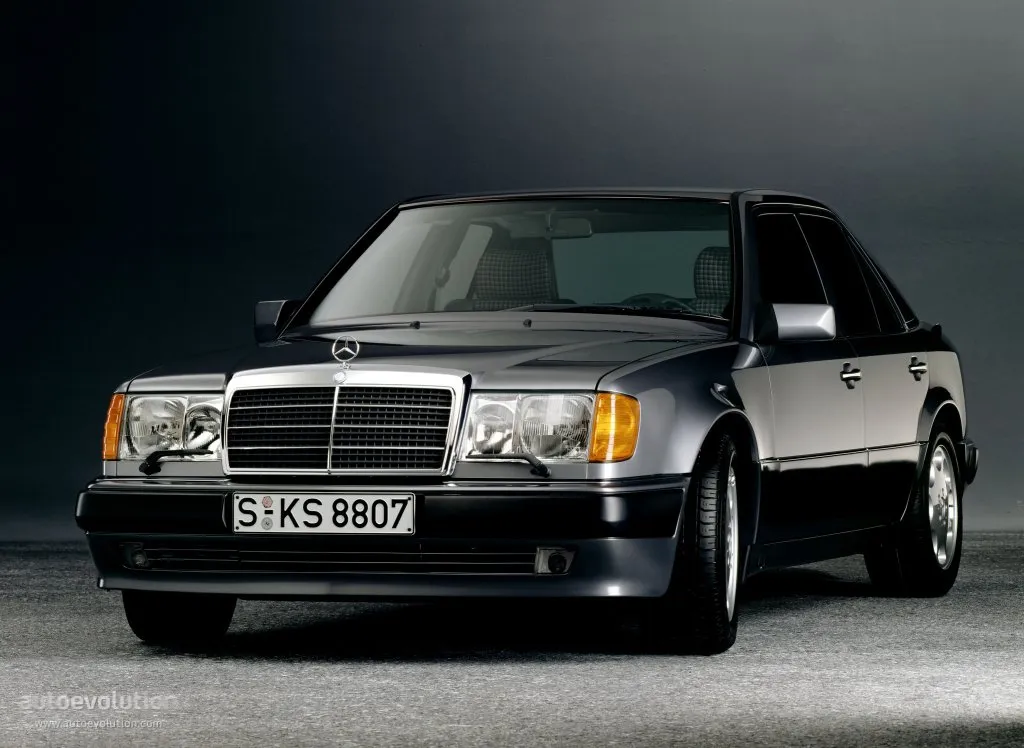
The 500 E from Mercedes-Benz was one of the first attempts to tackle the performance luxury sedan segment. It appeared in 1991 and it was developed and built by Porsche in its factory, in Zuffenhausen. It was the first 4-door vehicle built in the Porsche factory, long before the Panamera was even on the marketing list.

The short story is that Mercedes-Benz board had decided to built a performance vehicle out of the well-known W124 E-Class. It took the biggest engine, a 5.0-liter V8, and somehow installed it in the engine bay. But to do this the engine bay had to be enlarged. As a consequence, the front track and the whole car was wider by 56 mm (2.2”) compared to a 300 E. To keep the outside look of the vehicle and cut costs, the car had almost the same body panels except from the front, where the wheel-arches were flared.

Inside, the car had many luxury features such as automatic climate control, an electrically adjustable right side-mirror, dual airbags and an advances sound system that could be fitted with a CD-changer.

From the technical point of view, the engine was mated to a 4-speed automatic gearbox that had a winter program, when the snow-chains were installed. This program told the car to start directly in the second gear instead of first. The brakes were upgraded to support the heavy vehicle. The 500 E was heavier than a 300 E by around 380 kg (837.7 lbs).

How much power does the Mercedes-Benz 500 E (W124) have?

The most powerful Mercedes-Benz 500 E (W124) trim is the 5.0L V8 4AT RWD (326 HP) with 326 hp. The model has 2 trims, starting at 320 hp.

What is the fuel consumption of the Mercedes-Benz 500 E (W124)?

The most economical Mercedes-Benz 500 E (W124) trim is the 5.0L V8 4AT RWD (326 HP), with a stated combined consumption of 13.5 l/100 km and — g CO2 per km.

How quickly does the Mercedes-Benz 500 E (W124) accelerate from 0 to 100 km/h?

The quickest trim is the 5.0L V8 4AT RWD (320 HP): 0-100 km/h in 6.1 seconds, with a top speed of 250 km/h.

How large is the cargo volume of the Mercedes-Benz 500 E (W124)?

The largest stated cargo volume for the Mercedes-Benz 500 E (W124) is 484 litres.

Other Mercedes-Benz models