About Opel Ampera-e
Opel unveiled the Ampera-e at the 2016 Paris Motor Show, and the car became an instant hit in some European countries when the sales started the following year.
GM approached the EV market differently after the Chevrolet Volt/Opel Ampera experience. It ditched the internal combustion engine, installed new batteries and motors, and created a whole new platform for the following chapter in its electrification program. The result was the Chevrolet Bolt in the U.S. and the Opel/Vauxhall Ampera in Europe. At the same time, other EV makers, such as Tesla, were gaining big chunks of the electric car market, and competition was fierce. However, things went in a different way for the 2017 Opel Ampera-e. After the European arm of GM was bought by the French automaker PSA (Peugeot-Citroen) in 2017, the two automakers agreed to have the Ampera-e supplied to Europe by GM. That arrangement didn’t last too long, and in late 2019, Opel didn’t extend the contract, selling only the remaining vehicles in its stock in 2020.
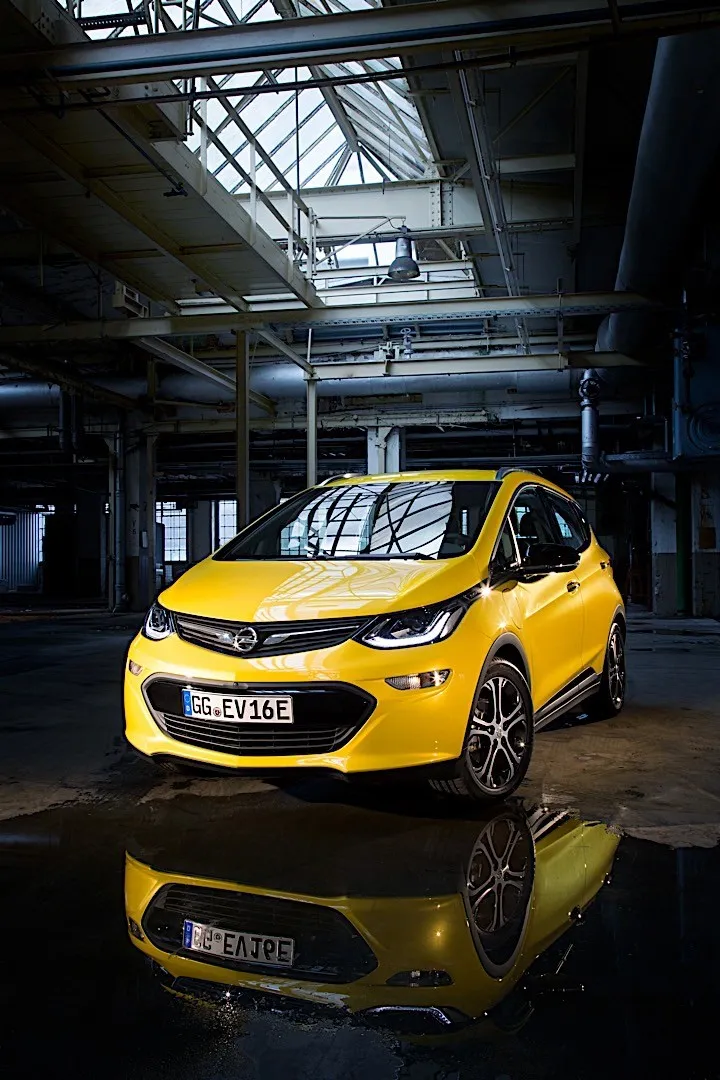
Opel had a different design language than its owner, GM, when it unveiled the 2017 Ampera-e. The car’s front fascia had a visor-shaped grille between the swept-back headlight that flanked it. Lower, on the bumper, the automaker added a black plastic trim that looked like an air intake, even though it wasn’t. It was flanked on its upper area by the parking lights. Overall, Opel tried to make the Ampera-e look like a domestic, city-oriented vehicle with no aggressive styling or performance-oriented details.
From its profile, the minivan-shaped subcompact hatchback revealed its intentions as a daily companion for the urban commute. Its tall doors and greenhouse, the generous window area, and the ascending beltline were made for those looking for a spacious family vehicle. However, the 2017 Opel Ampera-e had some design touches that made it look a little bit more special than most other cars in the segment. For instance, it featured a black trim that visually connected the headlights with the A-pillars, while at the back, the shiny black piece of decoration mounted on the C-posts created a floating roof aspect. Despite the black trims around the wheel arches and the alloy wheels, the car was not a crossover. Finally, at the back, the automaker added horizontal taillights extended from the rear quarter panels onto the tailgate. A roof spoiler completed the vehicle’s aerodynamics. It wasn’t there just for the looks but to lower drag resistance and help with the car’s range.
Inside, the design was not as wild as in the Opel Ampera. It still featured two screens, one for the instrument panel and the other for the infotainment system, but provided a more spacious feeling. Its high-mounted seats were almost flat and didn’t provide side support during cornering. After all, it was a city vehicle, not a hot hatch. In the back, there was enough room for three adults thanks to the flat floor. GM noticed that the T-shaped battery compartment from the previous Volt/Ampera took up too much space in the cabin.
Under its skin, the 2017 Opel Ampera concealed a 204 PS (201 hp) electric motor that drove the front wheels only. It was fed by a 60 kWh battery pack placed under the cabin and integrated into the vehicle’s floor. Its 288 cells provided enough juice for up to 520 km (323 miles) of travel before it needed recharging. It could be replenished at fast chargers with up to 50 kW DC. However, thanks to the 360 Nm (266 lb-ft) torque, it could sprint from naught to 100 kph (0-62 mph) in 7.3 seconds, which was already in the hot-hatch territory.