About Toyota Picnic
While in the U.S., the minivan segment was highly appreciated in Europe and other parts of the world, not that much, but still, Toyota considered that it might get some slice of the market when it made the 1996 Picnic.
Based on the same platform as the Toyota Avensis, the Picnic tried to convince customers that it’s a better car than a regular station wagon and could perform just as well in terms of driving experience. But when the car arrived in Europe, it had to face stiff competition from Volkswagen Sharan, Fiat Ulysse, Ford Galaxy, and Renault Espace, to name just a few. The Japanese minivan began its life in 1995 in Japan as the Ipsum and reached export markets in the following year but with a few significant upgrades, such as a turbo-diesel.
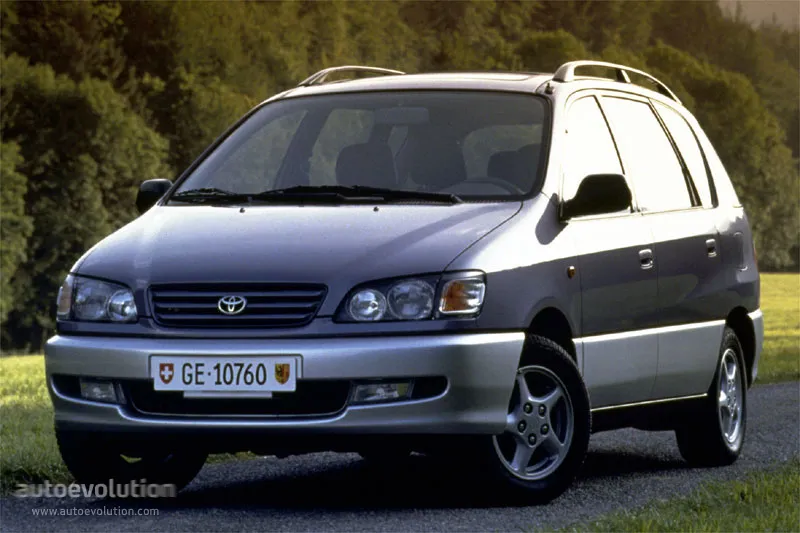
At the front, the Picnic’s front fascia showed car-like headlights with black accents inside. Its corner-mounted blinkers sported amber lenses and were not integrated into the headlamps. Between them, the automaker installed the main grille adorned by three horizontal slats and the Toyota’s badge in the middle. The Picnic sported a light-gray color on the lower bumper, featuring fog lamps and a broad lower air intake that helped cool the engine. While it didn’t look as tall as other MPVs, its roof sat higher than regular station wagons.
Toyota penned the car with a tall greenhouse with a generous window area. The hood was angled-up compared to a regular station wagon and was followed by a panoramic windshield. Surprisingly, the automaker made the car with body-colored door handles but black door mirrors. A unique detail of the vehicle on the MPV segment was on the rear side, where the automaker installed a raked C-pillar. As a result, the Picnic showed a wrap-around glass area formed by the third row of windows, the rear windscreen, and the darkened D-posts.
Inside, the Picnic boasted three rows of seats, with room for up to seven people. The dashboard had a car-like design with a rounded visor for the instrument cluster. On the center stack, Toyota placed the HVAC controls and the stereo. As an option, customers could get a sat-nav system. The high-mounted bucket seats at the front were comfortable, designed for long travels, and with minimal side support. For the second row, the bench seat occupants could enjoy the folding tables installed on the back of the front seat’s backrests, while the third row was mainly made for children since it offered limited legroom or headroom.
Toyota offered the Picnic with a choice of two engines, a two-liter gasoline and a 2.2-liter turbo-diesel. The former was paired with a five-speed manual or a four-speed automatic, while the latter was mated to a five-speed manual only.