Skip to content
AD

Toyota Rukus (2007 - present)

Toyota · 1 trim

Toyota Rukus

The Toyota Rukus (2007 - present) is available in 1 trims producing 185 to 185 hp. The fastest trim reaches 200 km/h. The lowest stated fuel consumption is 8.8 l/100 km.

Power
185 hp
0–100
Fuel economy
8.8 l/100 km
Cargo
309 l

Rukus Trims

Compare →
Trims and engine versions — Toyota Rukus
Trim Fuel Power Torque 0–100 Top speed Fuel economy CO2 Select
2.4L VVT-i 4AT (185 HP) Petrol 185 hp 224 Nm 200 km/h 8.8 l/100 km

Fuel economy and CO2 follow the stated test cycle. Manufacturer figures; deviations per market and option pack are possible.

Is Toyota Rukus a good choice against other models?

Average across every Toyota Rukus trim, compared with 7,820 trims of other cars from the 2004–2010 period.

Is Toyota Rukus a good choice against other models?
Measure This model Average Position
Power 185 hp 189 hp
better than 63%
Torque 224 Nm 300 Nm
better than 33%
Top speed 200 km/h 208 km/h
better than 42%
Combined consumption 8.8 l/100 km 7.9 l/100 km
better than 29%
Cargo volume 309 l 477 l
better than 22%
Unladen weight 1,390 kg 1,508 kg
better than 63%

Percentages show the share of trims from the same period this model beats on that measure. Manufacturer figures.

Not stated by the manufacturer: acceleration 0–100 km/h and co2 emissions. Those measures are left out of the comparison.

Comparable models from other brands

Mercedes-Benz Suzuki BMW Oldsmobile

About Toyota Rukus

Toyota tried to introduce a cheaper sub-brand under its umbrella, the Scion. Still, soon after, it died killed by the 2008 world economic crisis's after-effects.

The Scion xB was not very successful on the market, but since it used the same platform as the Toyota Corolla/Auris, it was easy to build by the Japanese carmaker. In 2007, due to high demands for spacious, but small, hatchbacks on several markets, it introduced the Rukus.

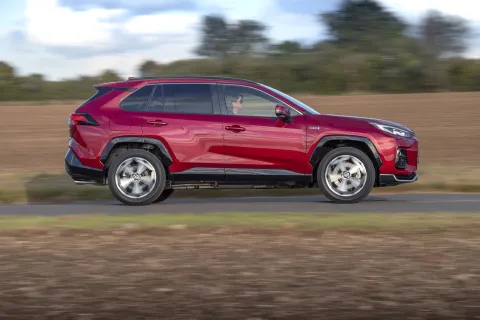
Basically, the Rukus was a re-badged Scion xB with a different front bumper, hood, and badge. The high-roof, boxy, appearance was needed to offer enough interior room. In the back, the flat and vertical tailgate was cut around the taillights.

Since the car featured a short wheelbase, the designers had to put higher seats for all passengers to provide enough legroom and headroom. The dashboard was flat and narrow, with the instrument cluster placed in the middle. Their design mimicked an inline-four engine, with separate clusters for the dials and the digital speedometer. The car featured an infotainment unit with a sat-nav system that was installed above the center stack, closer to the passenger than to the driver.

Toyota installed a 2.4-liter, naturally aspirated engine under the Rukus's hood. It was paired as standard to a 4-speed automatic gearbox that sent the power to the front wheels. It was the only option available.

How much power does the Toyota Rukus have?

The most powerful Toyota Rukus trim is the 2.4L VVT-i 4AT (185 HP) with 185 hp. The model has 1 trims, starting at 185 hp.

What is the fuel consumption of the Toyota Rukus?

The most economical Toyota Rukus trim is the 2.4L VVT-i 4AT (185 HP), with a stated combined consumption of 8.8 l/100 km and — g CO2 per km.

How large is the cargo volume of the Toyota Rukus?

The largest stated cargo volume for the Toyota Rukus is 309 litres.

Other Toyota models

Toyota iQ

2009 - present · 5 trims

Power
98 hp
0–100
11.6 s
Fuel economy
4.0

Petrol Diesel

Toyota Verso-S

2010 - present · 4 trims

Power
99 hp
0–100
12.1 s
Fuel economy
4.3

Petrol Diesel

Toyota Alphard

2002 - 2007 · 3 trims

Power
220 hp
0–100
Fuel economy

Petrol Hybrid