Skip to content
AD

Mercedes-Benz Coupe (C123) (1977 - 1985)

Mercedes-Benz · 6 trims

Mercedes-Benz Coupe (C123)

The Mercedes-Benz Coupe (C123) (1977 - 1985) is available in 6 trims producing 110 to 185 hp. The fastest trim reaches 200 km/h. The lowest stated fuel consumption is 10.5 l/100 km.

Power
185 hp
0–100
Fuel economy
10.5 l/100 km
Cargo
501 l

Coupe (C123) Trims

Compare →
Trims and engine versions — Mercedes-Benz Coupe (C123)
Trim Fuel Power Torque 0–100 Top speed Fuel economy CO2 Select
230 C 4MT RWD (110 HP) Petrol 110 hp 185 Nm
230 CE 4AT RWD (136 HP) Petrol 136 hp 205 Nm 180 km/h 10.5 l/100 km
230 CE 4MT RWD (136 HP) Petrol 136 hp 205 Nm 180 km/h 10.5 l/100 km
280 C 4MT RWD (158 HP) Petrol 158 hp 223 Nm
280 CE 4AT RWD 185 HP) Petrol 185 hp 240 Nm 200 km/h 12.0 l/100 km
280 CE 4MT RWD (185 HP) Petrol 185 hp 240 Nm 200 km/h 12.0 l/100 km

Fuel economy and CO2 follow the stated test cycle. Manufacturer figures; deviations per market and option pack are possible.

Is Mercedes-Benz Coupe (C123) a good choice against other models?

Average across every Mercedes-Benz Coupe (C123) trim, compared with 464 trims of other cars from the 1974–1980 period.

Is Mercedes-Benz Coupe (C123) a good choice against other models?
Measure This model Average Position
Power 152 hp 128 hp
better than 72%
Torque 216 Nm 195 Nm
better than 68%
Top speed 190 km/h 178 km/h
better than 70%
Combined consumption 11.3 l/100 km 10.7 l/100 km
better than 30%
Cargo volume 501 l 416 l
better than 79%
Unladen weight 1,417 kg 1,300 kg
better than 32%

Percentages show the share of trims from the same period this model beats on that measure. Manufacturer figures.

Not stated by the manufacturer: acceleration 0–100 km/h and co2 emissions. Those measures are left out of the comparison.

Comparable models from other brands

Oldsmobile Suzuki BMW Toyota Zender

About Mercedes-Benz Coupe (C123)

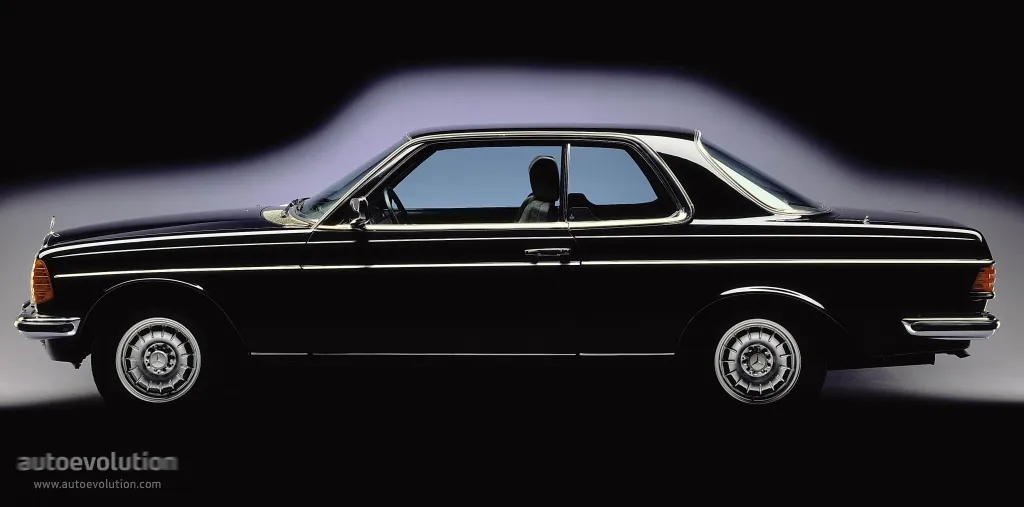
The W123 E-Class was a huge success and, in 1977, a coupe version was introduced to replace the previous middle-size segment of the sporty-look vehicle. Even though it wasn't that sporty.

Unlike the previous generation, the W123 E-Class coupe had a shorter wheelbase than the four-door sedan with 85 mm (3.3”). This modification allowed a better design for the car. The removal of the C-pillar allowed the body to look like a convertible with the roof up. That type of bodywork had the “fake-cabriolet” name. It had a lot of parts in common with the four-door sedan and that ease the logistics and spare-parts department.

Inside, there was enough room for four adults, even if those in the rear couldn't be very happy on a long journey. The instrument cluster had three big dials with an unusual layout. One dial had three gauges, in the middle it was the speedometer and on the right, it was a big regular analog clock, but no tachometer. The car featured either a 4-speed manual or a 4-speed automatic transmission.

Over the years it had different engines, starting with a 2.3-liter carburetor engine, but ended up with fuel-injected units only. A particular diesel version was made for the U.S. It was a 300 CD model that offered 80 hp. The bizarre model was built to help Mercedes-Benz to achieve “corporate average fuel economy”. By adjusting the injection system, the engine produced 88 hp. It was replaced in 1981 by a turbodiesel unit with the same 3.0-liter displacement, but it offered 125 hp.

By the end of production time in 1985, a total of 99884 units were produced, from which 15509 were diesel.

How much power does the Mercedes-Benz Coupe (C123) have?

The most powerful Mercedes-Benz Coupe (C123) trim is the 280 CE 4AT RWD 185 HP) with 185 hp. The model has 6 trims, starting at 110 hp.

What is the fuel consumption of the Mercedes-Benz Coupe (C123)?

The most economical Mercedes-Benz Coupe (C123) trim is the 230 CE 4AT RWD (136 HP), with a stated combined consumption of 10.5 l/100 km and — g CO2 per km.

How large is the cargo volume of the Mercedes-Benz Coupe (C123)?

The largest stated cargo volume for the Mercedes-Benz Coupe (C123) is 501 litres.

Other Mercedes-Benz models