About Suzuki Kizashi
Suzuki was known as one of the biggest automakers of small-sized cars and SUVs and tried its luck in the mid-size sports sedan segment when it launched the Kizashi in 2009 as an all-wheel-drive, no-nonsense, affordable vehicle.
Whether it was bad timing or lack of brand awareness in the segment, the Kizashi was met with stiff resistance by the market. Unfortunately for the Japanese brand, those were the years of the world financial crisis that ruined some automakers and crippled others. Still, Suzuki was determined to keep its mid-size sedan on the market and tried to sell it on all continents. The introduction of new Euro 6 emission standards in Europe, the brand’s withdrawal from the American and Canadian markets in 2013 and 2014, and the lack of a wide choice of engines made this vehicle go down sooner than expected. In 2014, Suzuki pulled the plug on this model and didn’t have a successor.
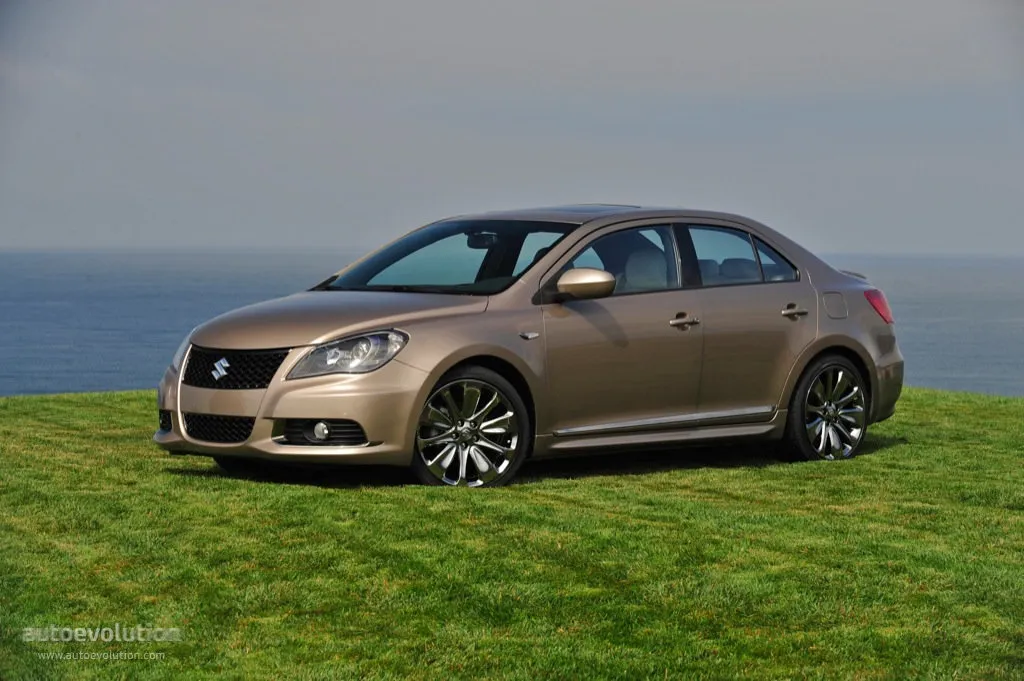
Suzuki tried to create a sporty-looking vehicle and installed an aggressive front fascia for the Kizashi, dominated by the split grille and the broad, wrap-around headlights. The lower apron was split into three sections where. The center one was for cooling, and those from the sides housed the fog lamps. From its profile, the vehicle showed its fluid lines that followed the new-edge design concept. Its ascending waistline and arched roofline created an airy interior, while at the back, the automaker made a short deck adorned by a small, integrated wing on the trunk’s lid. From behind, the triangular-shaped chromed tips concealed the actual exhausts.
While the automaker was not experienced in creating mid-size sedans, it knew a lot about cabins. It used that to create a decently designed one with clean lines and soft materials that covered the dashboard, the door cards, and the armrest. In front of the driver, the Kizashi sported an instrument cluster with large dials for the speedometer and the rev counter that flanked an LCD. In addition, two small gauges for the fuel level and water temperature were integrated into the speedometer and tachometer’s dials, respectively. The upscale feeling was amplified by the leather-covered steering wheel and the Rockford-Fosgate sound system mounted on the center stack.
The bolstered front seats provided enough comfort for long travels, and they were also available with heating. In the back, the bench seat could accommodate up to three passengers, although the legroom for the middle-seated one was obstructed by the tall transmission tunnel that crossed the car from front to back. The 60/40 split-folding seatback from the bench seat could expand the 462-liter (16.3 cu-ft) trunk space. Depending on the market and grade, the Kizashi greeted its customers with leather seats, power windows, multiple airbags, and a sunroof.
Under the hood, Suzuki installed a 2.4-liter four-banger carried over from the Vitara but enhanced to produce 185 hp (188 PS) for the six-speed manual version, while the CVT was slightly detuned to 180 hp (182 PS). Power went in all corners via an electronically controlled all-wheel-drive system.