
Skip to content
AD

Suzuki Baleno (2016 - present)

Suzuki · 4 trims

Suzuki Baleno

The Suzuki Baleno (2016 - present) is available in 4 trims producing 90 to 111 hp. The fastest trim reaches 200 km/h. The lowest stated fuel consumption is 4.0 l/100 km. On the Belgian market the list price started at € 15,500 when it launched in 2016.

Price from
€ 15,500
Power
111 hp
0–100
11.0 s
Fuel economy
4.0 l/100 km
Cargo
354 l

Launch price from (2016)

€ 15,500

Most expensive regular version

€ 21,000

Belgian list price for a new car in 2016, including 21% VAT and excluding options, delivery costs and the regional registration tax (BIV). A historical guide price, not a current asking price.

Baleno Trims

Compare →
Trims and engine versions — Suzuki Baleno
Trim Fuel Power Torque 0–100 Top speed Fuel economy CO2 Select
1.2L DUALJET 5MT FWD (90 HP) Petrol 90 hp 120 Nm 12.3 s 180 km/h 4.2 l/100 km 98 g/km
1.2L DUALJET SHVS 5MT FWD (90 HP) Hybrid 90 hp 120 Nm 12.3 s 180 km/h 4.0 l/100 km 94 g/km
1.0L BOOSTERJET 5MT FWD (111 HP) Petrol 111 hp 170 Nm 11.4 s 200 km/h 4.5 l/100 km 105 g/km
1.0L BOOSTERJET 6AT FWD (111 HP) Petrol 111 hp 170 Nm 11.0 s 190 km/h 4.9 l/100 km 115 g/km

Fuel economy and CO2 follow the stated test cycle. Manufacturer figures; deviations per market and option pack are possible.

Is Suzuki Baleno a good choice against other models?

Average across every Suzuki Baleno trim, compared with 7,147 trims of other cars from the 2013–2019 period.

Is Suzuki Baleno a good choice against other models?
Measure This model Average Position
Power 101 hp 221 hp
better than 10%
Torque 145 Nm 355 Nm
better than 7%
Top speed 188 km/h 216 km/h
better than 22%
Acceleration 0–100 km/h 11.8 s 8.6 s
better than 14%
Combined consumption 4.4 l/100 km 6.6 l/100 km
better than 82%
CO2 emissions 103 g/km 145 g/km
better than 89%
Cargo volume 354 l 495 l
better than 24%
Unladen weight 980 kg 1,607 kg
better than 97%

Percentages show the share of trims from the same period this model beats on that measure. Manufacturer figures.

Comparable models from other brands

Hyundai Mini Peugeot Volkswagen Mazda

About Suzuki Baleno

In the spring of 2016, Suzuki launched the Baleno hatchback on the European market. Even though it wasn't a new name for the Japanese brand, the car tried to offer compact-class room in small class size.

Suzuki was well known as a big manufacturer for small cars. He tried to upscale its models but it didn't succeed. Its main products were the little Swift, the small off-roader Jimny and, of course, the Grand Vitara SUV. A car that it wasn't that grand, but it was a well received SUV by the market. How about the Baleno? Was it enough for the market?

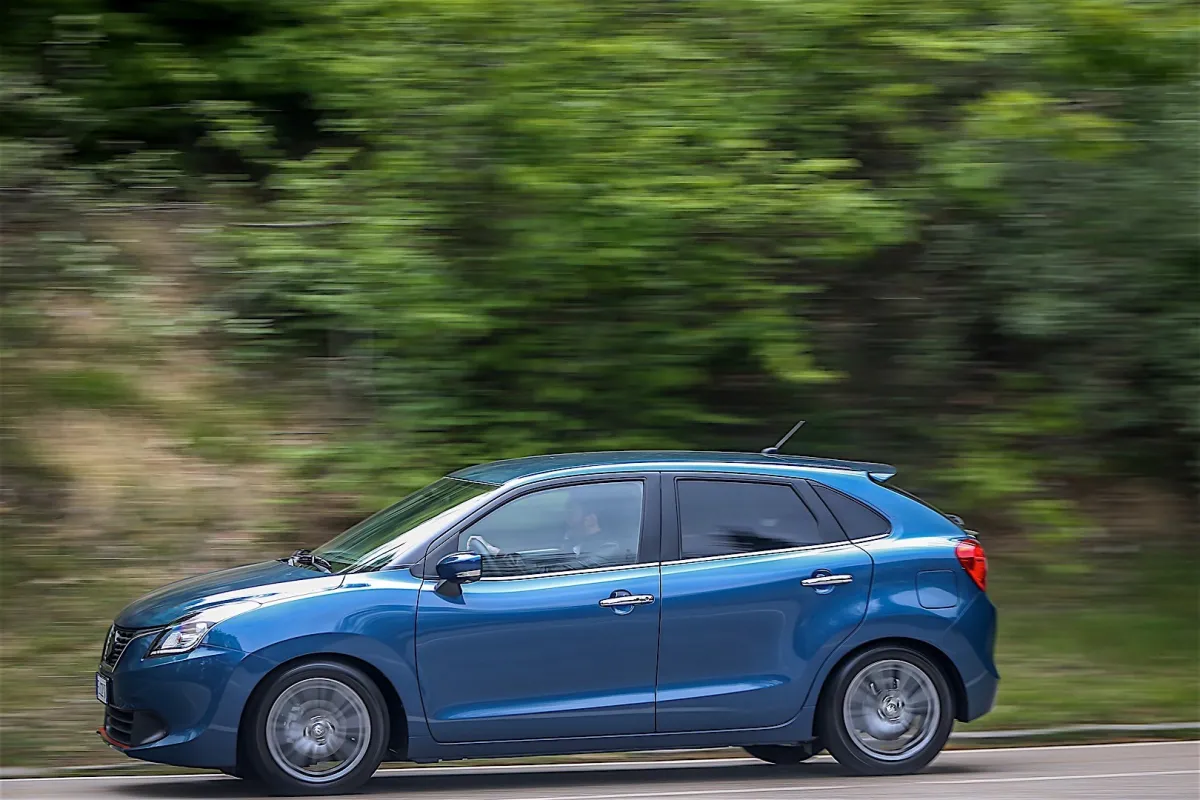
From the outside, the Baleno featured a small grille between two bigger headlights. The front fascia was rather flat than raked. The A-pillars though were a different story. They had to be raked to give a sportier look of the car. From the side, the Baleno was a mix between a small-class hatchback and a small-class SUV.

Despite its overall length that was on the small-class size, the interior room was big. Its trunk was large enough to compete in the compact-class. The rear seats could have been folded in a 60:40 split way. In the front, the Baleno featured a 7” infotainment system on the dashboard and a 4.2” display between the dials in the instrument cluster.

The Baleno was available with two engine choices, both with gasoline. Both were mated to a standard 5-speed manual. A 6-speed automatic was available as an option for the top version.

What did the Suzuki Baleno cost new?

On the Belgian market the Suzuki Baleno started at € 15,500 when it launched in 2016, rising to € 21,000 for the most expensive regular trim. This is the list price for that model year, not a current asking price.

How much power does the Suzuki Baleno have?

The most powerful Suzuki Baleno trim is the 1.0L BOOSTERJET 5MT FWD (111 HP) with 111 hp. The model has 4 trims, starting at 90 hp.

What is the fuel consumption of the Suzuki Baleno?

The most economical Suzuki Baleno trim is the 1.2L DUALJET SHVS 5MT FWD (90 HP), with a stated combined consumption of 4.0 l/100 km and 94 g CO2 per km.

How quickly does the Suzuki Baleno accelerate from 0 to 100 km/h?

The quickest trim is the 1.0L BOOSTERJET 6AT FWD (111 HP): 0-100 km/h in 11.0 seconds, with a top speed of 190 km/h.

How large is the cargo volume of the Suzuki Baleno?

The largest stated cargo volume for the Suzuki Baleno is 354 litres.

Other Suzuki models

Suzuki Across

2020 - present · 1 trim

Power
185 hp
0–100
Fuel economy

Hybrid

Suzuki Ertiga

2012 - present · 3 trims

Power
95 hp
0–100
Fuel economy

Petrol Diesel

Suzuki Swace

2020 - present · 1 trim

Power
102 hp
0–100
11.1 s
Fuel economy

Hybrid

Suzuki Kizashi

2010 - present · 5 trims

Power
185 hp
0–100
7.8 s
Fuel economy
7.9

Petrol

Suzuki S-Cross

2022 - present · 6 trims

Power
129 hp
0–100
9.5 s
Fuel economy
5.2

Hybrid

Suzuki XL7

2007 - 2009 · 2 trims

Power
252 hp
0–100
9.5 s
Fuel economy
11.2

Petrol