Skip to content
AD

Volkswagen Santana (1982 - 1985)

Volkswagen · 6 trims

Volkswagen Santana

The Volkswagen Santana (1982 - 1985) is available in 6 trims producing 54 to 116 hp. The fastest trim reaches 183 km/h.

Power
116 hp
0–100
Fuel economy
Cargo
501 l

Santana Trims

Compare →
Trims and engine versions — Volkswagen Santana
Trim Fuel Power Torque 0–100 Top speed Fuel economy CO2 Select
1.6L D 4MT FWD (60 HP) Diesel 54 hp 100 Nm 140 km/h
1.3L 4MT FWD (60 HP) Petrol 60 hp 100 Nm 148 km/h
1.6L TD 5MT FWD (71 HP) Diesel 71 hp 133 Nm 154 km/h
1.6L 4MT FWD (75 HP) Petrol 75 hp 125 Nm 159 km/h
1.8L 4MT FWD (90 HP) Petrol 90 hp 145 Nm 169 km/h
2.0L 5MT FWD (116 HP) Petrol 116 hp 165 Nm 183 km/h

Fuel economy and CO2 follow the stated test cycle. Manufacturer figures; deviations per market and option pack are possible.

Is Volkswagen Santana a good choice against other models?

Average across every Volkswagen Santana trim, compared with 873 trims of other cars from the 1979–1985 period.

Is Volkswagen Santana a good choice against other models?
Measure This model Average Position
Power 78 hp 119 hp
better than 27%
Torque 128 Nm 183 Nm
better than 27%
Top speed 159 km/h 180 km/h
better than 25%
Cargo volume 501 l 461 l
better than 67%
Unladen weight 1,017 kg 1,180 kg
better than 63%

Percentages show the share of trims from the same period this model beats on that measure. Manufacturer figures.

Not stated by the manufacturer: acceleration 0–100 km/h, combined consumption and co2 emissions. Those measures are left out of the comparison.

Comparable models from other brands

Renault Lancia Citroën Toyota Dacia

About Volkswagen Santana

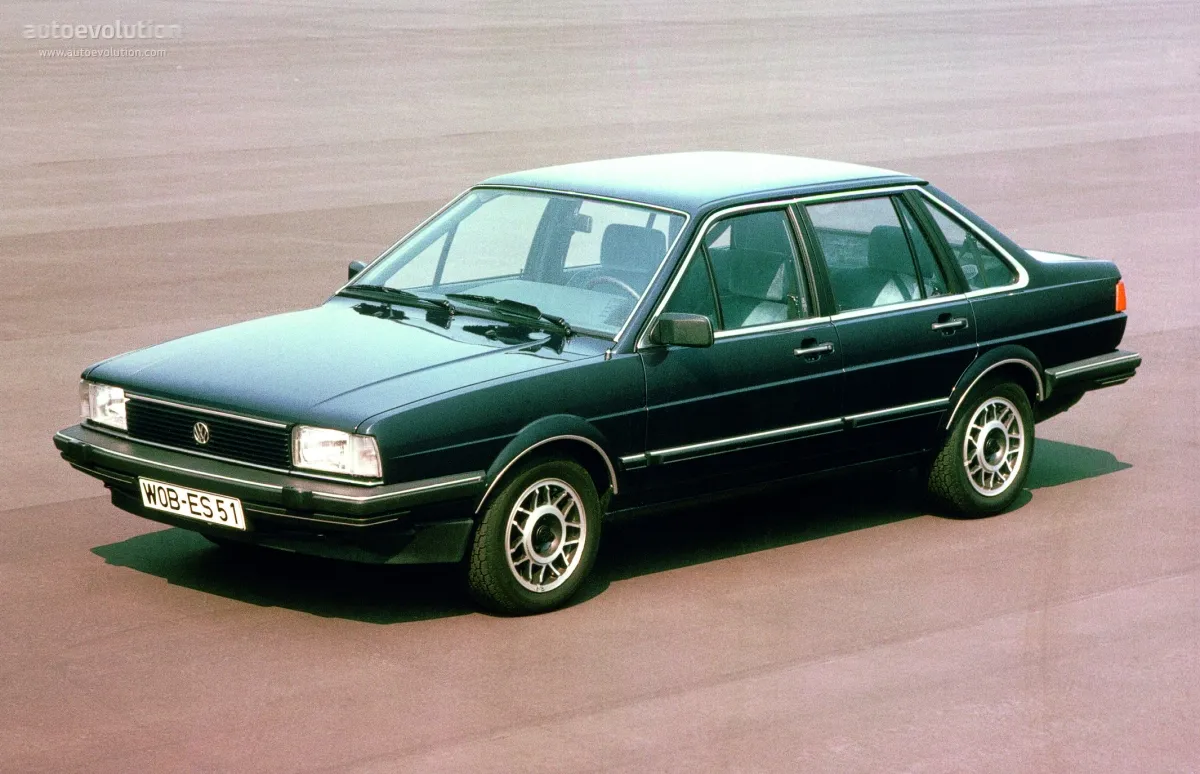
In 1982, Volkswagen introduced the Santana model for specific markets, but it was more of a badge-engineered Passat B2, with small differences.

The German carmaker saw the opportunity to use specific names for specific markets. In Spanish and Portuguese-speaking countries, the name was easier to remember than the Passat. That's why in South America, Volkswagen kept the nameplate for longer times. It was also used for vehicles built in 1983 at the SAIC (Shanghai Tractor Automobile Corporation) in China.

Its angular lines, the big rectangular headlights, and the plastic bumper were a fresh look on the market. The three-box sedan version was not the most popular on the market, but it was considered an excellent middle-management vehicle thanks to its roomy interior. Soon, it became popular for families as well.

Inside, Volkswagen installed two large dials on the dashboard for the speedometer and tachometer in the angular instrument cluster and two smaller gauges for fuel and coolant temperatures. There was an area with ten lights for turn signals, hazard, oil pressure, parking brakes, and a few other warning lights in the middle.

Volkswagen offered the Passat a wide choice of engines, both diesel and gasoline. Its long-range autonomy, of over 1000 km (623 miles), made it one of the most cost-effective cars on the market. Its reliability and low running costs increased over the years.

How much power does the Volkswagen Santana have?

The most powerful Volkswagen Santana trim is the 2.0L 5MT FWD (116 HP) with 116 hp. The model has 6 trims, starting at 54 hp.

How large is the cargo volume of the Volkswagen Santana?

The largest stated cargo volume for the Volkswagen Santana is 501 litres.

Other Volkswagen models

Volkswagen Derby

1977 - 1981 · 2 trims

Power
60 hp
0–100
12.9 s
Fuel economy
8.2

Petrol

Volkswagen 2020

Unknown · 11 trims

Power
245 hp
0–100
8.5 s
Fuel economy

Petrol Diesel Hybrid

Volkswagen Fox

2005 - 2009 · 3 trims

Power
75 hp
0–100
13.0 s
Fuel economy
4.9

Petrol Diesel