Skip to content
AD

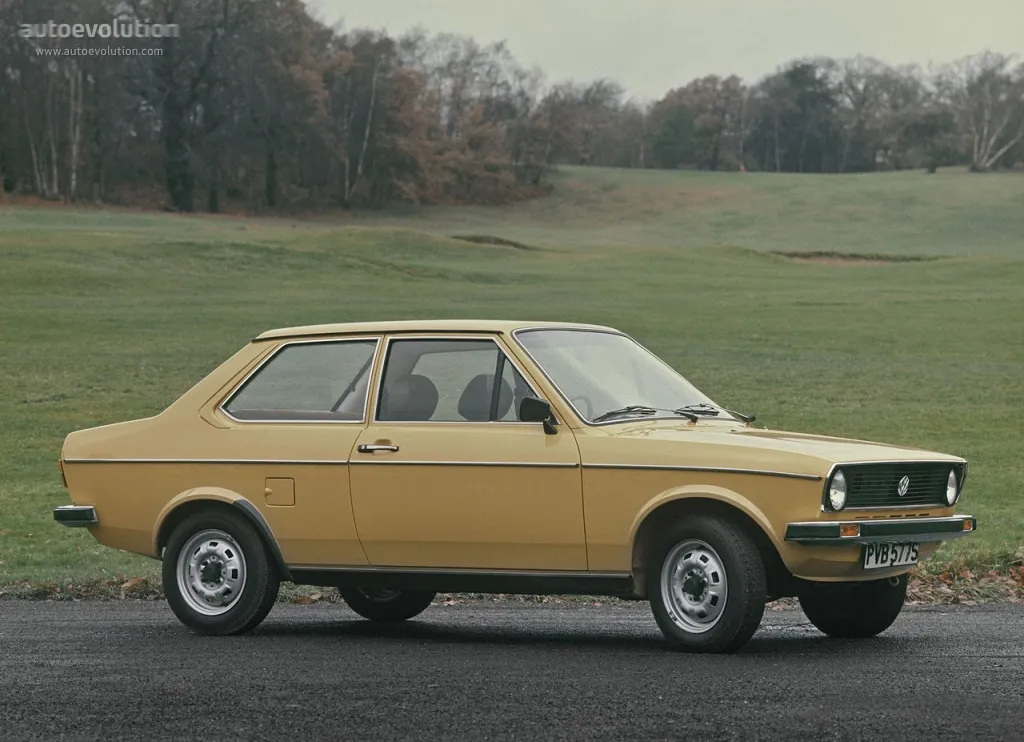
Volkswagen Derby (1977 - 1981)

Volkswagen · 2 trims

Volkswagen Derby

The Volkswagen Derby (1977 - 1981) is available in 2 trims producing 50 to 60 hp. The fastest trim reaches 154 km/h. The lowest stated fuel consumption is 8.2 l/100 km.

Power
60 hp
0–100
12.9 s
Fuel economy
8.2 l/100 km
Cargo
425 l

Derby Trims

Compare →
Trims and engine versions — Volkswagen Derby
Trim Fuel Power Torque 0–100 Top speed Fuel economy CO2 Select
1.1L 4MT (50 HP) Petrol 50 hp 76 Nm 15.4 s 145 km/h 8.2 l/100 km
1.3L 4MT (60 HP) Petrol 60 hp 93 Nm 12.9 s 154 km/h 8.3 l/100 km

Fuel economy and CO2 follow the stated test cycle. Manufacturer figures; deviations per market and option pack are possible.

Is Volkswagen Derby a good choice against other models?

Average across every Volkswagen Derby trim, compared with 468 trims of other cars from the 1974–1980 period.

Is Volkswagen Derby a good choice against other models?
Measure This model Average Position
Power 55 hp 128 hp
better than 4%
Torque 85 Nm 196 Nm
better than 5%
Top speed 150 km/h 178 km/h
better than 17%
Acceleration 0–100 km/h 14.2 s 12.6 s
better than 30%
Combined consumption 8.3 l/100 km 10.7 l/100 km
better than 84%
Cargo volume 425 l 417 l
better than 60%
Unladen weight 700 kg 1,304 kg
better than 99%

Percentages show the share of trims from the same period this model beats on that measure. Manufacturer figures.

Not stated by the manufacturer: co2 emissions. Those measures are left out of the comparison.

Comparable models from other brands

Mercedes-Benz Holden Ford Citroën

About Volkswagen Derby

The '70s were the years of exploration for Volkswagen, and it tried to get more attention from the market, offering the Polo in a three-box shape, named as Derby.

After its unexpected and huge success recorded with the Golf, the management was happy. The compact hatchback was a cash-making machine and provided financial support for other projects. The first step was to take the Audi 50, which was too expensive for that market segment, and turned it into a Volkswagen Polo. Then, since the customers started to ask for sedans, the R&D department added a trunk to the small hatchback, and thus it created the Derby. It was another big hit, outselling the three-door Polo in 1977.

Volkswagen said that the Bertone Design Studio was involved in the design process, but its contribution was smaller. Unlike the Golf, which Giugiaro designed, the little Derby received the Polo's front side up to the C-pillars, and Volkswagen's designers added the trunk. The round headlights and the black plastic grille with horizontal slats were similar.

Inside, the design was bland, with a straightforward dashboard design, interrupted by a pair of vents in the middle. Underneath it, the carmaker added a shelf that covered the entire car's width. The instrument panel was as simple as possible, with only a speedometer and a fuel-level gauge. For other important information such as coolant temperature or oil pressure, Volkswagen relied on warning lights. It was good enough for four adults.

Under the hood, the German carmaker introduced the Derby with a 1.1-liter engine. Later on, it added a 0.9-liter and a 1.3-liter engine. All versions were paired to a four-speed manual gearbox.

How much power does the Volkswagen Derby have?

The most powerful Volkswagen Derby trim is the 1.3L 4MT (60 HP) with 60 hp. The model has 2 trims, starting at 50 hp.

What is the fuel consumption of the Volkswagen Derby?

The most economical Volkswagen Derby trim is the 1.1L 4MT (50 HP), with a stated combined consumption of 8.2 l/100 km and — g CO2 per km.

How quickly does the Volkswagen Derby accelerate from 0 to 100 km/h?

The quickest trim is the 1.3L 4MT (60 HP): 0-100 km/h in 12.9 seconds, with a top speed of 154 km/h.

How large is the cargo volume of the Volkswagen Derby?

The largest stated cargo volume for the Volkswagen Derby is 425 litres.

Other Volkswagen models

Volkswagen 2020

Unknown · 11 trims

Power
245 hp
0–100
8.5 s
Fuel economy

Petrol Diesel Hybrid

Volkswagen Fox

2005 - 2009 · 3 trims

Power
75 hp
0–100
13.0 s
Fuel economy
4.9

Petrol Diesel