Skip to content
AD

Bristol 412 Convertible (1975 - 1978)

Bristol · 1 trim

Bristol 412 Convertible

The Bristol 412 Convertible (1975 - 1978) is available in 1 trims producing 264 to 264 hp. The fastest trim reaches 225 km/h. The lowest stated fuel consumption is 20.5 l/100 km.

Power
264 hp
0–100
7.5 s
Fuel economy
20.5 l/100 km
Cargo
620 l

412 Convertible Trims

Compare →
Trims and engine versions — Bristol 412 Convertible
Trim Fuel Power Torque 0–100 Top speed Fuel economy CO2 Select
6.6L V8 3AT (264 HP) Petrol 264 hp 454 Nm 7.5 s 225 km/h 20.5 l/100 km

Fuel economy and CO2 follow the stated test cycle. Manufacturer figures; deviations per market and option pack are possible.

Is Bristol 412 Convertible a good choice against other models?

Average across every Bristol 412 Convertible trim, compared with 446 trims of other cars from the 1972–1978 period.

Is Bristol 412 Convertible a good choice against other models?
Measure This model Average Position
Power 264 hp 128 hp
better than 96%
Torque 454 Nm 190 Nm
better than 99%
Top speed 225 km/h 180 km/h
better than 88%
Acceleration 0–100 km/h 7.5 s 12.7 s
better than 89%
Combined consumption 20.5 l/100 km 10.5 l/100 km
better than 1%
Cargo volume 620 l 410 l
better than 89%
Unladen weight 1,715 kg 1,201 kg
better than 7%

Percentages show the share of trims from the same period this model beats on that measure. Manufacturer figures.

Not stated by the manufacturer: co2 emissions. Those measures are left out of the comparison.

Comparable models from other brands

Caterham Daewoo Saturn Hyundai Lamborghini Subaru

About Bristol 412 Convertible

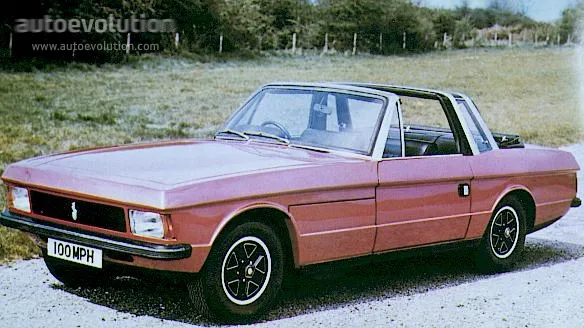
After they stopped producing airplanes, the Bristol company started to build cars. Three decades after WWII was over, the British company introduced the 412 Targa.

It was a strange marriage, with the bodies being built in Italy, then shipped to the U.K. in Filton to meet their chassis. But, somehow, that recipe worked for a few years. To spice things up, the engine came from the U.S. In the end, it was difficult to say if that was a British car.

The wedge-shaped vehicle, with flat surfaces and angular lines, was imagined in Italy. A long and flat hood, a flat front fascia, and flat front fenders made the car look angular. The cabin was short and it featured a targa-top. While the roof was removable and could have been stored in the trunk, the B-pillars remained on the car along with the security arches. There was a folding rear canvas-back, to cover the rear seats. So, if the top was kept in place and the rear was folded down, the car was converted into a landaulet. The result was an eccentric-looking vehicle.

The interior had other interesting features. With a wooden dash panel and a leather-covered instrument cluster, the car offered an exclusive look for its owner. In the middle of the dash, there was the air-conditioning unit. On the floor, on the transmission tunnel, the car-manufacturer installed the gear-selector for the 3-speed automatic gearbox. To justify the high price-tag, the car featured leather upholstery as standard.

Under the hood, the 1975 Bristol 412 featured a V8 Chrysler engine. Its price was just below a Rolls-Royce Corniche.

How much power does the Bristol 412 Convertible have?

The most powerful Bristol 412 Convertible trim is the 6.6L V8 3AT (264 HP) with 264 hp. The model has 1 trims, starting at 264 hp.

What is the fuel consumption of the Bristol 412 Convertible?

The most economical Bristol 412 Convertible trim is the 6.6L V8 3AT (264 HP), with a stated combined consumption of 20.5 l/100 km and — g CO2 per km.

How quickly does the Bristol 412 Convertible accelerate from 0 to 100 km/h?

The quickest trim is the 6.6L V8 3AT (264 HP): 0-100 km/h in 7.5 seconds, with a top speed of 225 km/h.

How large is the cargo volume of the Bristol 412 Convertible?

The largest stated cargo volume for the Bristol 412 Convertible is 620 litres.

Other Bristol models

Bristol Type 603

1976 - 1982 · 1 trim

Power
175 hp
0–100
8.8 s
Fuel economy

Petrol

Bristol 408

1963 - present · 1 trim

Power
253 hp
0–100
10.2 s
Fuel economy
20.3

Petrol

Bristol 407

1961 - 1963 · 1 trim

Power
253 hp
0–100
Fuel economy

Petrol

Bristol 406

1958 - 1961 · 1 trim

Power
107 hp
0–100
14.0 s
Fuel economy
12.0

Petrol