Skip to content
AD

Chrysler Airflow (1934 - 1937)

Chrysler · 1 trim

Chrysler Airflow

The Chrysler Airflow (1934 - 1937) is available in 1 trims producing 117 to 117 hp. The fastest trim reaches 145 km/h.

Power
117 hp
0–100
Fuel economy
Cargo

Airflow Trims

Compare →
Trims and engine versions — Chrysler Airflow
Trim Fuel Power Torque 0–100 Top speed Fuel economy CO2 Select
5.3L 3MT (115 HP) Petrol 117 hp 145 km/h

Fuel economy and CO2 follow the stated test cycle. Manufacturer figures; deviations per market and option pack are possible.

Is Chrysler Airflow a good choice against other models?

Average across every Chrysler Airflow trim, compared with 123 trims of other cars from the 1931–1937 period.

Is Chrysler Airflow a good choice against other models?
Measure This model Average Position
Power 117 hp 101 hp
better than 59%
Top speed 145 km/h 128 km/h
better than 65%
Unladen weight 1,686 kg 1,587 kg
better than 44%

Percentages show the share of trims from the same period this model beats on that measure. Manufacturer figures.

Not stated by the manufacturer: torque, acceleration 0–100 km/h, combined consumption, co2 emissions and cargo volume. Those measures are left out of the comparison.

Comparable models from other brands

Fiat Morgan Peugeot Dacia Renault

About Chrysler Airflow

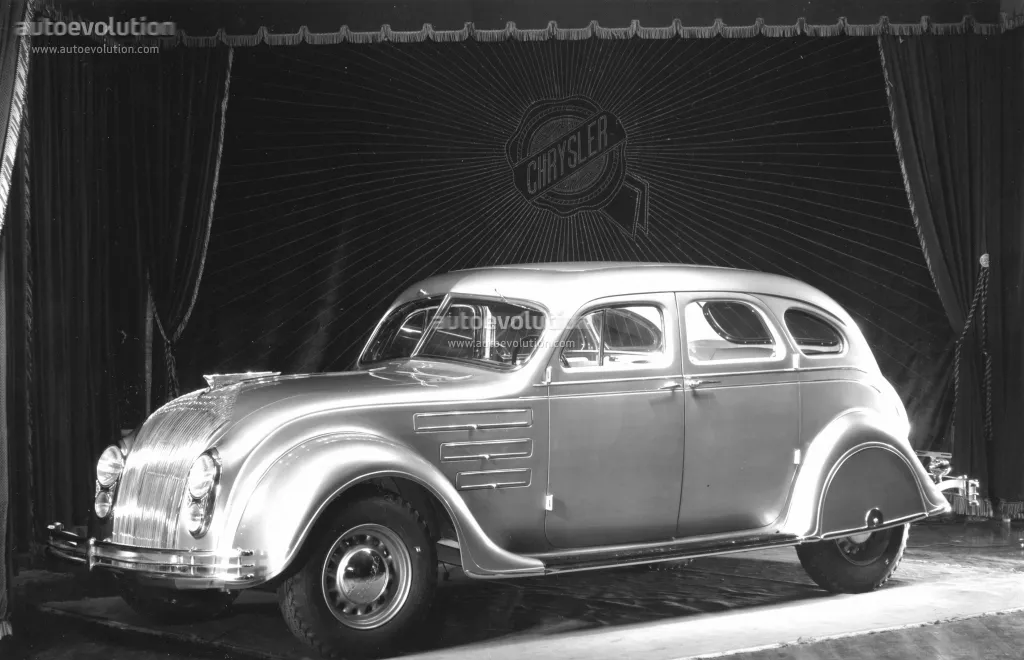
It was a car ahead of its times, with unibody construction, not based on a chassis like any other car on the market. On top of that, the streamlined shape made it faster and more fuel-efficient.

While the Airflow was a sales failure, the qualities of that vehicle were strong. But it was too far ahead of its times so the customers could appreciate it. It featured more important discoveries than most of the other vehicles on the market, starting with the double-glazed windows, steel, tubular, frame, hydraulic power brakes, and a rounded shape. It was available as a two-door coupe and four-door sedan.

The Chrysler Airflow featured a front fascia wit the headlights enclosed in the front fenders, in a time when most of the other car-makers installed them on a stainless steel rod, in front of the grille. The grille was high, in a V-shape forging forward, and with horizontal chromed bars. The split windshield could have been opened via two rotating knobs inside the car, to allow a better air-flow into the cabin. Like most of the other cars from that era, the sloped back featured a trunk and the spare wheel inside.

The interior was huge for its era. It featured seats with exposed frames until they were replaced with lower ones, for easier ingress and egress in 1945. The 1934-'35 cars featured a round-faced dashboard that was changed to more conventional square gauges in the last production year.

The 5.3-liter inline-eight engine was mated to a standard, 3-speed, Borg-Warner automatic gearbox. It featured solid axles front and rear supported by leaf springs and hydraulic dampers in all four corners.

How much power does the Chrysler Airflow have?

The most powerful Chrysler Airflow trim is the 5.3L 3MT (115 HP) with 117 hp. The model has 1 trims, starting at 117 hp.

Other Chrysler models

Chrysler Six

1924 - 1931 · 1 trim

Power
69 hp
0–100
Fuel economy

Petrol

Chrysler C-300

1955 - present · 1 trim

Power
304 hp
0–100
10.6 s
Fuel economy
19.0

Petrol

Chrysler LeBaron

1982 - 1988 · 4 trims

Power
101 hp
0–100
Fuel economy
7.6

Petrol

Chrysler Daytona

1992 - 1993 · 4 trims

Power
143 hp
0–100
8.8 s
Fuel economy
9.0

Petrol

Chrysler 300M

1998 - 2004 · 2 trims

Power
252 hp
0–100
8.8 s
Fuel economy
10.5

Petrol