About Dacia 500 Lastun
Back in the ‘80s, in Romania, there was a high demand for affordable, fuel-efficient cars, and the governing communist party asked several R&D departments to find a proper solution, and that came in the shape of the 1985 Dacia 500 Lastun.
The L?stun (Martin in English) was a project developed by several Romanian companies, and they were asked to use only products made in that country. They worked cleverly by using existing vehicle components on assembly lines, such as the Oltcit (Citroen Visa), made under license in Craiova, Romania, and Dacia, a licensed and modernized version of the Renault 12. Furthermore, since the fiberglass-reinforced plastic was cheaper and easier to produce than sheet metal, it was the material of choice for the bodywork. The result was not exactly a success, and the entire project, along with the factory, was shut down just a few years after the 1989 Romanian revolution.
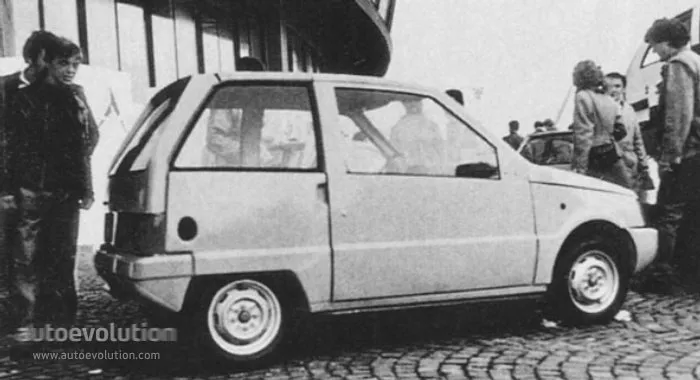
With its edge-designed bodywork, the Lastun was more of a box on wheels. Its front fascia sported a set of round headlights carried over from a farming tractor and turn signals from other vehicles. To cut production costs, the bumper was black and unpainted, and it featured a lower area that sported a narrow air intake split in two. A short hood covered the engine compartment.
From its profile, the tiny vehicle showed its tall greenhouse that started with a steep windshield. Since the Romanian industry didn’t have vast experience in producing fiberglass components suitable for the automotive industry, they had to use flat panels for the fenders, doors, and rear quarter panels. In addition, the flat windows were also cheaper to produce. Finally, at the back, the car had a vertical drop for the tailgate, which ended above the square-looking taillights. After 1989, customers had the option to have the bumpers painted in the car’s color.
Inside, the car offered two front seats and a bench in the back that was supposed to accommodate up to four adults. Still, the short wheelbase made legroom narrow for those seated in the back. At the front, the driver faced a tiny instrument cluster where only a speedometer and a fuel-level gauge could fit. There was no coolant temperature needed since the engine was air-cooled. Another peculiar detail was the gear shifter, which was mounted behind the steering wheel since there was limited place on the floor to install it.
Under the hood, the Romanian engineers installed a two-cylinder engine that was developed based on the one featured on the licensed Citroen Visa. Its 500 cc displacement (30.5 cu-in) produced a mere 22 PS (22 hp), and it was paired with a four-speed manual gearbox. The platform featured an independent front suspension and a torsion beam at the back.