Skip to content
AD

Renault 4 CV (1947 - 1961)

Renault · 1 trim

Renault 4 CV

The Renault 4 CV (1947 - 1961) is available in 1 trims producing 21 to 21 hp. The fastest trim reaches 95 km/h.

Power
21 hp
0–100
34.0 s
Fuel economy
Cargo

4 CV Trims

Compare →
Trims and engine versions — Renault 4 CV
Trim Fuel Power Torque 0–100 Top speed Fuel economy CO2 Select
0.75L 3MT (21 HP) Petrol 21 hp 45 Nm 34.0 s 95 km/h

Fuel economy and CO2 follow the stated test cycle. Manufacturer figures; deviations per market and option pack are possible.

Is Renault 4 CV a good choice against other models?

Average across every Renault 4 CV trim, compared with 53 trims of other cars from the 1944–1950 period.

Is Renault 4 CV a good choice against other models?
Measure This model Average Position
Power 21 hp 64 hp
better than 4%
Top speed 95 km/h 134 km/h
better than 4%
Unladen weight 560 kg 1,093 kg
better than 94%

Percentages show the share of trims from the same period this model beats on that measure. Manufacturer figures.

Not stated by the manufacturer: combined consumption, co2 emissions and cargo volume. Those measures are left out of the comparison.

Comparable models from other brands

BMW Dacia Ford Fiat Buick

About Renault 4 CV

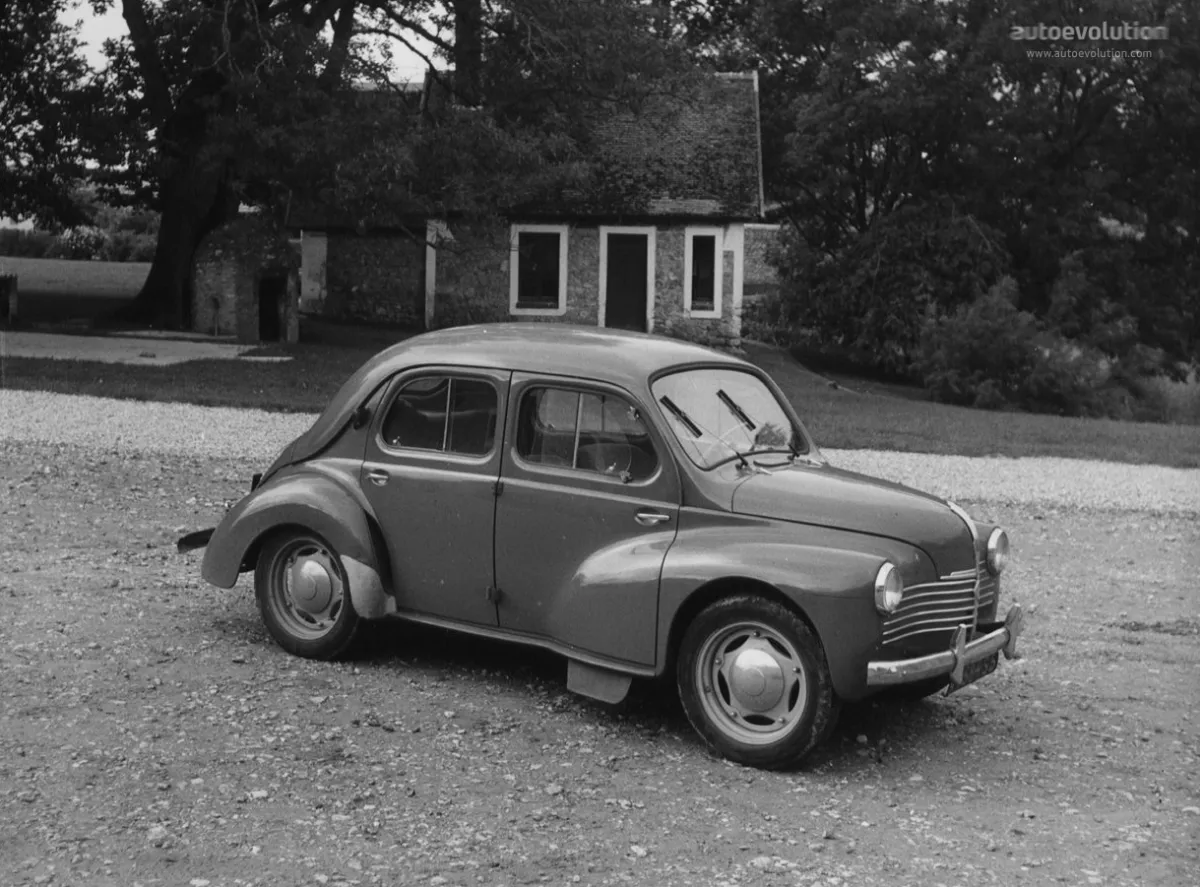
After WWII, the European economy was weak. Still, people needed vehicles, so Renault came with this affordable vehicle that put the French brand back on the automotive industry map.

Only a year had passed since the war ended, and countries started rebuilding themselves. Renault, now nationalized by the French Government, produced this small-sized vehicle that could provide what people needed: a four-door car where four adults could fit. In addition, it was cheap to run. In addition, while the 4CV didn't say anything for anyone outside France, for those living there, it meant that the taxes for such a vehicle were tiny.

Renault understood that it couldn't afford to create the same flamboyant vehicles it made before the war. Instead, it had to produce cheap, meaning they had to ditch the wide, long fenders, so they made them shorter but still in the same style. The front of the car resembled those from the pre-war period, with a triangular-shaped hood, but the grille was now wide and shorter instead of slim and tall. In addition, Renault added chromed bumpers front and back to create better protection. In front of the rear wheels, the automaker added a set of air intakes that fed the small engine placed in the rear.

To access the cabin, Renault installed rear-hinged front doors and front-hinged rear doors. The cabin was simple, with a flat dashboard that sported a speedometer in the middle flanked by fuel and water temperature gauges. In addition, a squared glove box was placed in front of the side passenger.

The small inline-four engine in the back produced just a mere 21 PS, which it sent to the rear wheels via a three-speed manual gearbox. Nevertheless, by 1961, when the production ended, Renault produced over one million units of this small vehicle.

How much power does the Renault 4 CV have?

The most powerful Renault 4 CV trim is the 0.75L 3MT (21 HP) with 21 hp. The model has 1 trims, starting at 21 hp.

How quickly does the Renault 4 CV accelerate from 0 to 100 km/h?

The quickest trim is the 0.75L 3MT (21 HP): 0-100 km/h in 34.0 seconds, with a top speed of 95 km/h.

Other Renault models

Renault 16

1965 - present · 4 trims

Power
90 hp
0–100
12.5 s
Fuel economy
9.3

Petrol

Renault 20

1975 - 1984 · 6 trims

Power
116 hp
0–100
11.6 s
Fuel economy
7.9

Petrol Diesel

Renault 14

1976 - 1983 · 2 trims

Power
70 hp
0–100
13.0 s
Fuel economy
8.1

Petrol

Renault 30

1979 - 1984 · 7 trims

Power
143 hp
0–100
9.7 s
Fuel economy
7.4

Petrol Diesel

Renault Fuego

1980 - 1985 · 4 trims

Power
110 hp
0–100
11.0 s
Fuel economy
6.7

Petrol