Skip to content
AD

Ferrari 250 Europa (1953 - 1955)

Ferrari · 1 trim

Ferrari 250 Europa

The Ferrari 250 Europa (1953 - 1955) is available in 1 trims producing 200 to 200 hp. The fastest trim reaches 217 km/h. The lowest stated fuel consumption is 14.8 l/100 km.

Power
200 hp
0–100
8.6 s
Fuel economy
14.8 l/100 km
Cargo

250 Europa Trims

Compare →
Trims and engine versions — Ferrari 250 Europa
Trim Fuel Power Torque 0–100 Top speed Fuel economy CO2 Select
3.0 V12 4MT (200 HP) Petrol 200 hp 237 Nm 8.6 s 217 km/h 14.8 l/100 km

Fuel economy and CO2 follow the stated test cycle. Manufacturer figures; deviations per market and option pack are possible.

Is Ferrari 250 Europa a good choice against other models?

Average across every Ferrari 250 Europa trim, compared with 110 trims of other cars from the 1950–1956 period.

Is Ferrari 250 Europa a good choice against other models?
Measure This model Average Position
Power 200 hp 114 hp
better than 91%
Torque 237 Nm 190 Nm
better than 80%
Top speed 217 km/h 162 km/h
better than 91%
Acceleration 0–100 km/h 8.6 s 17.2 s
better than 93%
Combined consumption 14.8 l/100 km 12.1 l/100 km
better than 19%
Unladen weight 1,175 kg 1,276 kg
better than 64%

Percentages show the share of trims from the same period this model beats on that measure. Manufacturer figures.

Not stated by the manufacturer: co2 emissions and cargo volume. Those measures are left out of the comparison.

Comparable models from other brands

Mercedes-Benz Ford Nissan

About Ferrari 250 Europa

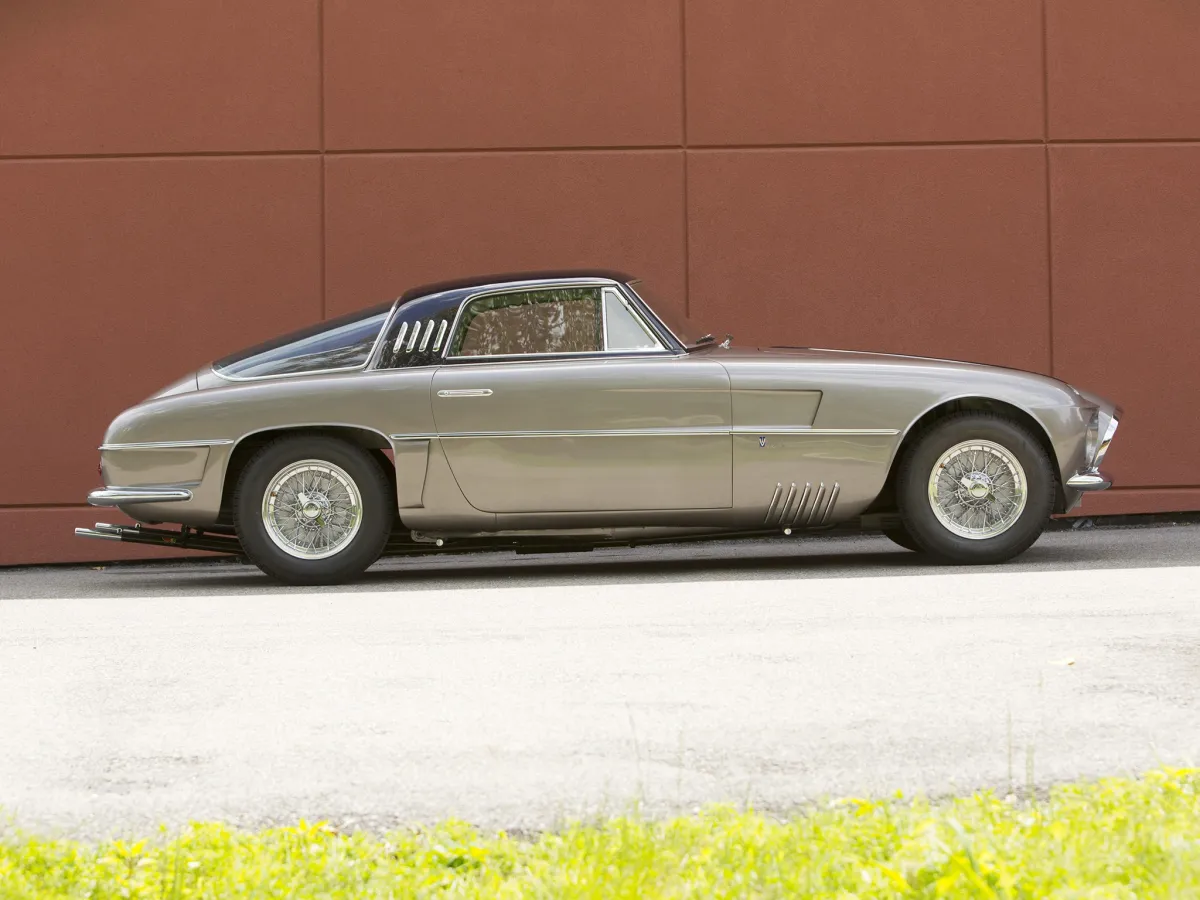
Unveiled at the 1953 Paris Motor Show, the Ferrari 250 Europa was a car designed for the new European rules and preferences. It used a 3.0-liter V12 based on a design for Formula One 3.3 L engine.

The first cars produced were bodied by Vignale along the lines of the 340 Mexico. The production was moved to Pininfarina, who built a 2-seat cabriolet version. There were clear styling cues with the Ferrari 375 America, with which it shared the same chassis.

The cars were produced with an odd chassis number for the road-going vehicles, while the race-version featured even numbers. Usually, the race versions featured aluminum bodies but some private owners ordered lighter bodyworks for the road-going models.

The long hood and short cabin were a sign for sportiness and the two-door coupe style was elegant. It was built as a 2+2 vehicle, but most of the time the rear seats were mostly used as a padded shelf for luggage.

Even though it was considered a fast car for that era, it was more of a GT vehicle than a sports car. In 1954, the 250 Europa was renamed 250 Europa GT, and then it became known as simply as the 250 GT.

The suspension was independent at the front, with double wishbones and a transverse leaf spring. It was later replaced with individual coil springs. The rigid rear axle was with leaf springs and hydraulic dampers. Hydraulically operated drum brakes were on all four corners. The transmission was a 4-speed manual.

How much power does the Ferrari 250 Europa have?

The most powerful Ferrari 250 Europa trim is the 3.0 V12 4MT (200 HP) with 200 hp. The model has 1 trims, starting at 200 hp.

What is the fuel consumption of the Ferrari 250 Europa?

The most economical Ferrari 250 Europa trim is the 3.0 V12 4MT (200 HP), with a stated combined consumption of 14.8 l/100 km and — g CO2 per km.

How quickly does the Ferrari 250 Europa accelerate from 0 to 100 km/h?

The quickest trim is the 3.0 V12 4MT (200 HP): 0-100 km/h in 8.6 seconds, with a top speed of 217 km/h.

Other Ferrari models

Ferrari 250 GT

1954 - 1963 · 5 trims

Power
280 hp
0–100
6.0 s
Fuel economy
16.0

Petrol

Ferrari 195 S

1950 · 1 trim

Power
170 hp
0–100
8.0 s
Fuel economy

Petrol