Skip to content
AD

Ferrari Testarossa (1984 - 1991)

Ferrari · 1 trim

Ferrari Testarossa

The Ferrari Testarossa (1984 - 1991) is available in 1 trims producing 390 to 390 hp. The fastest trim reaches 291 km/h. The lowest stated fuel consumption is 15.1 l/100 km.

Power
390 hp
0–100
5.4 s
Fuel economy
15.1 l/100 km
Cargo

Testarossa Trims

Compare →
Trims and engine versions — Ferrari Testarossa
Trim Fuel Power Torque 0–100 Top speed Fuel economy CO2 Select
4.9L B12 5MT (390 HP) Petrol 390 hp 490 Nm 5.4 s 291 km/h 15.1 l/100 km 371 g/km

Fuel economy and CO2 follow the stated test cycle. Manufacturer figures; deviations per market and option pack are possible.

Is Ferrari Testarossa a good choice against other models?

Average across every Ferrari Testarossa trim, compared with 1,043 trims of other cars from the 1981–1987 period.

Is Ferrari Testarossa a good choice against other models?
Measure This model Average Position
Power 390 hp 119 hp
better than 100%
Torque 490 Nm 180 Nm
better than 100%
Top speed 291 km/h 183 km/h
better than 100%
Acceleration 0–100 km/h 5.4 s 12.3 s
better than 99%
Combined consumption 15.1 l/100 km 8.8 l/100 km
better than 1%
CO2 emissions 371 g/km 201 g/km
better than 1%
Unladen weight 1,506 kg 1,143 kg
better than 8%

Percentages show the share of trims from the same period this model beats on that measure. Manufacturer figures.

Not stated by the manufacturer: cargo volume. Those measures are left out of the comparison.

Comparable models from other brands

Maserati Lotus Cupra Bristol RAM Trucks Audi

About Ferrari Testarossa

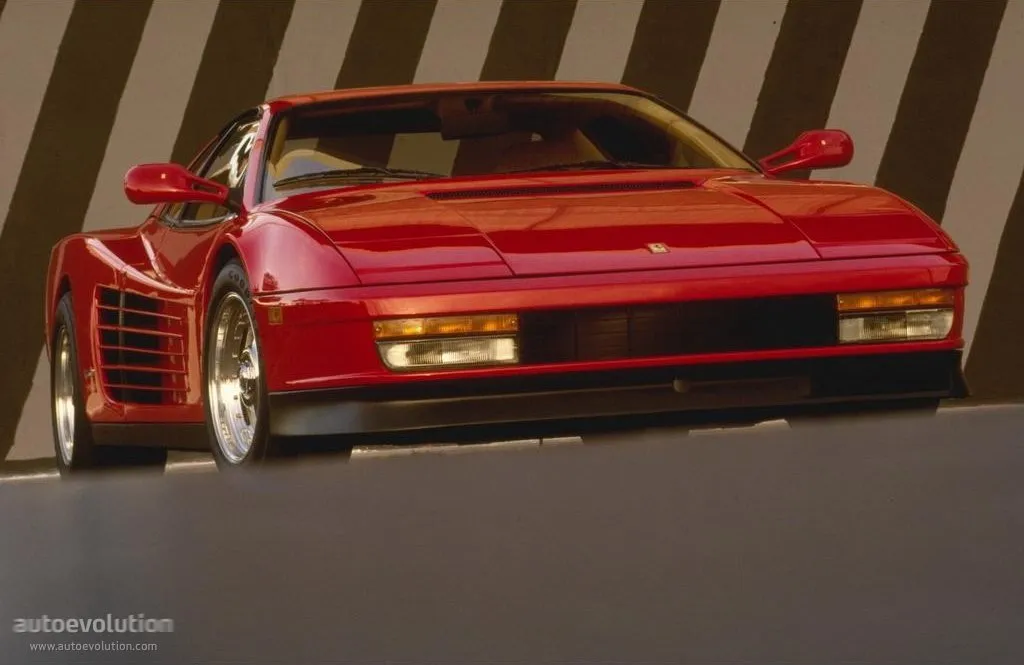
The Ferrari Testarossa was one of the most iconic models built by the Italian carmaker, a legendary car due to its complex design and strange engine.

Ferrari used the name Testarossa (red-head) for vehicles with two overhead camshafts. Over time, that technical detail became so common that it didn't worth mentioning it over time. In 1984, when the car was introduced, it was still a great achievement. For that engine, Pininfarina built a special bodywork.

The Testarossa was instantly recognizable due to its side air-intakes for the engine. The long slats that were continued on the door panels channeled the air into the radiators to cool the engine. But more than their functional value, their look was even more important and gave the car a specific stance. At the front, the pop-up headlights and the black grille at the lower part of the bumper were specific car signatures. At the back, Pininfarina installed the taillights behind a black grille with horizontal slats. Unlike many other Ferraris, the Testarossa's taillights were big and squared.

Inside, the designer used leather for most of the panels. The designer wrapped the door panels, the dashboard, the sun visors, and the headliner with leather apart from the bucket seats. The gear-stick popped out from the floor, without a proper center console to surround it. A small storage compartment found its way between the occupants.

The monster, boxer-12 engine was based on the 1975 Formula 1 unit. Its architecture allowed the car to have a very low gravity center to increase the cornering speed. It was paired to a standard 5-speed manual gearbox.

How much power does the Ferrari Testarossa have?

The most powerful Ferrari Testarossa trim is the 4.9L B12 5MT (390 HP) with 390 hp. The model has 1 trims, starting at 390 hp.

What is the fuel consumption of the Ferrari Testarossa?

The most economical Ferrari Testarossa trim is the 4.9L B12 5MT (390 HP), with a stated combined consumption of 15.1 l/100 km and 371 g CO2 per km.

How quickly does the Ferrari Testarossa accelerate from 0 to 100 km/h?

The quickest trim is the 4.9L B12 5MT (390 HP): 0-100 km/h in 5.4 seconds, with a top speed of 291 km/h.

Other Ferrari models

Ferrari 288 GTO

1984 - 1986 · 1 trim

Power
400 hp
0–100
4.9 s
Fuel economy
12.4

Petrol

Ferrari 412

1985 - 1989 · 2 trims

Power
340 hp
0–100
6.7 s
Fuel economy
18.2

Petrol

Ferrari F40

1987 - 1992 · 1 trim

Power
478 hp
0–100
4.1 s
Fuel economy
12.4

Petrol

Ferrari Mondial 8

1980 - present · 2 trims

Power
214 hp
0–100
9.4 s
Fuel economy
16.7

Petrol

Ferrari 400i

1979 - 1985 · 4 trims

Power
315 hp
0–100
6.8 s
Fuel economy
19.9

Petrol

Ferrari 456 GT

1992 - 1997 · 2 trims

Power
442 hp
0–100
5.2 s
Fuel economy
18.0

Petrol