Skip to content
AD

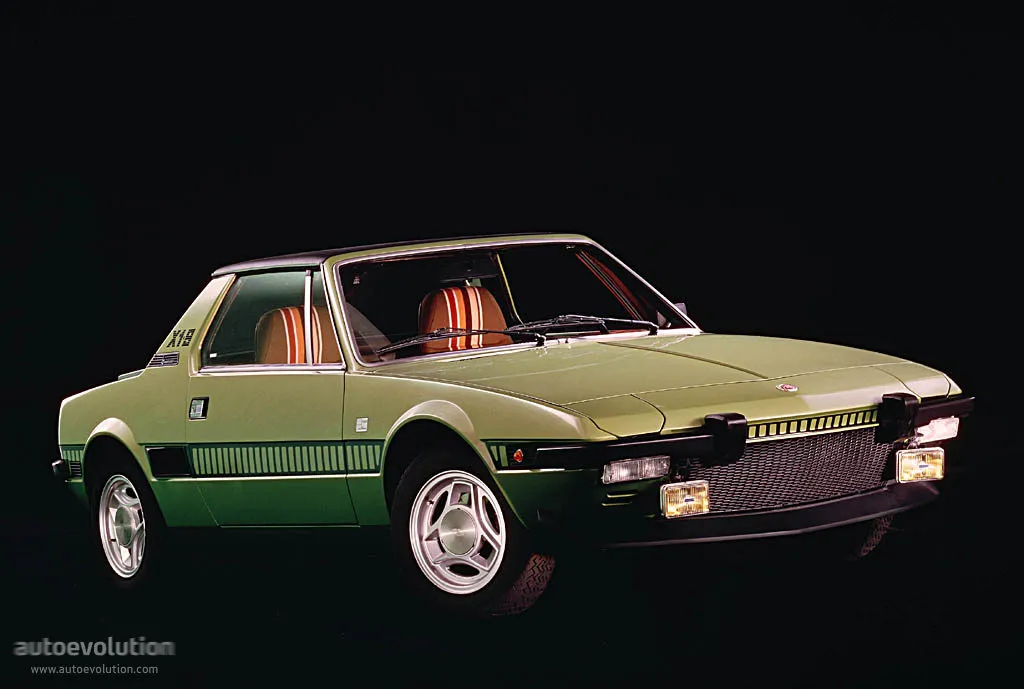
Fiat X1/9 (1972 - 1989)

Fiat · 2 trims

Fiat X1/9

The Fiat X1/9 (1972 - 1989) is available in 2 trims producing 75 to 86 hp. The fastest trim reaches 180 km/h. The lowest stated fuel consumption is 8.1 l/100 km.

Power
86 hp
0–100
12.5 s
Fuel economy
8.1 l/100 km
Cargo
278 l

X1/9 Trims

Compare →
Trims and engine versions — Fiat X1/9
Trim Fuel Power Torque 0–100 Top speed Fuel economy CO2 Select
1.3L 5MT (75 HP) Petrol 75 hp 98 Nm 12.5 s 169 km/h
1.5L 5MT (86 HP) Petrol 86 hp 118 Nm 12.5 s 180 km/h 8.1 l/100 km 193 g/km

Fuel economy and CO2 follow the stated test cycle. Manufacturer figures; deviations per market and option pack are possible.

Is Fiat X1/9 a good choice against other models?

Average across every Fiat X1/9 trim, compared with 458 trims of other cars from the 1969–1975 period.

Is Fiat X1/9 a good choice against other models?
Measure This model Average Position
Power 81 hp 154 hp
better than 20%
Torque 108 Nm 239 Nm
better than 15%
Top speed 175 km/h 180 km/h
better than 43%
Acceleration 0–100 km/h 12.5 s 12.6 s
better than 39%
Combined consumption 8.1 l/100 km 12.1 l/100 km
better than 91%
CO2 emissions 193 g/km 235 g/km
better than 83%
Cargo volume 278 l 377 l
better than 35%
Unladen weight 897 kg 1,268 kg
better than 88%

Percentages show the share of trims from the same period this model beats on that measure. Manufacturer figures.

Comparable models from other brands

Daihatsu Tata Motors Bristol Dacia Maruti Suzuki Proton

About Fiat X1/9

It was a unique Fiat built for guilty, sporty, pleasure, with a mid-engine and rear-wheel-drive system that fired up the car-enthusiasts imagination.

At the beginning of the '70s, only a few supersport had the engines mounted between the seats and the rear wheels. But Fiat considered that if that recipe worked for them, it would work well for a mass-market vehicle, such as the X1/9. For those times, it was just like a concept-car built on an assembly line.

Bertone designed the wedged-shaped vehicle as a targa, with a removable top. It kept the safety arch behind the cabin, over the flat rear end of the car. For the European market, the bumpers were made out of rubber. They were wrapped-around nicely around the front and the back. For the U.S.-market version, the carmaker had to install bigger bumpers with chromed-metallic parts built on top of thicker rubber parts to comply with the safety regulations, but that spoiled the roadster's image.

Inside, there was room for two passengers, and it was suitable for average-height people but was considered small for the taller ones. That's why Bertone modified the vehicles' floorpans and introduced a version with more legroom after 1982. The two bucket-seats were fitted as standard and covered with man-made leather, named leatherette.

Under the hood, Fiat X1/9 featured a 1.3-liter engine carried-over from the Fiat 128 paired to a 4-speed manual gearbox. It was a fuel-efficient engine but could hardly make the car get to 105 mph (170 kph). In 1979, Fiat introduced a new, 1.5-liter engine paired to a 5-speed manual that could propel the little nimble roadster to 112 mph (180 kph). Not a big improvement, but still, it was better thanks to that 5-speed transmission.

How much power does the Fiat X1/9 have?

The most powerful Fiat X1/9 trim is the 1.5L 5MT (86 HP) with 86 hp. The model has 2 trims, starting at 75 hp.

What is the fuel consumption of the Fiat X1/9?

The most economical Fiat X1/9 trim is the 1.5L 5MT (86 HP), with a stated combined consumption of 8.1 l/100 km and 193 g CO2 per km.

How quickly does the Fiat X1/9 accelerate from 0 to 100 km/h?

The quickest trim is the 1.3L 5MT (75 HP): 0-100 km/h in 12.5 seconds, with a top speed of 169 km/h.

How large is the cargo volume of the Fiat X1/9?

The largest stated cargo volume for the Fiat X1/9 is 278 litres.

Other Fiat models

Fiat 132

1972 - 1981 · 11 trims

Power
115 hp
0–100
10.3 s
Fuel economy
7.6

Petrol Diesel

Fiat 126

1972 - 2000 · 3 trims

Power
26 hp
0–100
33.0 s
Fuel economy
5.2

Petrol