About Isuzu Axiom
In 2001, Isuzu introduced the Axiom SUV to the North American market, trying to convince customers with its advanced engineering solutions, but unfortunately, that didn’t happen, and the car lasted only for three years.
Isuzu was eager to stay afloat in the U.S. market, but it lacked the resources to design a new vehicle from the ground up. As a result, it took the chassis from the Amigo lineup and created the Axiom. The model’s name was selected after an online contest, but it seemed uninspired from the sales perspective. It came in an era when most automakers started to launch SUVs and crossovers based on unibody constructions, and the body-on-frame vehicles in this class started to fade away. However, the Axiom had some aces up its sleeves, offering significant improvements for its times, such as adaptive suspension and electronic stability control, even though these were named differently in the Isuzu language, as Intelligent Suspension Control and Torque-on Demand, respectively.
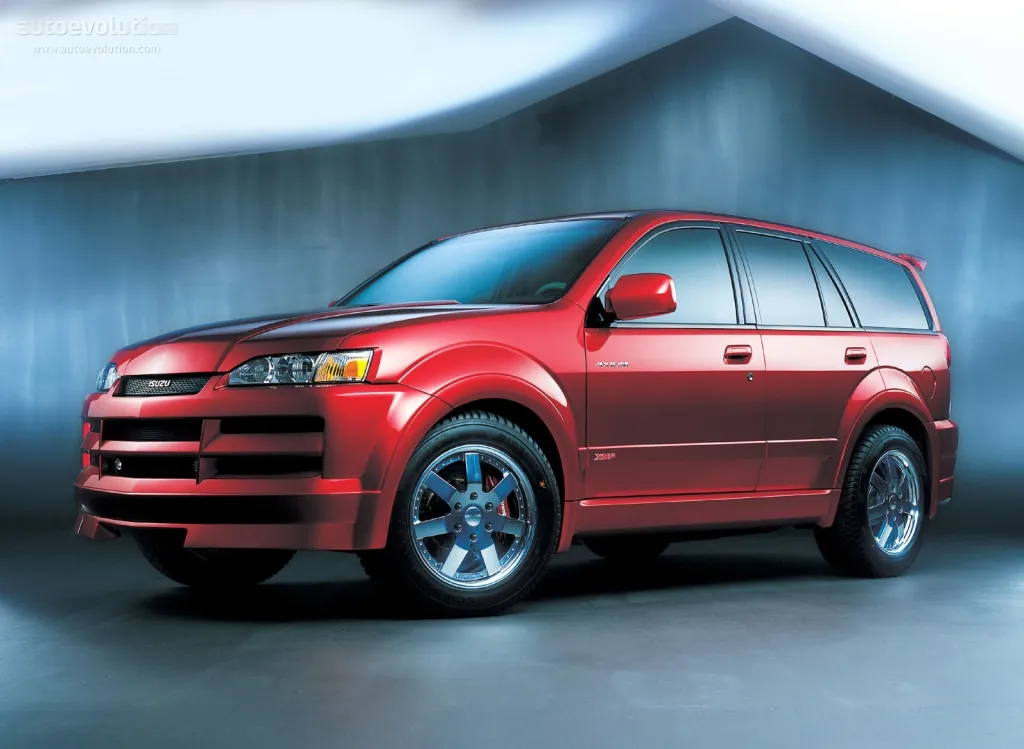
At the front, the 2002 Isuzu Axiom showed a modern face with slim cat-eye-like headlights that flanked a narrow grille with horizontal slats where the brand’s badge took center stage. The fat, wrapped-around plastic bumper below had six horizontal slats and integrated the round fog lamps in the lower section. While it looked futuristic, customers were not highly impressed.
From its profile, the five-door compact SUV 2002 Isuzu Amigo showed a slightly ascending hood followed by a raked windshield. The roof, on the other hand, followed an arched line that slowly descended towards the back and was abruptly cut by a vertical tailgate. To make the vehicle look more upscale and rugged, the automaker installed flared wheel arches around the standard 17-inch light alloy wheels. Furthermore, it installed chromed door handles and body-colored mirrors. At the back, the automaker installed small corner-mounted, small taillights that flanked the wide-open tailgate. At the same time, below the bumper, the automaker placed the dual exhaust with chromed tips.
Inside, the 2002 Isuzu Amigo boasted an elegant cabin with available heated leather seats up front. The four-spoke steering wheel framed an instrument cluster featuring large dials for the speedometer and tachometer flanked by the coolant temperature on the left and the fuel level gauge on the right. The digital odometer was shown on an LCD integrated into the speedometer’s dial. On the center stack, Isuzu placed a Multi-Information Display, kind of a predecessor for the infotainment systems, where information about the media, onboard computer data, and a compass relied on U.S. satellites. In the back, the split-folding (60/40) bench seat could expand the trunk space from 35.2 cu-ft (997 liters) to 85.4 cu-ft (2,418 liters).
Under the hood, Isuzu installed a standard 3.5-liter V6 with dual overhead camshaft and variable valve timing technology. It produced 230 hp (233 PS) and was paired with a standard four-speed automatic gearbox provided by GM. The automaker offered the car with either a rear or part-time 4WD system. Its suspension featured electronically-controlled shock absorbers. Furthermore, for versions fitted with traction in all corners, Isuzu installed a system that could reduce or send more torque.