About Isuzu Hombre
While Isuzu still had some in-house designed and engineered SUVs on the market, it also tried to set foot into the pickup segment with a badge-engineered product named the Hombre.
Since GM owned more than 30 percent of Isuzu's stakes, it tried to expand the Japanese brand presence in the U.S. market with a badge-engineered version of the Chevrolet S-10, and the result was the 1996 Isuzu Hombre. The new product tried to increase Isuzu's brand awareness with a Louisiana-built vehicle that provided more features and amenities than its bow-tie-badged twin brother. In addition, the Hombre's design language was different, and the nameplate was an apparent attempt to attract more customers from the Spanish-speaking communities within the U.S.
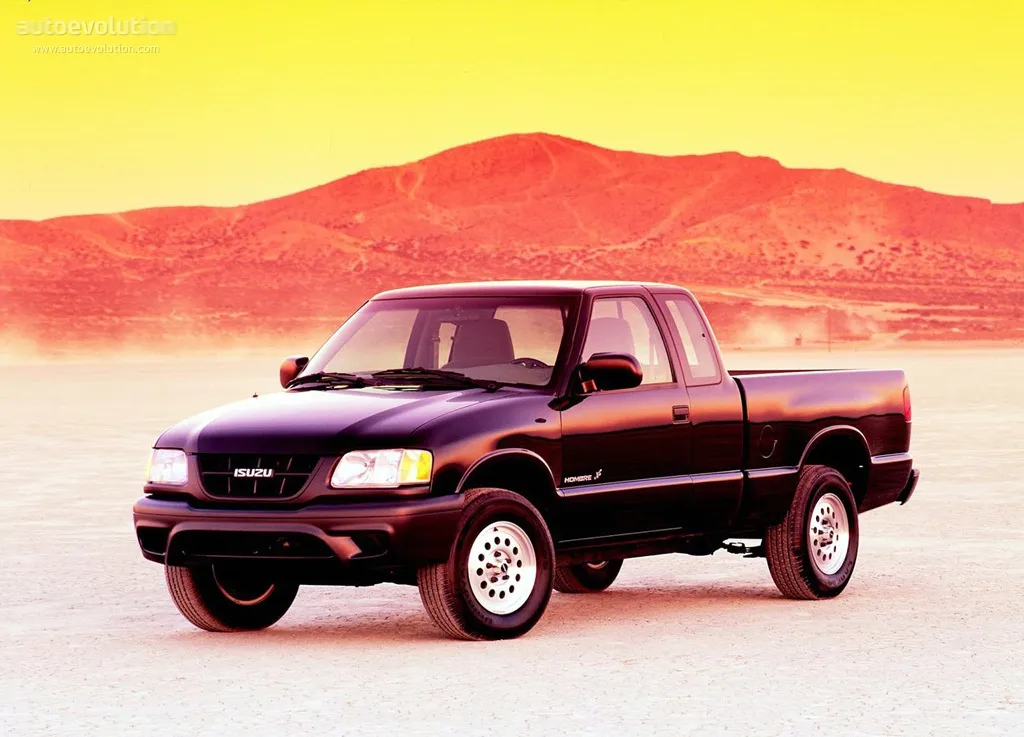
The American automaker tried to create a different brand identity for the 1996 Isuzu Hombre compared to the second generation of the Chevrolet S-10. At the front, the pickup truck featured horizontal, rectangular-shaped headlights with rounded edges. In addition, the corner-mounted turn signal lamps looked different than those installed on its GM-badged twin brother. They flanked a grille with a pair of horizontal slats where Isuzu's chromed badge took center stage. Below, the heavy-duty front end continued with an unpainted and scratch-resistant bumper that integrated a pair of vents in its lower area.
From its profile, the car started to show its DNA inherited from the Chevrolet S-10 Pickup. Even though the front fenders and hood were different, they were still rounded-shaped, with slightly flared wheel arches at the front and the rear. Isuzu offered the car in two cabin options: a two-door Standard or a three-door extended cab named Spacecab. However, regardless of the grade, all versions sported black door mirrors and handles. At the back, the corner-mounted taillights were short and flanked the tailgate. Like the front bumper, the rear one was also designed with hard and unpainted plastic for endurance.
Inside, like the S-10, the 1995 Isuzu Hombre had a tall dashboard with a driver-centered curved shape that integrated the instrument panel and the center stack. The large dials of the speedometer and tachometer were flanked by the gauges for the fuel level, the oil pressure, the coolant temperature, and the ammeter. While Isuzu offered the Hombre with a few amenities on the base model, customers could equip them with power windows and locks, a stereo, and air conditioning. The three-door option had some storage behind the front seats and even a jump seat. At the front, the automaker offered a choice of bucket seats or a bench seat with a 60/40-split seatback. Isuzu sold the car in just two trims, the S and the XS, with an additional package available.
Under its hood, the 1996 Isuzu Hombre was available with a choice of two engines: a 2.2-liter inline-four or a 4.3-liter V6, just like its S-10 brother. These were paired with either a five-speed manual or a four-speed automatic gearbox, with standard rear-wheel drive or, as an option, a 4WD system. However, the main advantages of this pickup on the U.S. market were its low price and the three-year/50,000 miles (80,467 km).