Skip to content
AD

Mercedes-Benz SSK (W06) (1928 - present)

Mercedes-Benz · 3 trims

Mercedes-Benz SSK (W06)

The Mercedes-Benz SSK (W06) (1928 - present) is available in 3 trims producing 200 to 250 hp. The fastest trim reaches 192 km/h. The lowest stated fuel consumption is 27.0 l/100 km.

Power
250 hp
0–100
Fuel economy
27.0 l/100 km
Cargo

SSK (W06) Trims

Compare →
Trims and engine versions — Mercedes-Benz SSK (W06)
Trim Fuel Power Torque 0–100 Top speed Fuel economy CO2 Select
7.1 Kompressor (27/160/200) Petrol 200 hp 450 Nm 180 km/h 27.0 l/100 km 643 g/km
7.1 Kompressor (27/170/225) Petrol 225 hp 458 Nm 192 km/h 27.0 l/100 km 643 g/km
7.1 Kompressor (27/180/250) Petrol 250 hp 562 Nm 192 km/h 27.0 l/100 km 643 g/km

Fuel economy and CO2 follow the stated test cycle. Manufacturer figures; deviations per market and option pack are possible.

Is Mercedes-Benz SSK (W06) a good choice against other models?

Average across every Mercedes-Benz SSK (W06) trim, compared with 81 trims of other cars from the 1925–1931 period.

Is Mercedes-Benz SSK (W06) a good choice against other models?
Measure This model Average Position
Power 225 hp 116 hp
better than 95%
Top speed 188 km/h 132 km/h
better than 95%
Combined consumption 27.0 l/100 km 24.2 l/100 km
better than 35%

Percentages show the share of trims from the same period this model beats on that measure. Manufacturer figures.

Not stated by the manufacturer: acceleration 0–100 km/h, cargo volume and unladen weight. Those measures are left out of the comparison.

Comparable models from other brands

Honda Renault Subaru Lexus Isuzu Dodge

About Mercedes-Benz SSK (W06)

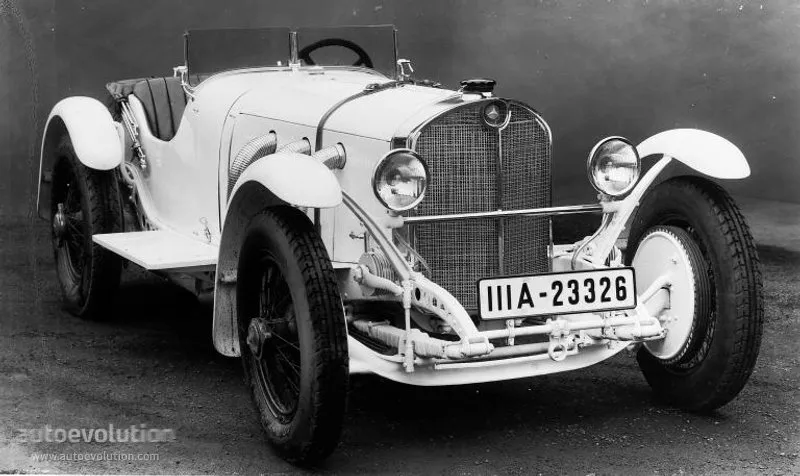
After the success recorded with the regular W06 in 1927, the German automaker tried to create an even sportier vehicle, and that's how the SSK was born in 1928.

The world was hungry for more power and more performance. Thus, Mercedes-Benz tried to create a vehicle that could satisfy the day's deep-pocket people and imagined a short-wheelbase version for the regular W06 SS. These letters came from Super Sport, and the K came from the "Kurts," meaning "Short" in German. The car was designed by a 52-year-old engineer by the name of Ferdinand Porsche. It was the last car created by him for the three-pointed star brand.

At the front, the SSK featured a similar-looking V-shaped radiator grille placed well behind the chassis' front ends. It was flanked by two rounded exposed fenders that were connected via a chromed bar, which in turn supported the headlights. Unlike its S sibling, the SSK featured cut-out side doors so the occupants could climb aboard. The short and flat-folding windshield protected the driver and the passenger from wind, dust, and flies. Not from elements.

The cockpit was cramped due to the shorter wheelbase than the one offered on the W06 S model. Moreover, behind the cabin, the car ended abruptly. Still, the carmaker considered adding a removable trunk that was more of an oversized suitcase rather than a luggage compartment.

Under the car's hood, Mercedes-Benz installed a huge inline-six supercharged powerplant. It developed enough power to propel the car at speeds up to 190 kph (118 mph). But its drum brakes in all corners made stopping difficult.

How much power does the Mercedes-Benz SSK (W06) have?

The most powerful Mercedes-Benz SSK (W06) trim is the 7.1 Kompressor (27/180/250) with 250 hp. The model has 3 trims, starting at 200 hp.

What is the fuel consumption of the Mercedes-Benz SSK (W06)?

The most economical Mercedes-Benz SSK (W06) trim is the 7.1 Kompressor (27/160/200), with a stated combined consumption of 27.0 l/100 km and 643 g CO2 per km.

Other Mercedes-Benz models